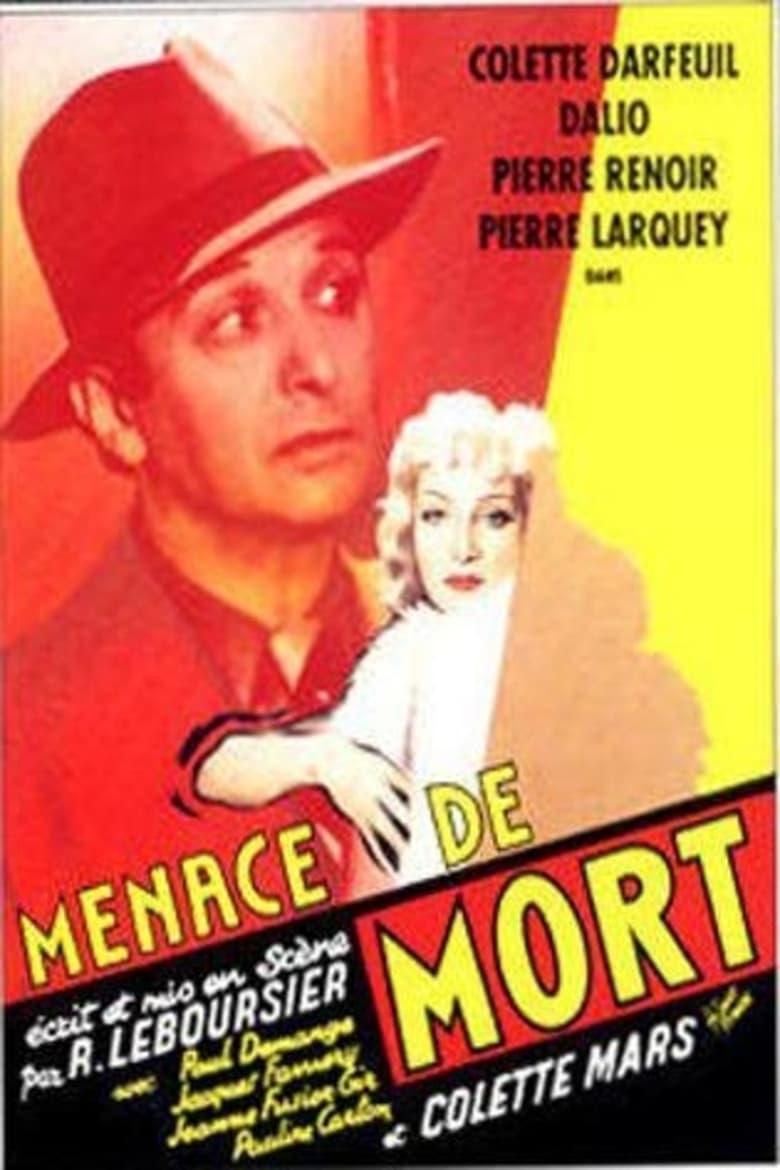
In postwar Paris, a career criminal named Denis (Marcel Dalio) is released from prison after serving time for a murder conviction, a sentence made possible by the testimony of several witnesses. Rather than fade into obscurity, Denis moves with quiet, deliberate menace back into the city's margins, making it clear to those around him that he has not forgotten the names and faces responsible for his imprisonment. Hélène (Colette Darfeuil), a woman with her own complicated ties to Denis, finds herself caught between her fear of him and the hold he still exercises over her.
As Denis systematically reasserts his presence in the lives of those who testified against him, the retired inspector Bernier (Pierre Renoir) and the nervous, calculating Morel (Pierre Larquey) find their domestic routines fractured by dread. Allegiances that seemed fixed – between lovers, between former colleagues, between those who once did the right thing and those who simply did what was convenient – begin to shift under pressure. Hélène's position becomes increasingly untenable as Denis draws her back into a world she had tried to leave behind, and the question of whether she is his accomplice or his next victim grows harder to answer.
Threat operates within the tradition of the European procedural noir, less concerned with explosive violence than with the slow accumulation of psychological pressure. The film belongs to a cycle of French crime pictures from the late 1940s and early 1950s that drew on American genre conventions while grounding them in the specific textures of postwar French urban life – the cramped hotels, the cautious bureaucrats, the survivors who know better than to trust anyone who asks for their help.
Threat (1950) is a modestly scaled but carefully observed entry in the French noir cycle that flourished in the years immediately following the Liberation. Raymond Leboursier, working within tight studio constraints, keeps the film's tension almost entirely psychological, relying on performance and spatial compression rather than action. Marcel Dalio, best remembered internationally for his work with Renoir and Casablanca, brings a controlled, reptilian patience to Denis that makes him credible as a man whose danger lies not in impulsiveness but in memory. Pierre Renoir, son of the painter and brother of Jean, lends Bernier a weary institutional authority, the portrait of a man who understands the law's limits precisely because he has spent his life enforcing them. The film is not without structural weaknesses – its middle third loses focus – but it captures something specific about postwar France: a society still negotiating what truth-telling costs, and who ultimately pays. For students of international noir, it represents a useful counterpoint to the more stylized American product of the same period.
– Classic Noir
Georges Million frames the corridor in a long, shallow perspective, the low ceiling pressing down on the space and the single overhead fixture casting a cone of light that barely reaches the far end of the hall. Denis stands at the edge of that light, his face half-resolved, his body angled toward a door from beneath which a thin strip of yellow falls across the floor. The camera holds at a distance that refuses intimacy, treating the act of watching as itself a form of menace. Shadow pools in the corners and along the baseboard, and the geometry of the frame – vertical door, horizontal light, diagonal figure – produces a composition that feels governed by anxiety rather than accident.
The scene locates the film's central argument in visual terms: surveillance as violence, proximity as threat. Denis does nothing. He simply stands and looks, and the strip of light beneath the door becomes the only evidence that someone on the other side remains alive and unaware. The moment crystallizes what the film understands about how power is exercised – not through action but through the knowledge, held by one party and not the other, that action remains possible at any time.
Cinematographer Georges Million shoots Threat with a disciplined economy that suits both the film's budget and its moral atmosphere. Working largely on studio-constructed interiors – hotel rooms, staircases, a police anteroom – Million employs hard, raked light sources placed well off axis, producing shadows that carve figures out of their backgrounds rather than simply darkening them. His lens choices favor a slightly compressed middle focal length that flattens depth without distorting, which has the effect of making rooms feel smaller and exits feel farther away than they should. There is little camera movement; the film proceeds in static compositions and deliberate cuts, a formal restraint that keeps the viewer in a posture of watchful waiting analogous to that of the characters themselves. Where light does fall generously – on Darfeuil's face in the scenes with Hélène – it functions less as glamour than as exposure, the illumination of someone who cannot afford to be seen clearly. Million's work here is unpretentious craft in service of a coherent moral logic.
MUBI periodically programs French noir from this period in curated retrospectives; check current availability as titles rotate on a rolling basis.
Archive.orgFreePublic domain or freely available French productions of this era sometimes appear here; availability of this specific title has not been confirmed and should be verified.
Criterion ChannelSubscriptionThe Criterion Channel's French crime programming occasionally surfaces lesser-known titles from this cycle; this film has not been confirmed in their library and prospective viewers should check directly.