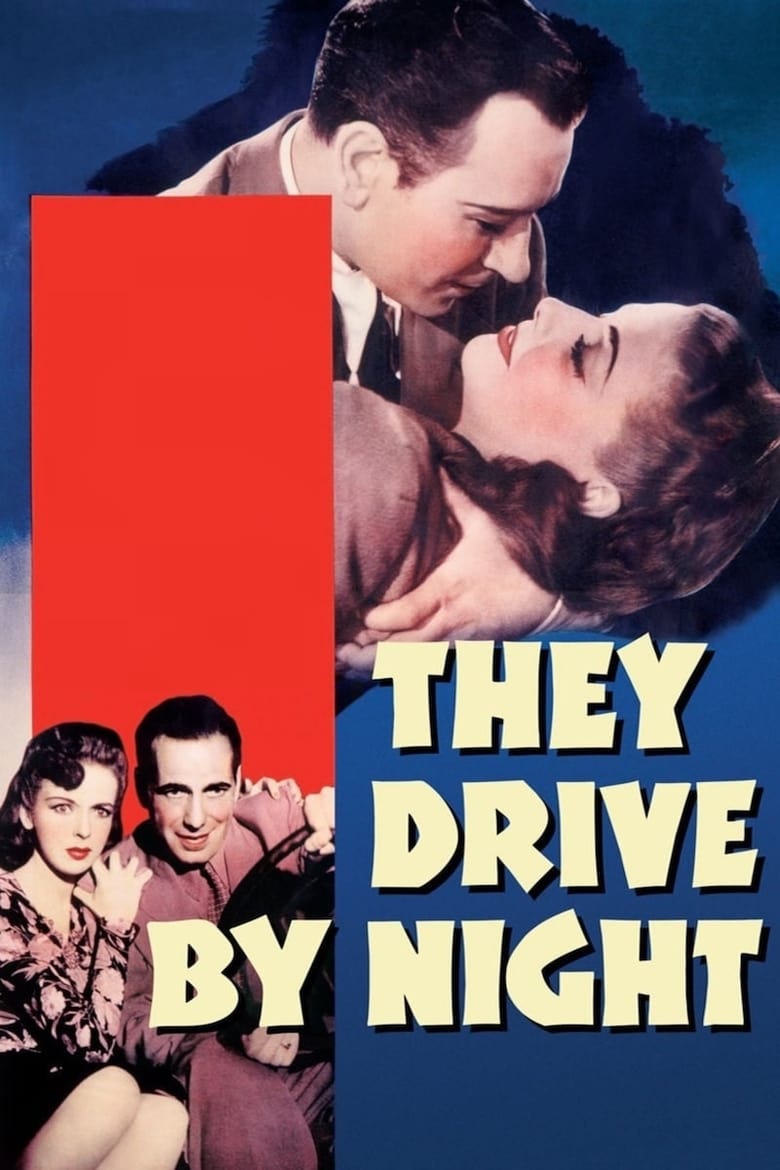
Joe and Paul Fabrini are independent truckers grinding out a living on California's overnight highways, sleeping in their cab, fighting fatigue and debt in equal measure. Joe, the steadier of the two, dreams of owning their own rig outright; Paul, married to the patient Pearl, is already worn thin. Along the way Joe meets Cassie Hartley, a roadside diner waitress with clear eyes and no illusions, who recognizes in him something worth trusting.
Their fortunes seem to shift when Ed Carlsen, a prosperous freight-line owner, takes the brothers on as hired drivers. Ed's wife Lana has long fixed her attention on Joe, and when he refuses her, she turns that frustrated desire into something far more dangerous. A fatal accident involving Ed removes one obstacle – or appears to – and Lana moves to consolidate her position, drawing Joe into a web of complicity he never chose.
They Drive by Night begins as a portrait of blue-collar endurance and pivots, without apology, into a domestic noir of obsession and courtroom reckoning. The film sits at a productive fault line between the Depression-era working-man picture and the postwar thriller, using the trucking world as a moral landscape where exhaustion and ambition corrode judgment. Its second half, driven by Ida Lupino's coiled, increasingly unhinged performance, is among the more unsettling pieces of studio noir Warner Bros. produced in its pre-war years.
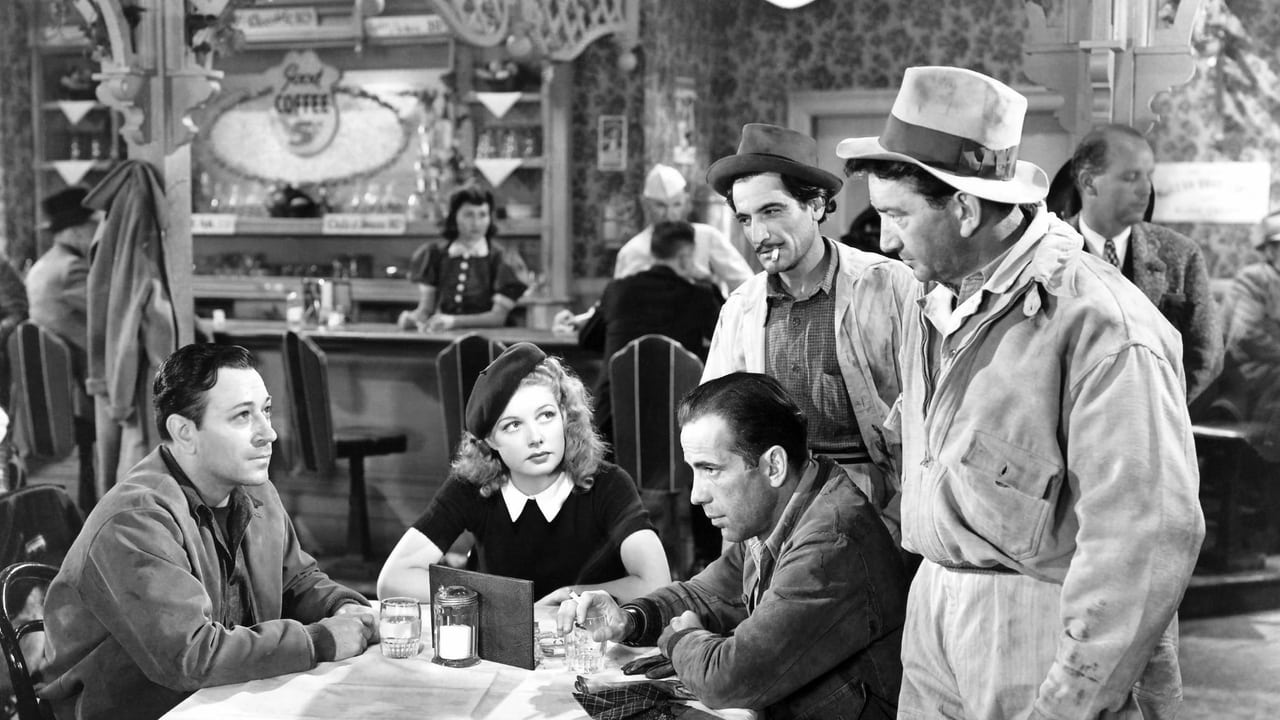
Raoul Walsh's film is something of a structural anomaly, and that anomaly is precisely what makes it worth sustained attention. The first half operates in the tradition of the social-conscience pictures Warner Bros. had been producing since the early thirties – hard men, harder roads, the American dream measured in miles logged and debts unpaid. Then Ida Lupino arrives, and the film remakes itself around her. Her Lana Carlsen is not a femme fatale in the classical mold; she is something more specific and more troubling – a woman of genuine intelligence warped by circumstance and refusal, whose breakdown in the courtroom scene achieves a pitch of psychological exposure rarely permitted to female characters of the period. George Raft holds the center with his customary economy, and Ann Sheridan's Cassie functions as moral anchor without becoming mere cipher. Arthur Edeson's cinematography – informed by his work on earlier Warners productions – maintains a low-key realism in the road sequences before tilting toward the enclosed, pressurized light of the Carlsen household. The film does not entirely resolve its tonal divisions, but those divisions are themselves revealing: America in 1940, caught between solidarity and suspicion.
– Classic Noir
Walsh and Edeson push the camera into medium close-up as Lana Carlsen, on the witness stand, begins to lose her grip on the performance she has rehearsed. The lighting is institutional and flat by design – overhead and unsparing – denying her the shadow she has relied on throughout the film. As her composure fractures, the cutting accelerates in small increments, the frame tightening incrementally on Lupino's face until the space around her seems to contract, the courtroom audience reduced to peripheral blur.
The scene argues something precise about the film's moral logic: that the domestic interior, which Lana constructed as a space of control, has no walls here. Stripped of architecture and darkness, exposed to collective witness, her version of events cannot hold. What reads as theatrical excess in the moment is, on examination, a considered performance of disintegration – Lupino calibrating the character's dissolution beat by beat, making visible the cost of a sustained lie.
Arthur Edeson, whose credits include the foundational Warner Bros. crime pictures of the early sound era and Casablanca two years after this film, brings a restrained but precise visual intelligence to They Drive by Night. In the trucking sequences, he works with available-feeling light – headlamps cutting asphalt dark, diner interiors pooled in warm tungsten – lending the first half a documentary weight appropriate to its subject. As the story migrates into the Carlsen household, the setups shift: deeper shadow ratios, tighter frames, the kind of controlled chiaroscuro that implies enclosure and withholding. Edeson does not overstate the transition; the change accumulates rather than announces itself. His use of the medium close-up throughout the Lupino sequences is particular – he keeps the camera at a distance that is neither intimate nor detached, placing the viewer in the position of an unwilling witness. The overall effect is of a film whose visual language tracks its moral argument: light is available on the road, and scarce in the rooms where decisions are made.
TCM holds strong rights to the Warner Bros. pre-1950 library and is the most reliable source for broadcast and streaming access via the Max bundle.
MaxSubscriptionAvailable through the Max streaming platform as part of the Warner Bros. classic library; verify current availability as catalogue rotates.
Archive.orgFreePublic domain status is uncertain for this title – confirm before relying on this source, as uploads may be incomplete or of compromised quality.