In a quiet California farming community, young Robert 'Bud' Fontaine Jr. becomes convinced that the reclusive new neighbor, a man calling himself Wardlaw, is responsible for the death of Bud's beloved dog. His father, Robert Fontaine Sr., a decent and practical citrus grower, dismisses the boy's accusations as childhood grievance, while Bud's mother Marge tries to hold the family together against the slow pressure of her son's obsession.
As Bud pursues his suspicions with the single-mindedness children bring to moral certainty, the mystery surrounding Wardlaw deepens. The arrival of Dr. Paul Mahler complicates the picture: identities blur, and the question of who Wardlaw actually is – and what he may have done before settling in the valley – begins to unsettle the adults who had been too comfortable to ask. The community's surface calm proves fragile under the weight of unverified accusation.
Talk About a Stranger operates at the margins of the rural noir, using a child's point of view to expose the paranoia and distrust that can corrode ordinary domestic life. The film belongs to that postwar cycle in which guilt and innocence are no longer clearly legible, and the danger closest to home is the one most easily rationalized away.
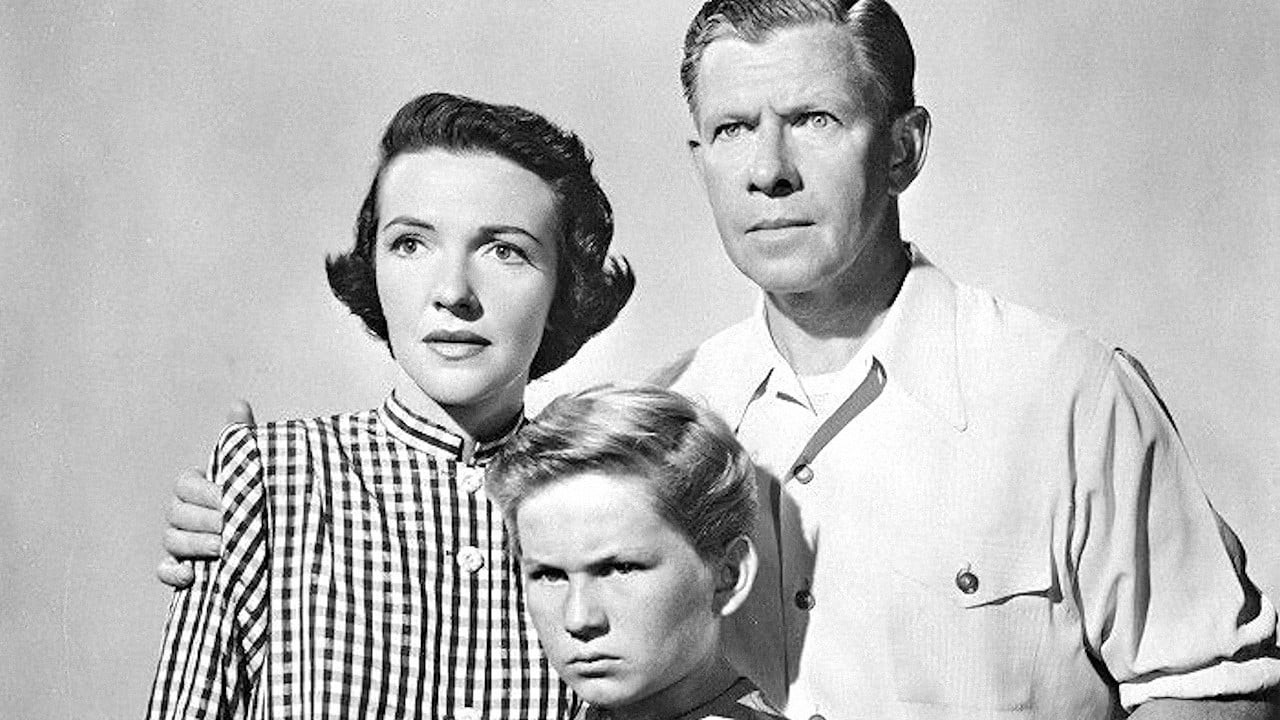
Talk About a Stranger occupies an unusual position within the MGM noir cycle: a B-picture with A-picture cinematography, shaped almost entirely by John Alton's presence behind the camera and confined to a runtime that forces economy on every scene. David Bradley, a director better known for his independent Shakespeare adaptations, brings an outsider's restraint to the material – the film never strains for effect. What makes it genuinely interesting is its refusal to frame the central mystery through an adult investigator; instead, the moral burden falls on a child whose perceptions may or may not be reliable. This is 1952, and the Red Scare undercurrent – the fear of the neighbor who is not who he claims to be, the community's readiness to credit suspicion over evidence – is not incidental. The film works as a minor document of national anxiety, even when its plot mechanics are thin. Nancy Reagan, in one of her final screen roles, is given little to do, but the casting itself is now a footnote of some cultural weight.
– Classic Noir
Alton places the camera low, at the child's eye level, so that the fence line becomes a genuine boundary between the known world and the territory beyond it. The light falls from a raking angle that turns the wooden slats into a grid of shadow across Bud's face, dividing him visually even as he strains to see past the obstruction. The Wardlaw house sits deep in the background, softened by a slight diffusion that withholds detail rather than providing it – the house is present without being fully readable.
The composition does the film's argumentative work without dialogue: the child is already outside the fence's protection, leaning into a space the adults have declared off-limits. Alton's framing suggests that the boundary between safe domesticity and threatening otherness is permeable, and that the act of looking – of insisting on seeing – is itself a form of transgression. Whether Wardlaw is guilty of anything becomes, for a moment, secondary to what the act of suspicion costs the boy doing the suspecting.
John Alton, shooting for MGM on a restricted budget, brings to Talk About a Stranger the same disciplined darkness he applied to larger productions. His lens choices favor a slightly longer focal length that compresses the rural space, making the valley feel less open than the setting implies. Alton's signature is the motivated light source: a window, a streetlamp, the flat California sun used as hard key, each source doing visible dramatic work rather than providing ambient fill. Shadow here is not decorative but diagnostic – it marks the characters who withhold information. The Wardlaw property scenes are lit with a consistency that is almost expressionist in a naturalist setting, the darkness around the house conforming to Bud's suspicion more than to any realistic light condition. Studio interiors are handled efficiently, with controlled bounce that keeps the family scenes visually warmer, a deliberate contrast that reinforces the film's structural opposition between the domestic and the unknown. Alton's work is the primary reason the film retains critical attention.
TCM holds and periodically broadcasts MGM library titles of this era; the print quality is generally reliable and this is the most likely source for a clean presentation.
Archive.orgFreeA public domain upload may be available, though picture quality varies – useful for access but not the preferred presentation for Alton's cinematography.
TubiFreeTubi has carried MGM B-titles from this period; availability shifts, but it is worth checking as a no-cost streaming option.