Films People Pull a Fast One Night Beat Reading Room On TV Shop
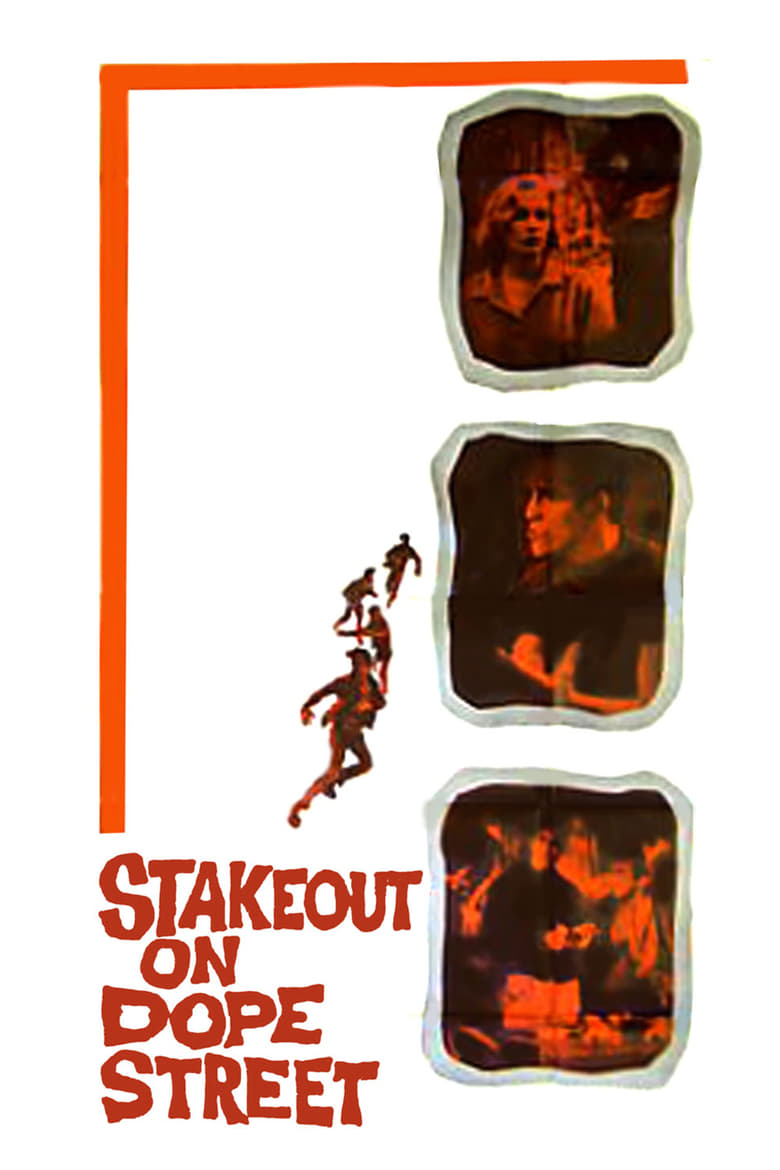
Stakeout on Dope Street 1958
1958 Warner Bros. Pictures
★★★☆☆ Notable
Film Noir · 89 minutes · Black & White

Stakeout on Dope Street

Directed by Irvin Kershner
Year 1958
Runtime 89 min
Studio Warner Bros. Pictures
TMDB 6.6 / 10
"Three boys find a bag of heroin and discover that some windfalls carry a price no one survives paying."

In the sun-bleached margins of Los Angeles, three young men – Jim Bowers, Julian 'Ves' Vespucci, and Nick Raymond – stumble upon a package of heroin discarded by a wounded drug courier. The find transforms their ordinary, directionless lives into something immediately dangerous. Jim, the most cautious of the three, senses the weight of what they have; Ves, impulsive and easily seduced by the idea of fast money, pushes toward cashing in; Nick wavers between them, the fulcrum on which the group's fate will turn.

The narcotics syndicate that lost the package has no intention of writing off the loss. As the three young men debate their options – sell, dispose, or surrender to the police – the organization tightens its circle around them. Jim's relationship with Kathy complicates his judgment, giving him both a reason to survive and a vulnerability that can be exploited. Ves's impatience accelerates the danger, and the film begins to strip away the illusion that the boys were ever in control of the situation.

Kershner frames the story not as a crime procedural but as a study in the mechanics of moral corrosion – how ordinary young men, given a single wrong choice and insufficient will, can be drawn into a world that operates by entirely different rules. The film belongs to a cycle of late-1950s semi-documentary street noirs that treated American youth as a social symptom, and it carries that ambition with more formal discipline than most of its peers.
Classic Noir

Stakeout on Dope Street arrives in 1958 as something of an anomaly: a Warner Bros. picture that carries the texture of a low-budget independent, shot on the streets of Los Angeles with a documentary frankness that recalls the best of the semi-realist cycle. Irvin Kershner, in only his second feature, demonstrates an instinct for spatial pressure – the way a city can function simultaneously as habitat and trap. The film's real distinction, however, is Haskell Wexler's cinematography, which treats natural light as a moral instrument rather than a convenience. The casting of largely unknown or stage-trained actors keeps the film honest; there is no star presence to absorb the audience's anxiety. What the film argues, quietly and without sentiment, is that the postwar American street is not a neutral space – it is an environment that rewards certain decisions and destroys others, and youth provides no exemption. The film's limitations are real: pacing occasionally slackens in the second act, and the syndicate figures lack the weight the narrative demands. But as a record of what serious low-budget filmmaking could accomplish within the genre at the end of the decade, it retains considerable force.

– Classic Noir
3 ★★★☆☆ Notable
Credits

The Crew

DirectorIrvin Kershner
ScreenplayAndrew J. Fenady
CinematographyHaskell Wexler
MusicRichard Markowitz
EditingMelvin Sloan
ProducerAndrew J. Fenady
Performances

The Cast

Close Reading

The Signature Scene

Stakeout on Dope Street – scene
The Vacant Lot Exchange The Package Changes Hands

Wexler shoots the exchange in flat, unsparing daylight, resisting the genre convention of protective shadow. The camera holds at a middle distance, refusing to glamorize the transaction. Figures are small against the geometry of a chain-link fence and the indifferent sprawl of the city behind them; the frame offers no cover, visual or moral. When a close-up finally arrives, it lands on hands rather than faces – the transfer of the package rendered as a mechanical act, stripped of drama.

The choice of daylight is the scene's argument. Noir had long used darkness as a correlative for moral compromise, but here the full light of the California afternoon implicates everything it touches. The boys are not hidden from the world; they are fully visible within it, which makes their exposure all the more complete. The scene insists that corruption does not require darkness – it requires only the wrong decision made in plain sight.

Visual Language

The Cinematography

🎞️
Haskell Wexler – Director of Photography

Haskell Wexler, working here before his reputation was fully established, brings to Stakeout on Dope Street a visual philosophy rooted in location rather than studio construction. Shooting on the actual streets, vacant lots, and alleys of Los Angeles, Wexler exploits available and near-available light to produce a texture that studio work cannot replicate – the grain and flatness of a city that has no interest in looking cinematic. His lens choices favor wider focal lengths that keep background and foreground in simultaneous focus, denying the characters the visual privilege of isolation. Shadow work, when it appears, is architectural rather than expressionistic: doorways, fences, and overhangs create confinement without announcing it. The result is a visual grammar in which the environment is always the dominant term and the human figures are always its subordinates. Kershner's framing and Wexler's light cooperate to produce a world that is not stylized into danger but simply observed to be dangerous – a distinction that places the film closer to Italian neorealism than to classical Hollywood noir.

In the Catalogue

Themes & Motifs

Availability

Where to Watch

Also in the Directory

See Also