Films People Pull a Fast One Night Beat Reading Room On TV Shop
Spiritualist 1948
1948 Ben Stoloff Productions
★★★☆☆ Notable
Film Noir · 78 minutes · Black & White

Spiritualist

Directed by Bernard Vorhaus
Year 1948
Runtime 78 min
Studio Ben Stoloff Productions
TMDB 6.2 / 10
"A con man's séance table holds more bodies than spirits."

In postwar Los Angeles, Alexis – a charming, calculating fraud – runs a lucrative spiritualist racket, exploiting the grief of wealthy clients through staged séances and manufactured visions of the dead. His operation depends on Christine Faber, a beautiful accomplice whose marriage to the prosperous Paul Faber gives Alexis access to a moneyed social circle. When young Janet Burke, recently arrived in the city and still raw with loss, falls under Alexis's influence, the scheme acquires a new and more dangerous dimension.

Janet's growing attachment to Alexis draws the suspicion of Martin Abbott, a skeptical journalist who begins to unpick the machinery behind the séances. Meanwhile the arrangement between Alexis and Christine curdles as financial stakes rise and personal loyalties shift. Paul Faber, oblivious to his wife's complicity, becomes both an obstacle and an instrument, and the film's moral center grows genuinely difficult to locate as each principal pursues a private agenda beneath the surface of occult theatrics.

Spiritualist uses the con-artist framework as a vehicle for examining how grief and loneliness make people available to exploitation, a preoccupation the noir cycle returned to repeatedly in the years after the war. The supernatural trappings are demystified almost from the opening reel; the real darkness lies in the human will to deceive and the equally human need to believe. The film belongs to a minor but coherent strand of postwar noir in which the criminal is less a predator than a parasite, feeding on emotional vulnerability rather than physical force.
Classic Noir

Spiritualist is a modest but honest piece of work that earns its place in the postwar noir cycle through precision of observation rather than ambition of scale. Bernard Vorhaus, directing from an independent production, keeps the tone controlled and the pacing tight within its 78 minutes. Turhan Bey's Alexis is the film's genuine achievement: neither a cartoon villain nor a tragic figure, he is a professional deceiver of recognizable competence, and the film treats him with a clinical interest that the era's major studio productions rarely afforded this type of character. Lynn Bari brings a useful wariness to Christine, a woman who has made one bad calculation and is now locked into its consequences. What the film reveals about its historical moment is specific: the spiritualist racket thrived in postwar America among the bereaved families of the war dead, and the film does not sentimentalize that fact. John Alton's cinematography, even within the constraints of an independent budget, gives the séance sequences a visual authority that larger productions might have spent considerably more to achieve.

– Classic Noir
3 ★★★☆☆ Notable
Credits

The Crew

DirectorBernard Vorhaus
ScreenplayMuriel Roy Bolton
CinematographyJohn Alton
MusicAlexander Laszlo
EditingNorman Colbert
Art DirectionFrank Durlauf
ProducerBenjamin Stoloff
Performances

The Cast

Close Reading

The Signature Scene

Spiritualist – scene
The Séance Chamber Light Behind the Veil

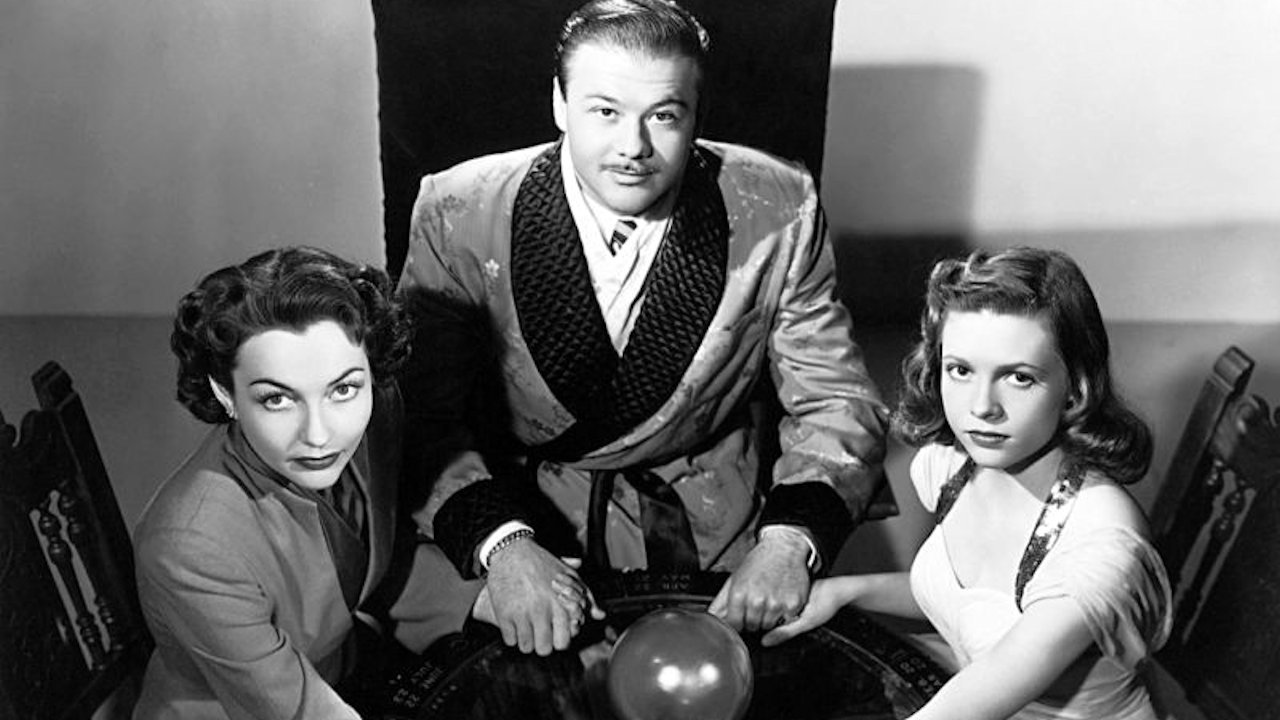
Alton lights the séance from a single practical source at the table's center, allowing the faces of the assembled clients to emerge from near-total darkness in varying degrees of legibility. Alexis himself is positioned at the far edge of the frame, partially obscured, so that the camera places the viewer among the believers rather than alongside the deceiver. The gauze through which the fabricated apparition is projected catches the light in layers, each plane of fabric introducing another degree of visual uncertainty. The composition refuses to reveal the mechanism while it is operating.

The scene makes the audience complicit in a way that functions as the film's central argument: the desire to see something in the dark is enough to generate the vision. Janet's face, held in close-up for the duration of the apparition, shows not credulity but longing – a distinction the film is careful to preserve. Alexis watches her watching, and in that triangulation of gazes the film locates its real subject: not fraud, but the specific human openness that fraud requires to survive.

Visual Language

The Cinematography

🎞️
John Alton – Director of Photography

John Alton brings to Spiritualist the same rigorous economy he applied to larger productions, and the independent budget appears to have imposed disciplines that suit the material. Working on studio-built interiors that are necessarily confined, Alton favors extreme key-to-fill ratios that hollow out the faces of characters who are either hiding something or being deceived – in this film, frequently the same people. The séance sequences demonstrate his characteristic practice of lighting through objects rather than around them: gauze, candle flame, and curtain fabric are used as primary light-shaping elements, producing a quality of illumination that registers as genuinely uncanny without recourse to optical effects. Deep focus is deployed selectively; in the domestic scenes Alton permits the background to soften, concentrating moral attention on the foreground transaction. The overall visual strategy argues that deception requires darkness to function, and that the film's occasional hard-lit investigative passages represent not safety but a different kind of exposure.

In the Catalogue

Themes & Motifs

Availability

Where to Watch

Also in the Directory

See Also