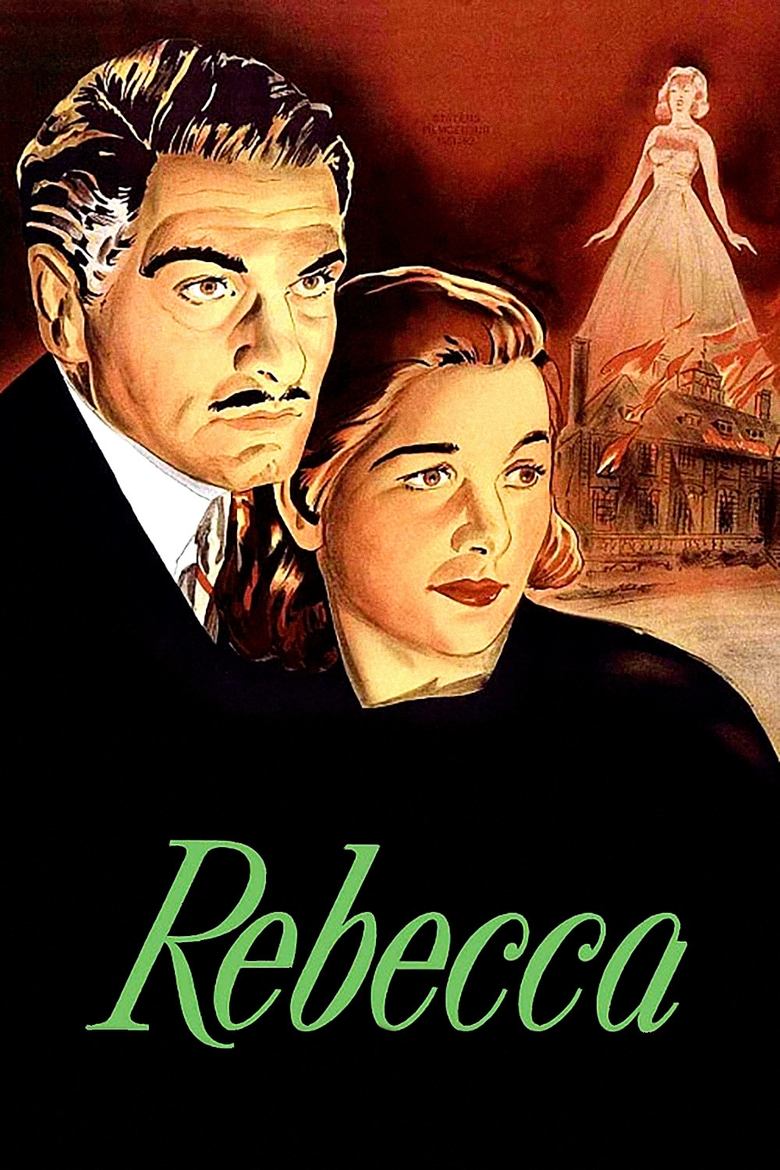
A shy, unnamed young woman working as a lady's companion in Monte Carlo meets Maxim de Winter, a wealthy English widower still visibly marked by the death of his first wife, Rebecca. Their courtship is swift and unequal – he is commanding and opaque, she is uncertain of her own right to exist in his world – and within weeks she becomes the second Mrs. de Winter, transplanted to Manderley, his vast estate on the Cornish coast.
At Manderley, the new Mrs. de Winter finds herself in competition with a ghost. The housekeeper, Mrs. Danvers, maintains Rebecca's rooms as a shrine and conducts a campaign of psychological attrition against the second wife, implying at every turn that she is an inadequate replacement. Maxim grows cold and distant. The arrival of Rebecca's cousin Jack Favell, a smirking opportunist with leverage over the household, signals that the past has not been contained – it is, in fact, closing in.
Rebecca sits at the intersection of gothic melodrama and psychological noir, structuring its dread not around physical violence but around institutional power and buried guilt. The film's central question – what a marriage conceals, and at what cost concealment is maintained – connects it to the noir tradition's abiding interest in the rot beneath respectable surfaces. Hitchcock uses Manderley itself as a mechanism of entrapment, and the resolution, when it arrives, implicates everyone.
Rebecca occupies an unusual position in the noir canon: it arrived at the threshold of the cycle's classical period, carrying the conventions of English gothic fiction into the idiom of Hollywood psychological suspense. Hitchcock, working for Selznick and constrained by the producer's loyalty to du Maurier's source novel, channeled his instincts for voyeurism and guilt into a film whose noir credentials derive less from urban crime than from the exposure of a marriage as a site of concealment and coercion. The film's real subject is not murder – though murder is present – but the architecture of social performance and the violence that underpins domestic authority. Mrs. Danvers, coded as an obsessive and played by Judith Anderson with cold precision, functions as the noir femme in displacement: her destructive loyalty is the film's most destabilizing force. George Barnes's cinematography, deep-shadowed and deliberately oppressive in the interior sequences, gives Manderley a quality closer to a prison than an estate. The result is a film that earns its genre position not through convention but through diagnosis.
– Classic Noir
The camera holds on Mrs. Danvers as she moves through Rebecca's preserved bedroom with the unhurried authority of a curator. George Barnes lights the sequence from low and lateral sources, so that Danvers's face is half-consumed by shadow while the fabrics she handles – furs, lingerie, embroidered pillowcases – catch the light with a tactile, almost obscene clarity. The second Mrs. de Winter stands at the periphery of the frame, diminished by the architecture and by Danvers's absolute ownership of the space. Barnes holds the composition long enough that the room reads as a stage set for a performance the living woman can never give.
The scene is the film's thesis rendered visually: the new wife is not merely inadequate but structurally surplus. Danvers is not grieving – she is administering, maintaining a world in which the second Mrs. de Winter has no authorized existence. That Danvers's attachment to Rebecca exceeds devotion and approaches something closer to possessed identification is left in the image rather than stated in dialogue, which is precisely what makes the scene function as noir. Guilt, desire, and control share the same frame without any one of them being named.
George Barnes, who won the Academy Award for this work, constructs Manderley as a space of graduated oppression. Shooting entirely on studio sets built at Selznick International, Barnes and Hitchcock used deep-focus compositions and high ceilings to make interiors feel uninhabitable rather than grand – rooms in which the human figure is perpetually outscaled. Barnes's key lighting on Judith Anderson is consistently asymmetric, cutting her face into planes of revelation and concealment that mirror the film's moral logic. In contrast, Joan Fontaine is frequently lit from slightly above and frontally, a setup that reads as exposure rather than glamour, reinforcing her character's vulnerability. Shadow work in the corridors and staircase sequences is deliberate and architectural, less expressionist than programmatic: darkness here is not atmosphere but enclosure. The West Wing sequences, in particular, use a narrowing depth of field to collapse the frame around Fontaine, so that the physical world appears to be actively contracting around her as the truth approaches.
The Criterion Channel streams a high-quality transfer and is the most reliable home for this title in the context of curated classic Hollywood programming.
MaxSubscriptionMax has carried Rebecca as part of its Warner Bros. and classic Hollywood library rotation, though availability may vary by region and period.
TubiFreeTubi has periodically offered Rebecca at no cost with ads; transfer quality is inconsistent, but it is a functional free option when available.