Films People Pull a Fast One Night Beat Reading Room On TV Shop
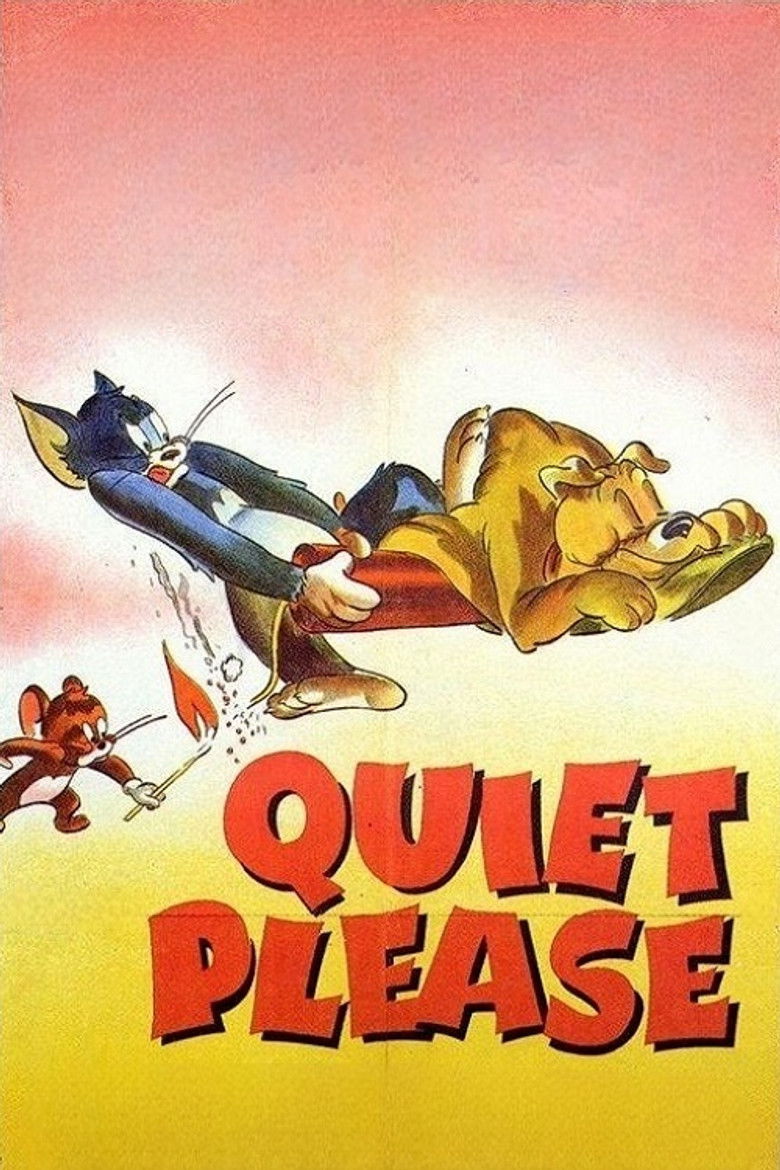
Quiet Please 1945
1945 MGM Cartoon Studio
★★★☆☆ Notable
Film Noir · 7 minutes · Black & White

Quiet Please

Directed by Joseph Barbera
Year 1945
Runtime 7 min
Studio MGM Cartoon Studio
TMDB 7.3 / 10
"Even a cat's courage has its limits when the house belongs to someone else."

A bulldog named Spike has claimed a quiet suburban house for his afternoon nap, and Tom – the household cat – finds himself caught between his instinct to chase Jerry and the absolute prohibition Spike has placed on any disturbance. The power structure is immediate and physical: Spike is larger, meaner, and entirely willing to enforce the silence with his fists. Tom, ordinarily the aggressor, is abruptly demoted to the most precarious position in the hierarchy.

Jerry, characteristically oblivious or simply indifferent to danger, continues to provoke Tom at every turn. Each time Tom attempts to neutralize the mouse, the resulting chaos edges closer to waking Spike. Tom is thus forced into an impossible negotiation – suppress his own nature to survive, or act on instinct and face annihilation. The mouse becomes less a prey item than an instrument of torment, and Tom's desperation acquires a quality that is genuinely existential.

The cartoon operates on the same contractual logic as much of postwar noir: the rules are set by those with the most force, and the protagonists scramble within those rules until the structure collapses. What begins as a slapstick chase resolves into something that rhymes, however obliquely, with the genre's preoccupation with entrapment, the reversal of the predator-prey relationship, and the punishment that awaits anyone who disturbs the peace of the powerful.
Classic Noir

Quiet Please is not a film one would ordinarily bring into a noir conversation, and that tension is precisely what makes it worth examining. Joseph Barbera, directing from a formula perfected alongside William Hanna at MGM, constructs here a scenario whose underlying geometry is unmistakably dark: a protagonist denied agency, a power structure enforced by violence, and a resolution that punishes the wrong party. Scott Bradley's score – chromatic, anxious, built from dissonance rather than comfort – refuses to let the comedy settle into innocence. The cartoon appeared in 1945, the same year that saw Double Indemnity's Academy nominations and Mildred Pierce's release, and its preoccupations rhyme with theirs more than the medium suggests. Quiet Please won the Academy Award for Animated Short Film, a fact that sits oddly against the cruelty of its internal logic. What it reveals about its era is a culture capable of packaging coercion and helplessness as entertainment, and finding it funny – which is, after all, something noir understood perfectly well.

– Classic Noir
3 ★★★☆☆ Notable
Credits

The Crew

DirectorJoseph Barbera
MusicScott Bradley
ProducerFred Quimby
Performances

The Cast

Close Reading

The Signature Scene

Quiet Please – scene
The Living Room Floor Tom Frozen in Silence

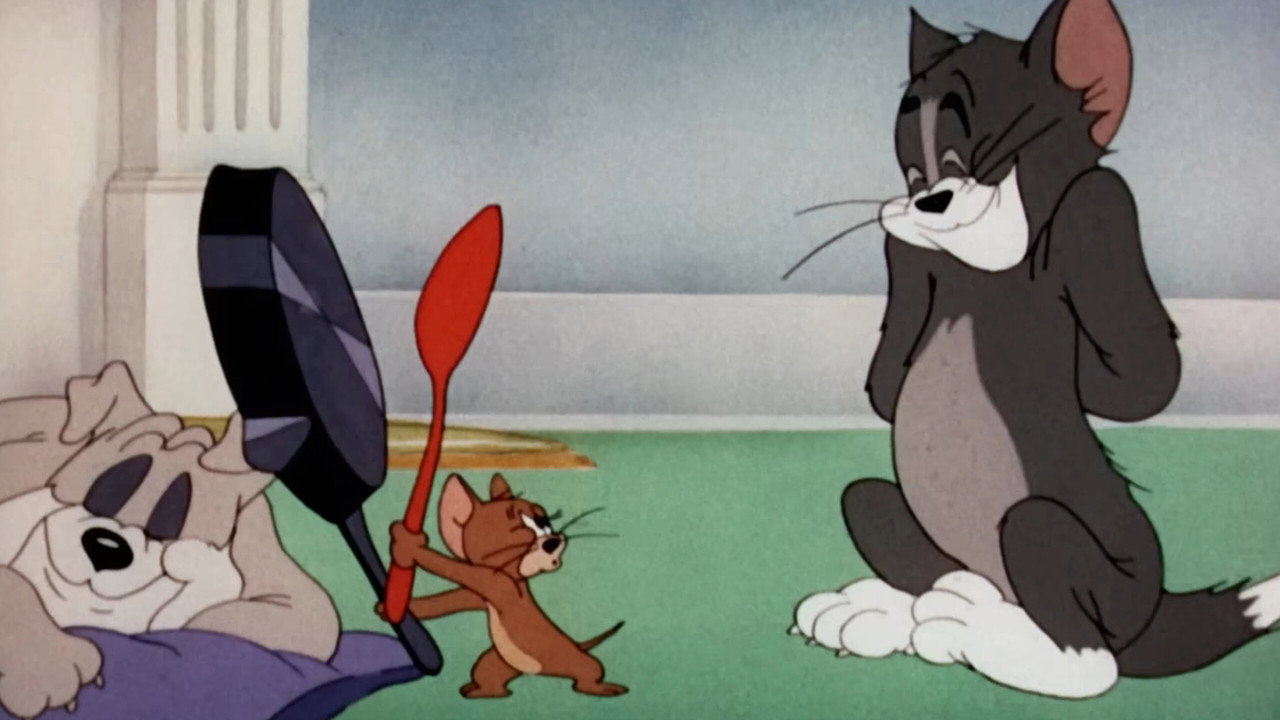
The frame is low and wide, Spike filling the background in soft focus while Tom occupies the foreground in a posture of complete physical arrest. The color palette shifts toward warmer ochres in Spike's zone and cooler, harder tones around Tom – a division that reads, in the context of the moment, as the difference between safety and exposure. The animation holds Tom's suspended gesture longer than comfort requires, letting the stillness accumulate weight.

The scene argues that the most effective restraint is internalized: Tom does not need a cage because the threat of Spike is sufficient architecture. It is the same logic that governs the compromised protagonists of countless noir narratives – the fear of consequence has replaced the fact of consequence, and the character is already trapped before any physical action is taken. Barbera uses the pause not for comedy alone but to map the precise dimensions of Tom's captivity.

Visual Language

The Cinematography

🎞️
Director of Photography – Director of Photography

The cinematographer for Quiet Please is uncredited, as was standard practice for MGM's cartoon unit, where background and layout work passed through a collective pipeline rather than a single credited operator. The visual language is nonetheless deliberate: the studio's Technicolor process is deployed with unusual restraint for an animated short, favoring domestic half-shadows and interior warmth over the saturated primaries typical of the period. Layout compositions favor asymmetry – doors slightly off-center, furniture that crowds the frame edges – creating an environment that feels inhabited rather than designed. Shadow work on Spike during his sleeping sequences is exaggerated just enough to read as threat rather than repose, his bulk rendered in gradients that suggest mass and menace simultaneously. The recurring choice to shoot Tom from slightly below neutral eyeline, particularly when Spike is in the same frame, is a spatial argument about power that operates independently of the script. It is modest technique in service of a coherent moral geometry.

In the Catalogue

Themes & Motifs

Availability

Where to Watch

Also in the Directory

See Also