Films People Pull a Fast One Night Beat Reading Room On TV Shop
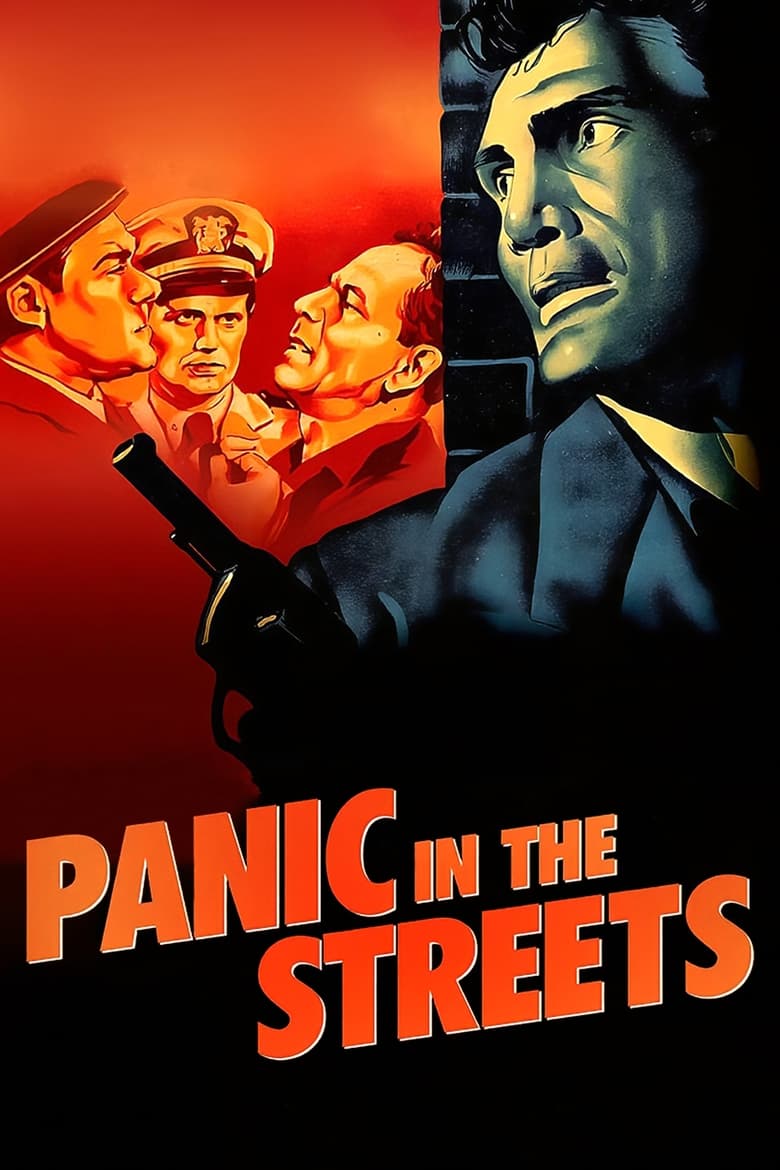
Panic in the Streets 1950
1950 20th Century Fox
★★★☆☆ Notable
Film Noir · 96 minutes · Black & White

Panic in the Streets

Directed by Elia Kazan
Year 1950
Runtime 96 min
Studio 20th Century Fox
TMDB 6.9 / 10
"A plague moves through the city, and the men hunting it have no time for the truth to catch up."

In the port city of New Orleans, an illegal immigrant is shot dead in a back-alley card game. When the body reaches the city morgue, U.S. Public Health Service officer Lt. Cmdr. Clinton Reed discovers the man died carrying pneumonic plague – a strain both lethal and communicable. Reed has forty-eight hours to find everyone who came into contact with the dead man before an outbreak becomes an epidemic. The problem is that finding them means finding the killers first.

The investigation pulls Reed into uneasy collaboration with Captain Tom Warren of the New Orleans Police Department, a practical, skeptical cop who resists federal intrusion and has little patience for Reed's urgency. The killers – a mid-level racketeer named Blackie and his associate Raymond Fitch – know only that they need to find the sailor's companions before the police do, unaware they may already be infected. The city's underworld and its public institutions are thus locked in a race whose stakes neither side fully understands.

Panic in the Streets operates at the intersection of the procedural and the noir thriller, using the mechanics of epidemic containment to examine institutional friction, masculine authority under pressure, and the indifference of criminal networks to the consequences they generate. Shot entirely on location in New Orleans, it grounds its tension in documentary authenticity while never losing the genre's appetite for shadow and moral ambiguity.
Classic Noir

Panic in the Streets occupies a precise and undervalued position in the postwar American noir cycle. Elia Kazan, working at the height of his formal confidence and two years before his HUAC testimony would fracture his reputation, turns a public-health procedural into a study in institutional inadequacy. The film's central argument – that bureaucratic rivalry and professional ego are as dangerous as the pathogen itself – carries the era's specific anxieties about collective vulnerability and state competence. Richard Widmark, so often cast as the threat, here plays the man trying to contain it, and the displacement produces a character whose authority is perpetually contested. Jack Palance's Blackie is menacing not through psychology but through a kind of blunt situational logic: he does what he must to remain invisible. What the film finally achieves is a portrait of a city as a system – its docks, its tenements, its chain of command – in which catastrophe is less an event than an outcome of ordinary failures.

– Classic Noir
3 ★★★☆☆ Notable
Credits

The Crew

DirectorElia Kazan
ScreenplayEdna Anhalt
CinematographyJoseph MacDonald
MusicAlfred Newman
EditingHarmon Jones
Art DirectionMaurice Ransford
CostumesTravilla
ProducerSol C. Siegel
Performances

The Cast

Close Reading

The Signature Scene

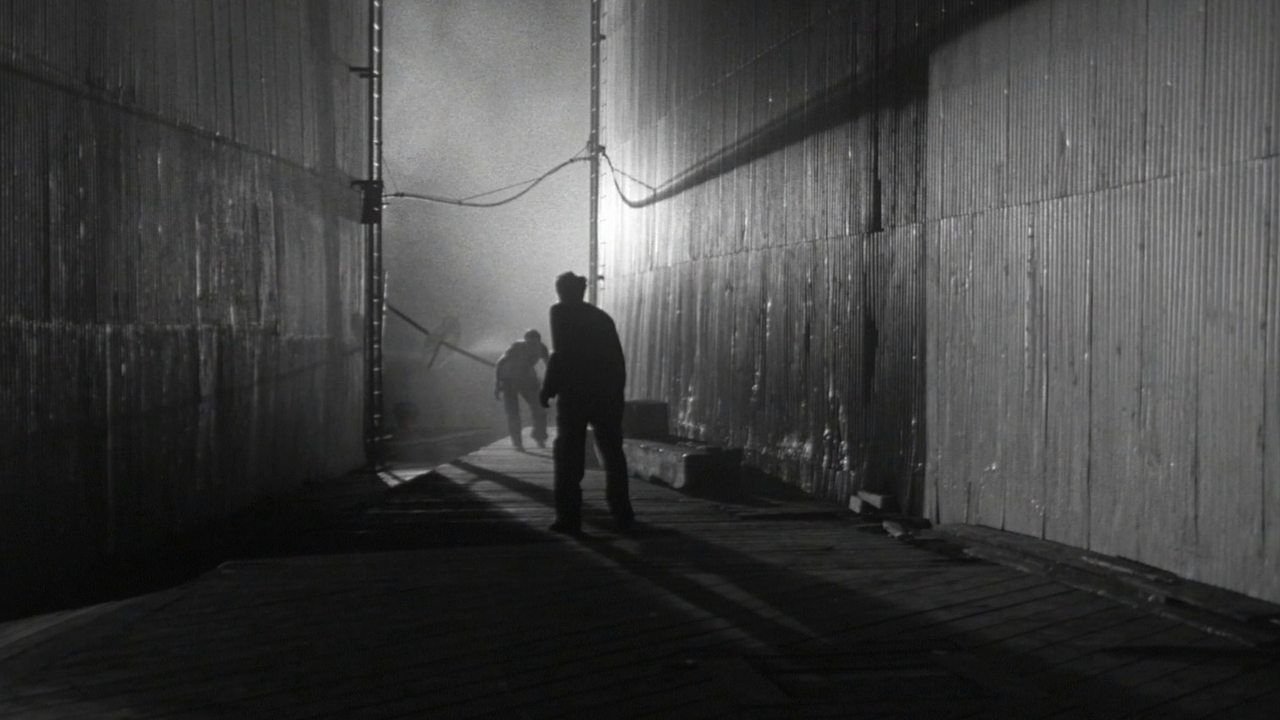
Panic in the Streets – scene
The Dockside Chase Blackie Cornered at the Waterfront

Joseph MacDonald's camera stays low and wide as the pursuit spills onto the working docks, the frame crowded with rope coils, machinery, and the flat grey light off the Mississippi. The geography is deliberately disorienting – gangways, warehouse interiors, and open water compress into a sequence of tight angles and sudden clearings. Shadow falls in broad industrial shapes rather than the usual venetian-blind geometry, and the location sound – wind, water, the scrape of metal – carries as much weight as Alfred Newman's score.

The chase distills the film's central irony: Blackie is running not from justice in any moral sense but from the exposure of an entirely contingent danger he never knew he carried. His violence throughout the film has been instrumental rather than emotional, and here his desperation is similarly mechanical. The waterfront setting – transient, borderless, neither fully land nor sea – makes literal the film's argument about the spaces where contagion, crime, and institutional authority all lose their clean edges.

Visual Language

The Cinematography

🎞️
Joseph MacDonald – Director of Photography

Joseph MacDonald's cinematography on Panic in the Streets represents one of the more disciplined applications of location shooting in the classical noir period. Working across the actual streets, docks, and interior spaces of New Orleans rather than studio reconstructions, MacDonald uses available architectural geometry to generate compression and unease without resorting to expressionist distortion. His lens choices favour a moderate wide angle that keeps backgrounds in meaningful focus – the city is never mere backdrop but an active element of the frame. Lighting setups on location are pragmatic but controlled: high-contrast pools in interior scenes, flatter but still directional light in exteriors, where the humidity and waterfront atmosphere do textural work that a studio environment could not replicate. Shadow functions less as psychological symbol here than as physical fact – the darkness where the infected might be moving, unseen. The visual language consistently reinforces the film's argument that danger is environmental and systemic rather than neatly localised in any single face.

In the Catalogue

Themes & Motifs

Availability

Where to Watch

Also in the Directory

See Also