Jim Ackland (John Mills) returns to London after a bus accident that killed a young child in his care and left him with a brain injury that periodically overwhelms him with suicidal impulses. Placed in a suburban boarding house while he recovers, he attempts to resume a normal working life, quietly supported by the gentle Joyce Carden (Adrianne Allen) and cautiously drawn toward her friend Jenny (Joan Greenwood). The house is a contained social world of lodgers and landladies, presided over with tight propriety by Mrs. Vinton (Joyce Carey) and observed with quiet suspicion by the watchful Miss Selby (Catherine Lacey).
When Molly Newman (Kay Walsh), a brash fellow lodger, is found strangled, circumstantial evidence accumulates around Ackland. He has no reliable alibi, his history of psychological instability is known, and those around him – including the officious Mr. Peachy (Edward Chapman) – begin to reinterpret his behaviour in the worst possible light. Only Jenny holds to her belief in his innocence, though the film is careful not to make her conviction simply romantic. Ackland himself cannot be certain of what he is capable, and that uncertainty is the film's central pressure point.
The October Man occupies a specific position in British postwar cinema: a psychological thriller that borrows the wrong-man architecture of American noir while grounding it in a milieu that is unmistakably English – respectable, repressed, and quietly lethal in its social judgements. The film is less interested in detection than in the experience of being suspected, and in the damage that suspicion does to a man already holding himself together by force of will.
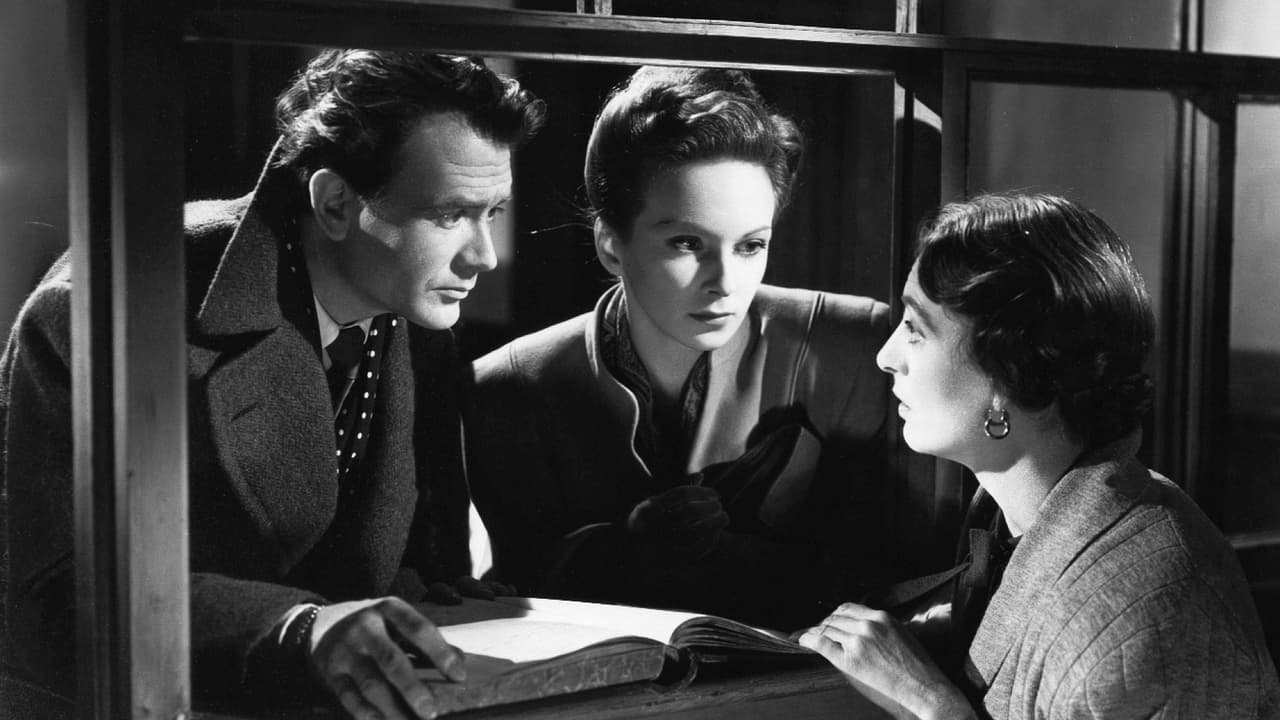
Produced by Eric Ambler from his own source novel, The October Man arrives in 1947 as one of the more psychologically rigorous British contributions to the noir cycle. Roy Ward Baker, in only his second feature, keeps the mise-en-scène close and domestic, refusing the expressionist excess that might have turned Ackland's mental fragility into spectacle. John Mills works against his established screen persona as a dependable Englishman – the injury here is interior, invisible to others, and Mills conveys its weight through stillness rather than performance. The film's real subject is not murder but the social mechanics of suspicion: how a community reconstructs a man's identity from fragments of behaviour and hearsay. In this it speaks directly to the postwar moment, when many men returned from the war psychologically altered and found that the civilian world had limited patience for damage it could not see. Joan Greenwood's Jenny is a notably unsentimental figure, her loyalty grounded in observation rather than feeling alone.
– Classic Noir
Ackland stands on a railway bridge at night, the river dark below him. Erwin Hillier lights the scene from a low angle, the iron framework of the bridge cutting the frame into angular segments that cage the figure of Mills without melodrama. The light source is ambient and diffuse – streetlamps and reflected water – giving the image a cold, flat quality that refuses the romanticism that expressionist shadow work might have supplied. The camera holds at a measured distance, not pressing in for an emotional close-up, allowing the composition itself to do the work.
The scene distills the film's central argument: Ackland is not a man being destroyed by external forces but one who carries the mechanism of his own destruction inside him. The bridge is not a dramatic location chosen for effect; it is simply the place his compulsion has led him, again, as it has before. The restraint of Baker's direction at this moment – no scoring surge, no cutaway to Jenny – forces the viewer into Ackland's isolation without the comfort of narrative framing.
Erwin Hillier's cinematography on The October Man demonstrates how controlled understatement can generate psychological pressure without recourse to the expressive distortions more commonly associated with the noir image. Shooting largely on studio sets designed to evoke the sealed, slightly airless world of the suburban boarding house, Hillier works with shallow depth of field to keep backgrounds indistinct and social interiors claustrophobic without obvious manipulation. Lighting setups favour practicals and motivated sources – table lamps, hallway lights – which give the domestic spaces a naturalistic texture while still allowing shadows to pool in corners where they register unease rather than declare it. The outdoor sequences, particularly the bridge and the park, are shot with harder, colder light that marks the exterior world as no less threatening than the interior one. Hillier had worked extensively in British studio cinema and brought to this material a disciplined economy that serves the film's moral logic: a world that looks ordinary is precisely where guilt becomes impossible to locate.
The BFI holds and restores British titles of this era and is the most authoritative source for a proper transfer of this film, though availability should be confirmed directly.
Archive.orgFreePublic domain copies circulate here and offer the most immediately accessible viewing option, though print quality varies considerably.
KanopyFreeAvailable through participating public library systems; check local library access for the most stable streaming version among free platforms.