John Howard Tracy, a down-on-his-luck songwriter, finds himself the prime suspect in a murder he did not commit. Released on a technicality but far from exonerated, Tracy moves through a Los Angeles that regards him with suspicion at every turn. Detective Simon Shayne, abrasive and convinced of Tracy's guilt, maintains a surveillance that amounts to persecution, while Tracy's only potential ally is Pat Peterson, a young woman whose motives remain opaque in the early reels.
As Tracy attempts to reconstruct the circumstances surrounding the killing, the investigation draws in Olga Valerie Lewis, a woman with connections to the city's seedier commercial interests, and Wilbur K. Grossett, whose role in the victim's life proves more complicated than it first appears. Shayne's pressure intensifies, allegiances shift, and Tracy finds that clearing his name requires moving through precisely the social strata most likely to destroy him. Pat's loyalty is tested as the danger around Tracy becomes less abstract.
No Escape operates within the wrongful-accusation tradition that noir inherited from the crime melodramas of the 1930s, compressing its mechanics into a taut 76 minutes. The film is less interested in procedural revelation than in the atmosphere of a man denied the presumption of innocence, trapped between institutional indifference and private menace. It sits comfortably in the cycle of B-noir productions that dominated independent studio output in the early 1950s, offering modest ambitions executed with professional economy.
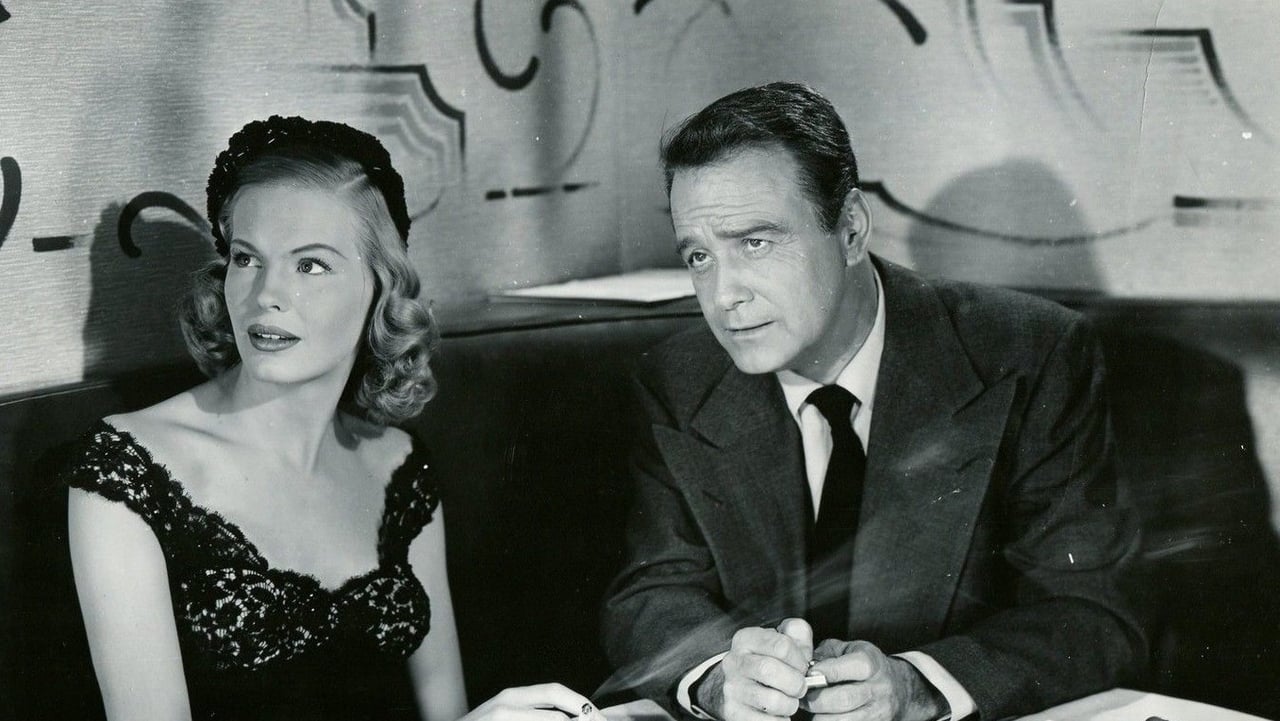
No Escape is a workmanlike entry in the crowded field of early-1950s independent noir, distinguished less by formal innovation than by the quiet credibility Lew Ayres brings to a role that could easily collapse into self-pity. Ayres, whose career had already traced its own complicated arc, carries Tracy with a weary plausibility that anchors the film's more schematic plotting. Charles Bennett, better known as a screenwriter for Hitchcock, directs with restraint rather than flair, keeping the film's modest resources from becoming liabilities. Sonny Tufts's Detective Shayne is the more interesting construction: not a corrupt cop but an overzealous one, a distinction that mattered to postwar audiences navigating complicated feelings about institutional authority. The film reflects a cultural moment in which the wrong-man scenario carried genuine social weight, arriving as it did during a period of heightened anxiety about accusation and due process. Benjamin H. Kline's cinematography never overreaches, but it consistently places Tracy in frames that shrink around him, a visual argument the narrative reinforces.
– Classic Noir
Kline positions the camera at a slightly low angle in a narrow corridor, the ceiling pressing into the upper frame while a single practical lamp at the far end throws Tracy's shadow forward and large across the wall behind him. Shayne enters from screen left, the doorframe bisecting the shot so that Tracy is geometrically hemmed: wall, door edge, shadow, and the detective's silhouette forming a quadrilateral from which no diagonal offers relief. The light source is hard, casting deep pools under brows and along jawlines, the kind of chiaroscuro that reads institutional even in a civilian space.
The scene distills the film's central argument about the mechanics of suspicion. Tracy has committed no crime within the frame, yet every compositional element positions him as a man already sentenced. Shayne's physical intrusion into the corridor is the visual equivalent of the film's moral premise: guilt, here, is a social verdict delivered before evidence is assessed. The shadow that precedes Tracy down the wall suggests a self that the world has already defined, and which Tracy must outrun rather than simply disprove.
Benjamin H. Kline, a veteran of Columbia's B-unit with credits stretching back into the 1920s, brings to No Escape the practiced efficiency of a craftsman who understood how to make limited budgets yield expressive results. Working almost entirely on studio sets, Kline uses deep shadows and compressed interiors to manufacture a city that feels perpetually watched. His lighting setups favor hard single sources – bare bulbs, desk lamps, window light raked at acute angles – over the diffused three-point schemes that softer productions favored. The effect is a world without neutral space: every room either traps or exposes its occupant. Kline's lens choices tend toward the slightly wider end of normal focal lengths, which keeps background detail legible while subtly distorting the edges of the frame, lending enclosed spaces a mild but persistent claustrophobic pressure. Taken together, these choices serve the film's moral logic precisely: in a world where a man's guilt is presumed, even empty space is adversarial.
As a public domain title, No Escape circulates on the Internet Archive in transfers of variable quality; the best available upload offers a watchable if imperfect print.
TubiFreeTubi has carried this and comparable early-1950s B-noirs in its classic crime catalogue; availability fluctuates and the transfer quality is uncertain.
Amazon Prime VideoSubscriptionPeriodically available through Prime's rotating public domain holdings; confirm current availability before seeking it here.