London, the 1890s. Belle Adair, a music-hall chorus girl with few prospects and considerable nerve, discovers that her friend and fellow performer Daisy Arrow has been murdered. Before her death, Daisy had been keeping company with a wealthy gentleman, and Belle recovers a Bible inscribed with his name: Michael Drego. Rather than go to the police, Belle uses what she knows to insert herself into Drego's life, traveling to his family's country estate under a false identity as Rose Lynton and positioning herself as a candidate for his affections – and his money.
At Douro Hall, Belle encounters Michael's formidable mother, Lady Margaret Drego, a woman who guards her son's reputation and her family's standing with a vigilance that shades into something darker. Michael himself is charming and evasive in equal measure, and Belle finds her calculated scheme beginning to complicate her own feelings. Meanwhile, Police Inspector Clinner pursues the murder investigation with methodical patience, and the deaths do not stop at Daisy. Each new development narrows the circle of suspects while raising the possibility that Belle herself may be in danger.
Moss Rose operates at the intersection of Victorian melodrama and American noir, transplanting the genre's characteristic obsessions – blackmail, sexual menace, fatal secrets within respectable families – into a gaslit period setting that Fox's production machinery renders with considerable craft. The film belongs to a cycle of mid-1940s noirs that used historical distance to examine class aspiration and the violence it can provoke, and it offers a female protagonist whose moral calculus is neither simple nor easily resolved.
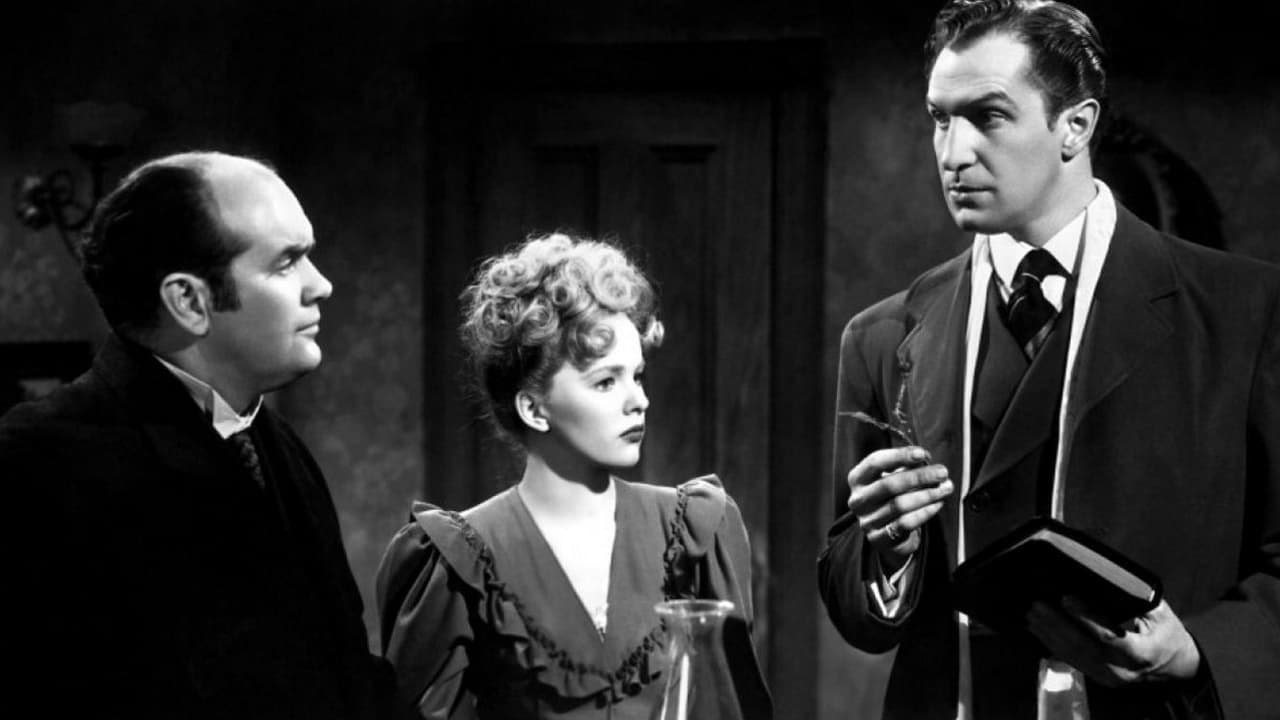
Moss Rose occupies an instructive position on the margins of the noir canon. Gregory Ratoff is not a director associated with the genre's harder edges, and the film's period trappings – Edwardian interiors, fog-laden exteriors, the conventions of the Victorian sensation novel – might seem to dilute the genre's characteristic severity. They do not entirely. The script, adapted from Joseph Shearing's novel, understands that respectability is noir's most reliable villain, and Lady Margaret, as played by Ethel Barrymore with glacial authority, embodies that proposition fully. Peggy Cummins brings a watchfulness to Belle that keeps the film from becoming mere costume melodrama; her character's social calculation is legible in every scene without being announced. Victor Mature is less interesting, though his physical ease reads correctly as a man who has never needed to account for himself. Vincent Price's Inspector Clinner is underused, a structural convenience rather than a character. The film's principal achievement is its insistence that upward mobility, when pursued through blackmail, leads not to safety but to deeper entrapment – a classically noir argument dressed in Edwardian clothes.
– Classic Noir
Lady Margaret receives Belle alone in the drawing room, and Joseph MacDonald's camera refuses to grant either woman a positional advantage for long. The frame favors close two-shots that compress the space between them, the high-ceilinged room's darkness pressing in from the edges. Key light falls on Barrymore's face at a low angle, deepening the hollows beneath her cheekbones and giving her stillness the quality of a carved object. Cummins is lit more softly, but her position in the frame – slightly lower, slightly closer to the lens – suggests surveillance rather than submission.
The scene makes explicit what the rest of the film has implied: that Lady Margaret has read Belle's intentions from the beginning and has her own calculations running in parallel. It reframes every prior interaction, suggesting that the apparent victim of the blackmail scheme has been the one in control. For a film concerned with who holds knowledge and who merely thinks they do, this reversal is its moral center – the moment when the class structure reveals itself not as the target of Belle's scheme but as its unmovable architecture.
Joseph MacDonald's work on Moss Rose is restrained in a manner that rewards close attention. Where a more atmospheric cinematographer might have leaned hard into fog and shadow to compensate for the period setting, MacDonald trusts the interiors to do the work, and his lighting setups inside Douro Hall favor deep-focus compositions that keep background details legible and slightly threatening. The studio construction of the English country house is handled with enough attention to depth – long corridors, doorways within doorways, windows that admit gray English light without warmth – that the artifice rarely distracts. MacDonald would go on to photograph Panic in the Streets and My Cousin Rachel with considerably more technical bravado, but the discipline he applies here is appropriate: a film about concealment benefits from a camera that does not dramatize every secret. His exterior work, including the music-hall sequences that open the film, uses harder contrast to mark Belle's origins, and the visual shift when she arrives at the estate is legible as a shift in moral register.
Moss Rose has circulated on Tubi as part of its classic Hollywood library; confirm availability in your region before viewing.
Archive.orgFreeA public domain print is likely accessible via Archive.org, though transfer quality may vary from copy to copy.
TCMSubscriptionTCM periodically broadcasts Fox studio noirs of the 1940s and would represent the most reliably restored broadcast version.