Films People Pull a Fast One Night Beat Reading Room On TV Shop
Man on the Eiffel Tower 1949
1949 A & T Film Productions, Inc.
★★★☆☆ Notable
Film Noir · 97 minutes · Black & White

Man on the Eiffel Tower

Directed by Burgess Meredith
Year 1949
Runtime 97 min
Studio A & T Film Productions, Inc.
TMDB 5.2 / 10
"A killer dares the law to catch him, and the law obliges."

Paris, late 1940s. A wealthy invalid and her nurse are found murdered in their apartment, and all evidence points to Joseph Heurtin, a meek knife-sharpener arrested near the scene. Inspector Jules Maigret of the Paris police, Georges Simenon's famously patient detective, is unconvinced. Where others see an open case, Maigret sees a man too frightened to be guilty and too inarticulate to save himself. He releases Heurtin under secret surveillance, gambling that the true killer will surface.

That killer is Johann Radek, a cultivated, sardonic expatriate who has committed the crime as an intellectual exercise – and who knows, with considerable pleasure, that Maigret suspects him. What follows is less a conventional investigation than a psychological duel. Radek courts exposure, taunting the inspector with the certainty that his own vanity will eventually destroy him. Around these two principals move a secondary cast of compromised figures: a young American, Bill Kirby, drawn into Radek's orbit through his wife Helen, and Gisella Heurtin, whose loyalty to her husband is both her virtue and her vulnerability.

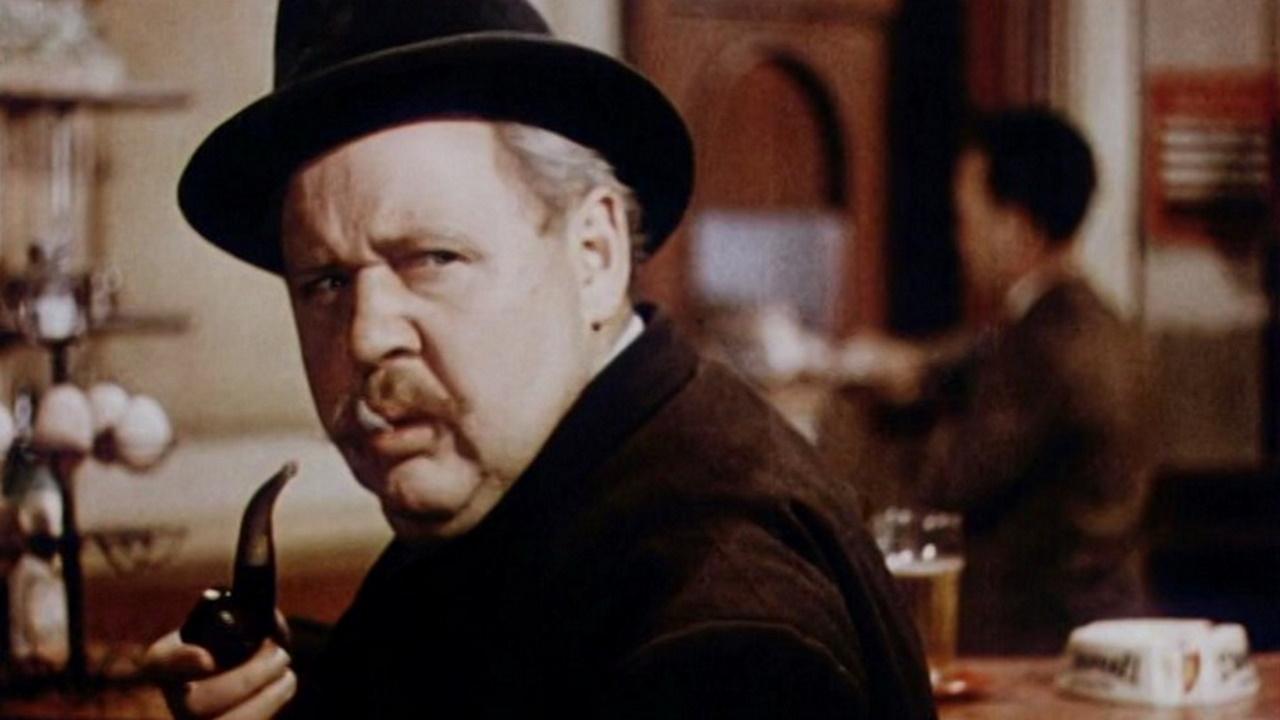
Man on the Eiffel Tower belongs to a specific strain of noir that is more interested in the criminal mind than in criminal procedure. The Parisian location gives the film a rare texture among American productions of the period – the city functions not as exotic backdrop but as moral environment, its monuments and working-class quartiers equally indifferent to the contest being played out beneath them. The climax, staged on the iron latticework of the Eiffel Tower, literalizes the film's central tension: a man of superior intelligence discovering, at altitude, the precise boundary of his control.
Classic Noir

Man on the Eiffel Tower occupies an unusual position in the noir canon – a Hollywood production filmed entirely in Paris, adapted from a Simenon novel, directed by its own co-star, and carrying the imprint of a cinematographer, Stanley Cortez, whose previous credit was The Night of the Hunter's principal competitor for expressionist honors in American studio photography. The film does not entirely reconcile its competing impulses: Burgess Meredith's direction is uneven, and the supporting cast is sometimes underpowered against Laughton's formidable Maigret. Yet what the film achieves is a portrait of detective work as moral patience rather than cerebral puzzle-solving, and of villainy as a form of self-destruction disguised as omnipotence. Franchot Tone's Radek is a rare noir antagonist – educated, self-aware, and entirely conscious of the psychological trap he is walking into. The film's postwar Parisian setting quietly registers the era's anxieties about order, justice, and the kind of violence that presents itself as philosophy.

– Classic Noir
3 ★★★☆☆ Notable
Credits

The Crew

DirectorBurgess Meredith
ScreenplayHarry Brown
CinematographyStanley Cortez
EditingLouis Sackin
ProducerIrving Allen
Performances

The Cast

Close Reading

The Signature Scene

Man on the Eiffel Tower – scene
The Tower Confrontation Radek Cornered at Height

Cortez frames the Eiffel Tower sequence in a series of vertiginous low and high angles that deny the viewer any stable orientation. The ironwork becomes an abstract geometry of shadows and receding diagonals; the Paris grid below is visible but remote, drained of specificity. Light falls in harsh, interrupted strips across Radek's face as he moves between girders, each cut emphasizing the narrowing space available to him. The camera does not aestheticize the height so much as use it to decompose the scene's spatial logic, making escape seem simultaneously possible and geometrically absurd.

What the sequence reveals is the film's central argument rendered in physical terms: Radek's entire strategy has been predicated on the assumption that superior intelligence creates freedom, that a man who understands the game better than his opponents can never be cornered. The tower strips that assumption away. The higher he climbs, the fewer options he retains, and the irony Cortez photographs – a man of considerable intellect reduced to scrambling across iron in the open air – is precisely the point Maigret has been waiting for the investigation to make.

Visual Language

The Cinematography

🎞️
Stanley Cortez – Director of Photography

Stanley Cortez, whose work on The Magnificent Ambersons had already demonstrated his capacity for light that carries psychological weight, brings to Man on the Eiffel Tower a location-based visual strategy that distinguishes the film from studio-bound noirs of the period. Shooting on actual Parisian streets, markets, and interiors, Cortez calibrates his lighting to the moral temperature of each scene rather than imposing a uniform expressionist scheme. The working-class environments associated with Heurtin are rendered in flat, grey naturalism; Radek's world carries deeper shadows and more precisely placed sources, as if the film's visual grammar understands that theatrical villainy requires theatrical light. His lens choices favor moderate focal lengths that preserve spatial relationships without flattening them, and his shadow work in the interior scenes – particularly those in which Maigret and Radek circle each other conversationally – uses architecture as a collaborator, letting doorframes and staircases do the compositional labor that, in a studio production, would have been built into the set.

In the Catalogue

Themes & Motifs

Availability

Where to Watch

Also in the Directory

See Also