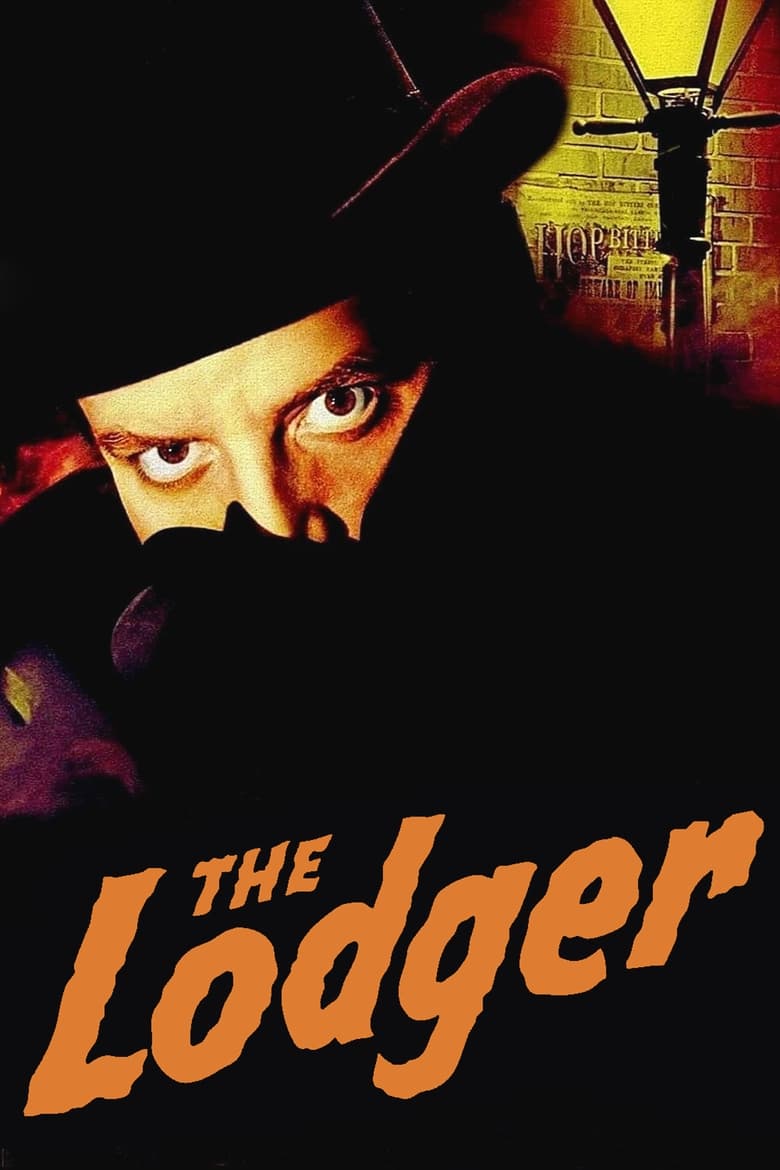
In late Victorian London, a fog-shrouded city is gripped by a series of murders targeting music-hall performers. When a reserved, darkly intense stranger calling himself Mr. Slade takes a room in the Bonting household, his landlords – the cautious Robert Bonting and his anxious wife Ellen – find themselves uneasily grateful for the income. Their niece Kitty Langley, a singer with ambitions beyond the gaslit stage, quickly becomes the object of Slade's unsettling attentions.
Scotland Yard, represented by the smoothly self-assured Inspector John Warwick, is closing in on the killer – and circumstantial evidence points with mounting pressure toward Slade. Warwick is also drawn to Kitty, setting up a quiet rivalry that complicates his professional judgment. As the killings continue and Slade's behavior grows stranger, Kitty finds herself caught between attraction and dread, unable to fully trust either the lodger or the inspector pursuing him.
John Brahm's film works the Jack the Ripper material not as sensational crime spectacle but as a study in suppressed obsession and domestic unease. The fog-bound setting and period trappings give the story a remove that allows the psychological dynamics to press harder – the threat inside the home proving more corrosive than any external danger. The film belongs to a cycle of Gothic-inflected noir that 20th Century Fox developed in the mid-1940s, films preoccupied with hidden pathology and the collapse of respectable surfaces.
The Lodger stands as one of the more psychologically precise entries in Fox's mid-1940s Gothic noir cycle, distinguished above all by Laird Cregar's performance – a portrait of repression and violence conducted entirely through physical bearing and vocal restraint. Cregar, who died the year of the film's release after drastic weight loss, gives Slade a quality of barely contained suffering that exceeds the script's requirements. John Brahm, a German émigré with a studied eye for expressionist atmosphere, keeps the film's period London convincingly airless without letting the Victorian setting become decorative. The film is not interested in the mechanics of detection so much as the sociology of suspicion – how a household rearranges itself around a dangerous secret it cannot name. George Sanders supplies his usual dry authority as Warwick, and Merle Oberon is asked to do less than her abilities allow. What persists is the film's central proposition: that the most intimate domestic space can also be the most exposed.
– Classic Noir
Lucien Ballard lights the attic sequence with a single dominant source – a lamp Slade carries or places near a collection of portraits of women, the rest of the frame pulled back into gradients of shadow. The camera stays close to Cregar's face, tracking the shift in his expression from composed to something rawer, while the portraits in the background remain just in focus enough to register their multiplicity. The composition creates a corridor effect, depth pressed into service as psychological space.
The scene is the film's thesis statement rendered visually: Slade is a man whose violence is inseparable from a damaged reverence, and the accumulation of faces behind him maps the extent of his obsession. What the moment also establishes is the film's refusal to use horror as pure spectacle – Brahm keeps the camera at a clinical distance even as the content grows more disturbing, so that the audience's discomfort is generated by implication rather than exposure.
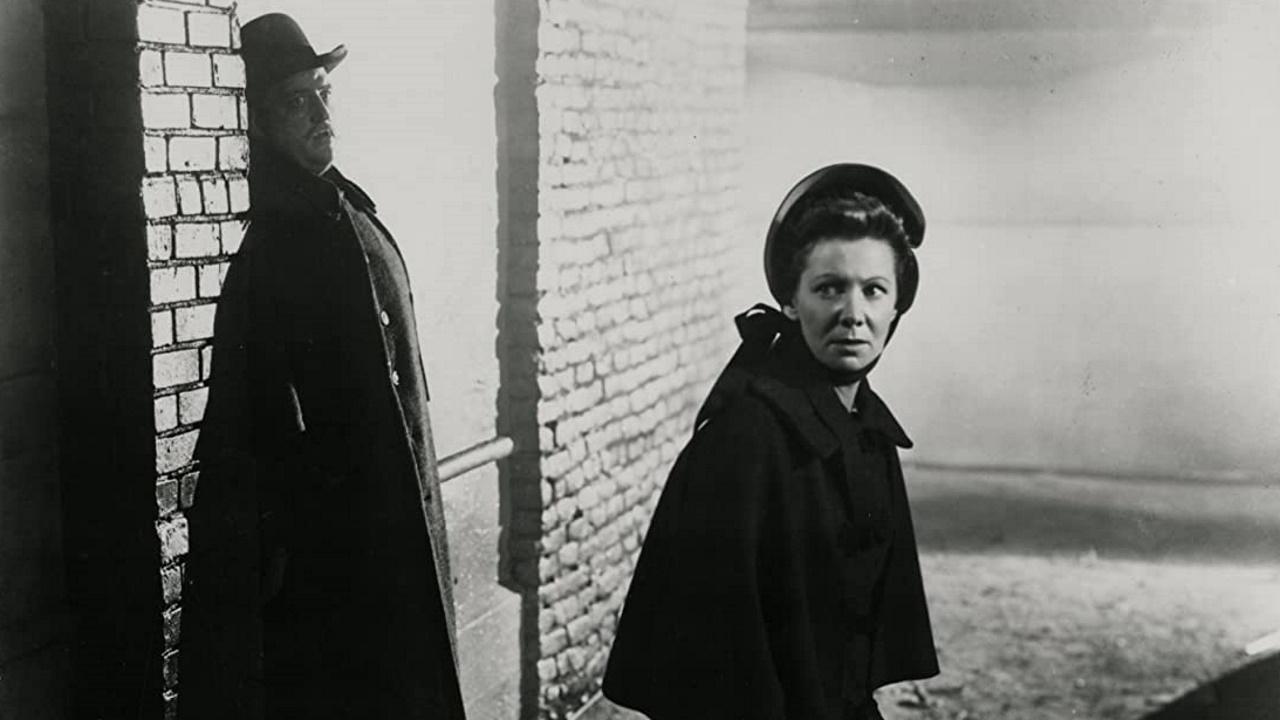
Lucien Ballard's work on The Lodger is among his most disciplined contributions to the noir period, and it rewards close attention. Working within Fox studio conditions rather than on location, Ballard constructs a London that is almost entirely a function of light and its absence – fog diffused through arc lamps, gaslight rendered as tight pools that leave faces half-erased. His lens choices favor a moderate focal length that keeps foreground figures in sharp relief against softened, receding backgrounds, reinforcing the film's sense of concealment. Shadow is used architecturally: staircases, doorframes, and window casements produce hard geometric darkness that structures the frame independently of narrative action. The effect is a visual atmosphere in which moral legibility is perpetually deferred – no character, and no space, is ever fully revealed. This approach serves the film's central concern with hidden pathology, ensuring that even domestic interiors carry a quality of surveillance and threat.
Criterion's streaming presentation of the film offers a clean transfer suited to appreciating Ballard's shadow work, and the platform's contextual programming often pairs it with related Fox noir titles.
TCMBroadcast/StreamingTCM licenses the film periodically and its presentation is typically from the best available Fox studio print; check the schedule or TCM's on-demand library via Max.
Archive.orgFreeA public domain version circulates on Archive.org; transfer quality varies and is best treated as a fallback option rather than a primary viewing source.