Films People Pull a Fast One Night Beat Reading Room On TV Shop
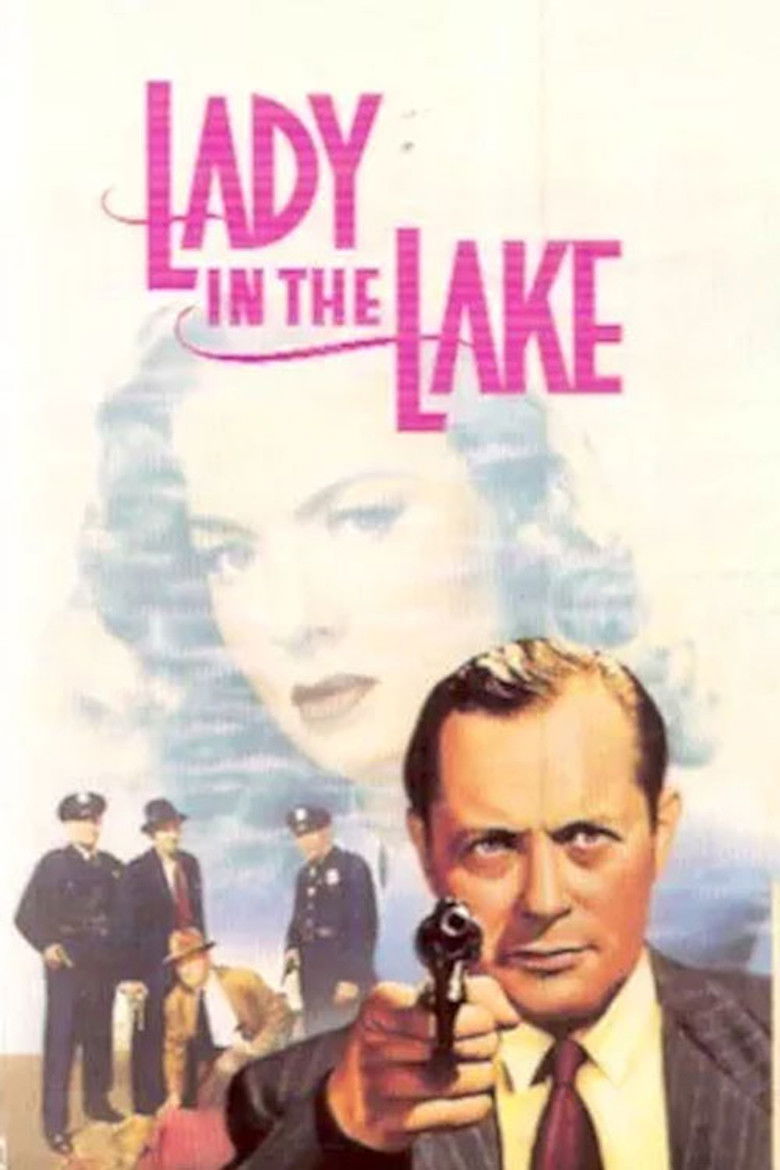
Lady in the Lake 1946
1946 Metro-Goldwyn-Mayer
★★★☆☆ Notable
Film Noir · 105 minutes · Black & White

Lady in the Lake

Directed by Robert Montgomery
Year 1946
Runtime 105 min
Studio Metro-Goldwyn-Mayer
TMDB 6.1 / 10
"A detective narrates his own case from behind the camera – and finds the view from inside no safer than the street."

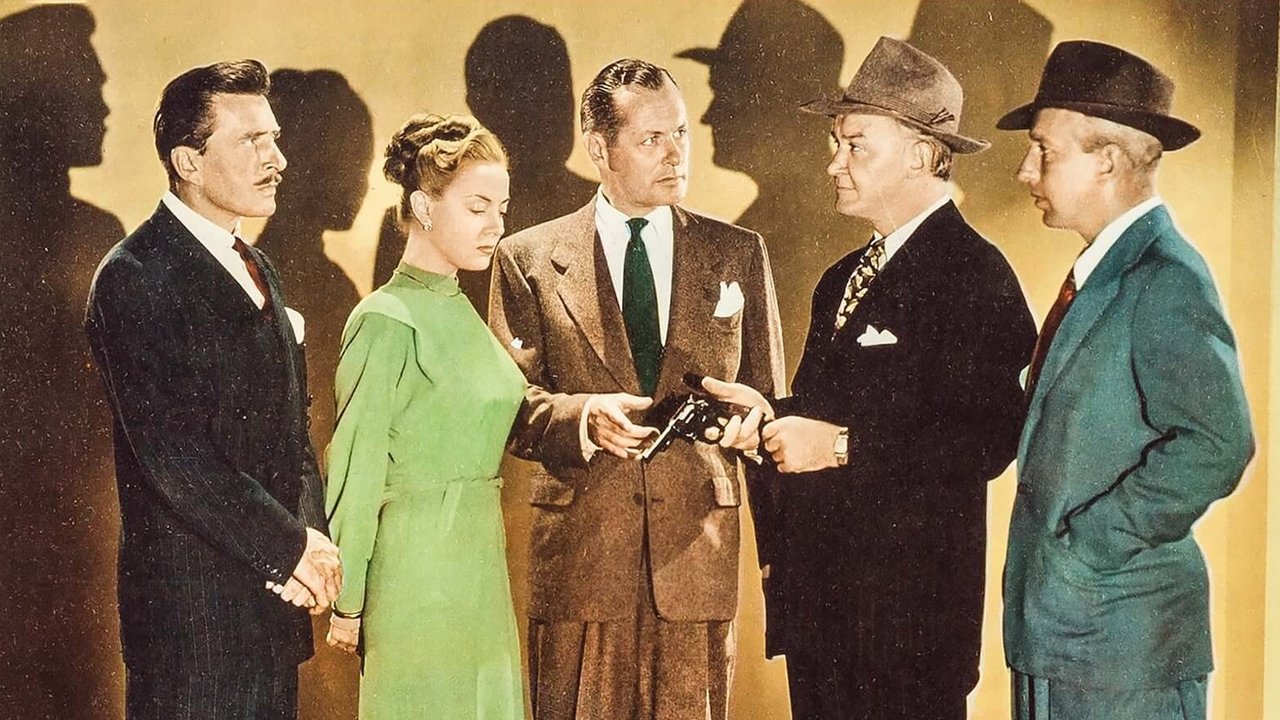
Philip Marlowe, Raymond Chandler's sardonic private investigator, takes a job from Derace Kingsby, a powerful Los Angeles publisher whose wife has gone missing – presumed to have run off with a man named Chris Lavery. Marlowe's contact inside Kingsby's firm is Adrienne Fromsett, an ambitious editor with motives of her own, who hired Marlowe partly to further her professional standing and partly, it seems, to position herself closer to Kingsby himself. What begins as a missing-persons inquiry shades quickly into something more serious when a body turns up in the lake at Kingsby's mountain property.

The investigation draws Marlowe into conflict with Lieutenant DeGarmot, a corrupt policeman who obstructs the case with a practiced ease that suggests he has something to protect, and Captain Kane, a more straightforward officer trying to hold a fraying department together. Lavery is found murdered, the identity of the woman in the lake becomes disputed, and Mildred Haveland – a nurse connected to several of the principals – emerges as a figure whose history with Kingsby's wife complicates every assumption the film has allowed the viewer to form. Allegiances shift; the timeline of events proves unreliable.

Lady in the Lake is most often discussed for its formal experiment: the film is shot almost entirely from Marlowe's optical point of view, placing the audience inside the detective's body for the duration. That choice transforms a Chandler adaptation into something closer to a phenomenological argument about observation, complicity, and the limits of the investigator's perspective – a structural question that the noir genre would continue to pose, in subtler ways, for the following decade.
Classic Noir

Lady in the Lake occupies an anomalous position in the classical noir cycle: formally audacious, commercially respectable as an MGM production, and finally more interesting as an experiment than as a thriller. Robert Montgomery's decision to shoot almost the entire film from Marlowe's first-person optical point of view was not without precedent – the device had appeared in short subjects and isolated sequences – but its sustained application here exposes both the possibilities and the severe constraints of the approach. The technique alienates the viewer from conventional identification even as it promises immersion; we cannot read Marlowe's reactions, and the camera's mechanical gaze lacks the subjectivity the conceit claims to deliver. What survives that limitation is a film deeply skeptical of institutional authority, featuring Lloyd Nolan's quietly menacing DeGarmot as one of the period's more credible portraits of police corruption. Audrey Totter's performance negotiates the femme fatale register with enough irony to give Fromsett genuine ambiguity. As a Chandler adaptation it is loose; as a document of Hollywood's postwar restlessness about form and genre, it repays close attention.

– Classic Noir
3 ★★★☆☆ Notable
Credits

The Crew

DirectorRobert Montgomery
ScreenplaySteve Fisher
CinematographyPaul Vogel
MusicDavid Snell
EditingGene Ruggiero
Art DirectionE. Preston Ames
ProducerGeorge Haight
Performances

The Cast

Close Reading

The Signature Scene

Lady in the Lake – scene
Marlowe Meets DeGarmot A Fist Enters the Frame

DeGarmot confronts Marlowe in a police anteroom, and the camera – positioned at Marlowe's eye level – holds steady as Nolan moves into close range. The lighting is flat and institutional, without the expressionist shadows that might elsewhere signal danger; the threat is made banal by fluorescent indifference. When the blow comes, the camera lurches and drops, the frame tilting and then cutting to black. Paul Vogel composes the attack not as spectacle but as interruption – the geometry of the shot collapses rather than dramatizes.

The scene makes explicit what the film's formal conceit implies throughout: the investigator is not protected by his role as observer. Placing the audience in Marlowe's position at the moment of violence removes the comfortable distance that classical Hollywood framing normally provides. The viewer does not watch Marlowe get hit; the viewer, nominally, gets hit. Whether that identification is genuinely achieved or merely asserted is the question the film leaves open – and it is a more productive question than the plot provides.

Visual Language

The Cinematography

🎞️
Paul Vogel – Director of Photography

Paul Vogel's work on Lady in the Lake is inseparable from the film's central formal problem. Shooting sustained first-person sequences required a camera rig that could approximate human movement without inducing incoherence, and Vogel's solution favors deliberate pans and slow advances over the handheld restlessness that a later generation would reach for. The lighting scheme is deliberately varied by location: Kingsby's offices carry a polished, high-key corporate gloss that reads as institutional deception, while the mountain cabin and the lake exterior use harder, raking light that isolates figures against dark surrounds. The mirror scenes – in which Montgomery briefly appears when Marlowe catches his own reflection – are lit to preserve continuity with the surrounding point-of-view footage rather than to create emphasis, a restrained choice that keeps the illusion intact. Vogel does not import the low-key chiaroscuro of the German-influenced noir cycle wholesale; the film's visual argument is less about shadow as moral atmosphere than about the frame itself as an unreliable instrument of knowledge.

In the Catalogue

Themes & Motifs

Availability

Where to Watch

Also in the Directory

See Also