Davy Gordon is a middleweight boxer at the fraying end of a mediocre career, living in a Manhattan rooming house where his only view is the window of the taxi dance hall across the alley. Through that glass he watches Gloria Price, a hostess employed by Vincent Rapallo, the club's owner – a man whose authority over her is equal parts proprietorial and obsessive. Davy and Gloria begin a tentative connection, conducted across the gap between two buildings like a conversation no one else can hear.
When Rapallo assaults Gloria after a night gone wrong, Davy intervenes, and in doing so pulls himself into a conflict with a man who treats violence as a management tool. Rapallo dispatches men to resolve the situation, and in the fog of mistaken identity Davy's manager Albert is killed in his place. Gloria and Davy, now both targets, attempt to flee the city while Rapallo's patience narrows to a point.
Kubrick structures the film as a chase narrative stripped of glamour – no heist to finance, no secret worth protecting, only two people trying to outlast a small, vicious man with local power. Its concerns sit firmly within the working-class noir tradition: the city as maze, romantic attachment as liability, and the knowledge that even modest ambitions tend to attract the wrong attention.
Killer's Kiss is the second feature Kubrick completed before his career achieved the resources his instincts demanded, and it shows both what those instincts were and how far raw formal intelligence can carry a film made for next to nothing. Shot on location in New York with a non-union crew and a cast of unknowns, it operates less as a fully developed narrative than as a demonstration reel for a director who understood visual grammar before he had the budget to deploy it at scale. The film's weaknesses are real – the voice-over is expository, the romance underwritten, the plotting thin. But Kubrick, doubling as his own cinematographer, composes frames with a rigor rarely seen in programmers of this length and cost. The mannequin warehouse fight sequence alone marks him as someone thinking about film differently from his contemporaries. Within the genre, Killer's Kiss occupies the lower tier of the canon, but it is a precise and illuminating lower tier – useful for understanding where noir's visual language could travel when capital was withdrawn and only craft remained.
– Classic Noir
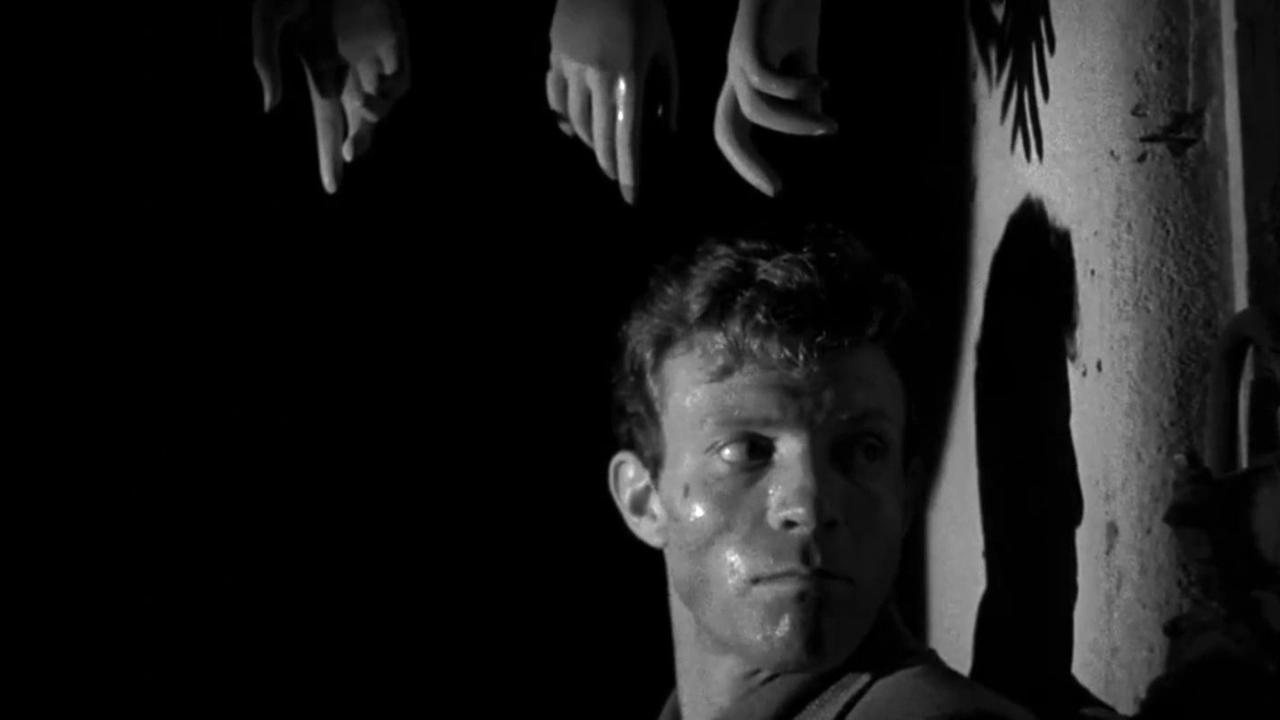
Rapallo and Davy fight their way through a storage warehouse crowded with undressed mannequins, the space lit from high angles that flatten the figures into an indeterminate crowd of limbs and torsos. Kubrick holds wide shots that make both men small against the artificial bodies, then cuts to tight angles that isolate weapons – a fire axe, a metal pole – against pale molded flesh. The lighting is harsh and unmodulated, producing deep shadows between the figures that suggest bodies already fallen. The camera moves with a controlled unease, never settling into comfortable coverage.
The setting externalizes the film's argument about power and objectification with a directness that borders on diagram. Rapallo, whose authority has always rested on treating Gloria as a possession rather than a person, now fights for his life surrounded by objects fashioned in the human form. The mannequins do not comment ironically on the action; they simply stand there, which is its own comment. The scene positions the film's violence not as excitement but as the logical end point of a world in which people are regularly mistaken for things.
Kubrick served as his own cinematographer on Killer's Kiss, and the film's visual language reflects both the constraints of independent low-budget production and a disciplined eye that neither constraint could suppress. Shooting on the streets of Manhattan with available and semi-available light, Kubrick favored fast lenses and high-contrast setups that press the city's architecture into service as moral geography – fire escapes, rooftops, and alley mouths frame the characters as people already partially enclosed. Interior sequences use single-source lighting to exaggerate shadow and isolate faces from their backgrounds, a technique less expressionist than economical, though the results occasionally approach both. The Times Square sequences carry the neon overexposure native to location night work of the period, while the rooftop chase is shot with a wide-angle closeness that compresses physical space and amplifies threat. Throughout, the lens choices favor depth and specificity over the burnished studio look of better-financed contemporaries – a roughness that suits a film whose subject is precisely the city's indifference to people with nowhere else to go.
The Criterion Channel streams a clean transfer and is the most reliable source for curated context around Kubrick's early work.
TubiFreeTubi has carried Killer's Kiss as a free ad-supported stream, though transfer quality is variable and availability should be confirmed.
Archive.orgFreeThe film has circulated in the public domain and Archive.org hosts multiple versions, though source quality differs significantly between uploads.