Films People Pull a Fast One Night Beat Reading Room On TV Shop
Killer Is Loose 1956
1956 Crown Productions
★★★☆☆ Notable
Film Noir · 73 minutes · Black & White

Killer Is Loose

Directed by Budd Boetticher
Year 1956
Runtime 73 min
Studio Crown Productions
TMDB 6.7 / 10
"A killer walks free in the suburban daylight, and the detective who put him away cannot keep his wife safe."

Los Angeles detective Sam Wagner leads a bank robbery investigation that ends in a shootout. In the confusion, Wagner kills the wife of nebbish bank clerk Leon 'Foggy' Poole – an accident, but one Poole cannot forgive. Convicted of his role in the robbery and sentenced to prison, Poole fixes his mild, expressionless gaze on a single purpose: to repay Wagner in kind. Wendell Corey plays Poole as a man emptied of everything except grievance, his blankness more disturbing than any conventional screen menace.

When Poole escapes, the police department mobilizes around Wagner and his wife Lila, played by Rhonda Fleming with a composure that slowly gives way under the weight of sustained threat. The investigation radiates outward through a network of former associates and rural contacts, each lead arriving just behind the quarry. Wagner, confident and methodical in his professional instincts, finds those instincts inadequate to a situation defined not by crime but by obsession – a man pursuing not money or power but symmetry.

Boetticher strips the procedural of most of its genre machinery, leaving a stripped frame in which institutional competence confronts something it cannot fully categorize. The film belongs to that strand of 1950s noir concerned less with corruption than with the thin margin between order and violence in ordinary American life. Poole is not a gangster or a schemer; he is a minor man made singular by loss, and it is that specificity that gives the film its chill.
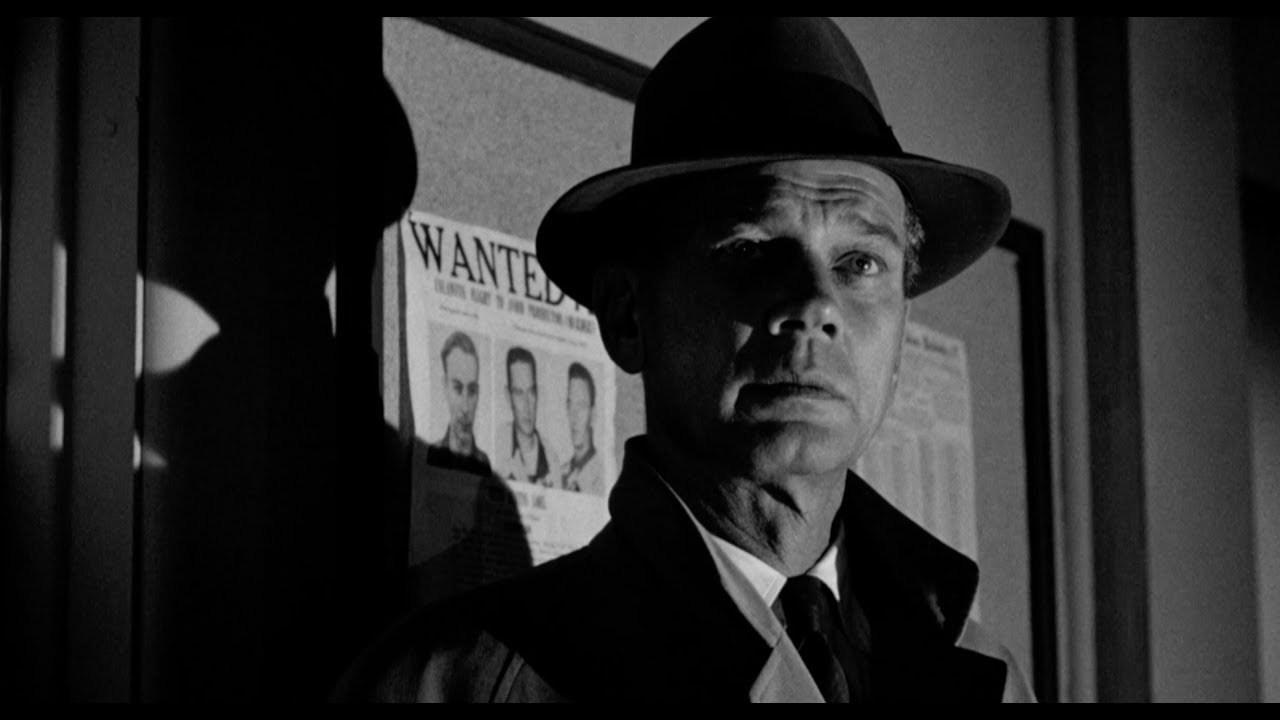
Classic Noir

Killer Is Loose occupies an interesting position in Budd Boetticher's career, arriving between his B-Western collaborations with Randolph Scott and sharing with those films a discipline of economy – no scene runs past its purpose, no character exists as mere furnishing. What the film adds to the procedural format is a psychological precision rarely attempted at the budget level Crown Productions afforded. Wendell Corey's performance is the engine: Poole is not coded as a monster but as a man whose inner life has narrowed to a single fixed point, and Corey projects this through understatement rather than theatrics. The suburban setting – tract houses, open lots, pale California light – works against any expressionist safety net, forcing the tension to emerge from situation rather than atmosphere. In this respect the film anticipates the 1960s crime pictures that would abandon darkness as a moral shorthand. Joseph Cotten's Wagner is a competent man undone by the limits of competence, a figure the decade found increasingly worth examining.

– Classic Noir
3 ★★★☆☆ Notable
Credits

The Crew

DirectorBudd Boetticher
ScreenplayJohn Hawkins
CinematographyLucien Ballard
MusicLionel Newman
EditingGeorge A. Gittens
Art DirectionA. Leslie Thomas
CostumesWilliam Sarris
ProducerRobert L. Jacks
Performances

The Cast

Close Reading

The Signature Scene

Killer Is Loose – scene
The Suburban Street, Final Sequence Pale Light, Open Ground

Lucien Ballard shoots the climactic confrontation in flat, unsparing daylight – no shadows to organize the danger, no architecture to funnel the eye. The frame is wide and relatively empty, the domestic streetscape refusing to become dramatic. Ballard holds distance, allowing the geography to register as unhelpfully ordinary: lawn, sidewalk, the blank face of a house. Poole moves through this space without the cover of night, and the camera's refusal to glamorize his approach makes it more disturbing, not less.

The scene argues the film's central case: that the logic of institutional protection – detectives, procedures, cordons – has geographic and conceptual limits. Lila Wagner is endangered not in a back alley or a warehouse but in the daylit American suburb that the postwar order promised was safe. Poole's presence there is an epistemological problem as much as a physical threat, and Boetticher frames it as such, denying the audience the compositional signals that would tell them how to feel before the outcome is decided.

Visual Language

The Cinematography

🎞️
Lucien Ballard – Director of Photography

Lucien Ballard's work on Killer Is Loose is a study in deliberate restraint, calibrated to a story whose menace has no need of expressionist flourish. Ballard – whose career spanned everything from studio glamour to Sam Peckinpah's open landscapes – uses a relatively flat, high-key approach for the suburban exteriors, draining the setting of the tonal reassurance that daylight usually provides. Interior sequences are lit with a functional sobriety that stops short of chiaroscuro, maintaining the procedural texture Boetticher requires. The lens choices keep figures in spatial relationship to their surroundings rather than isolating them for emotional emphasis, a choice that consistently implicates environment in the film's unease. Where shadow work appears, it is concentrated and purposeful – a doorway, a stairwell – never deployed atmospherically for its own sake. The overall visual logic supports the film's moral argument: that danger in postwar America does not announce itself through darkness and distorted angles but arrives in ordinary light, in legible spaces, in the face of a man who looks like no one in particular.

In the Catalogue

Themes & Motifs

Availability

Where to Watch

Also in the Directory

See Also