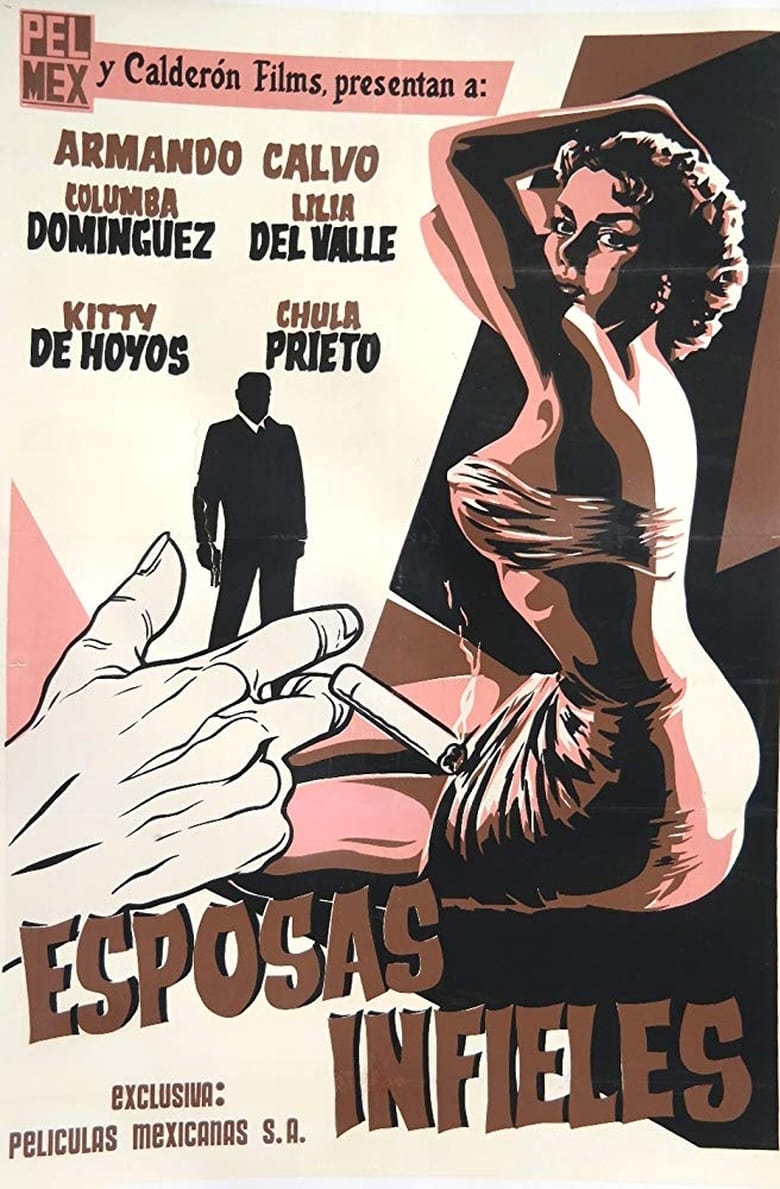
In Mexico City, a marriage held together by habit rather than feeling begins to show its cracks when one partner drifts toward an affair. The film opens on a domestic arrangement that looks stable from the outside but carries within it the particular restlessness of the postwar middle class – comfort mistaken for contentment, proximity mistaken for intimacy. The principals move through furnished rooms and city streets with the careful politeness of people who have stopped speaking honestly.
As the infidelity deepens, the web of loyalty among friends and family becomes compromised. Confidences are broken, small deceits accumulate, and the moral ground shifts beneath everyone involved. Secondary characters – a friend who knows too much, a spouse who suspects but cannot confirm – are drawn into complicity or confrontation, and the film uses these relationships to argue that betrayal is rarely a private act. It radiates outward, contaminating what surrounds it.
Infieles belongs to a strain of Mexican noir that interrogates bourgeois respectability rather than criminal underworlds, placing its corruption in the parlor rather than the back alley. The film's interest lies less in crime than in the slow erosion of character – how people justify what they do, and what remains of them afterward. Cinematográfica Calderón S.A. produced the film with the efficient economy typical of the studio, and the result is a compact moral study operating within genre conventions without being entirely contained by them.
Infieles arrives in 1956 at a moment when Mexican cinema was consolidating its own noir vocabulary – one distinct from Hollywood in its willingness to center domestic betrayal over procedural crime. José Díaz Morales, a director whose career moved steadily through genre work without attracting the critical attention afforded contemporaries like Ismael Rodríguez, brings to the film a controlled, unsentimental eye. The title is precise: unfaithfulness as the film's subject is not merely romantic but ethical, a collapse of the obligations that bind people to one another. What the film understands – and what makes it worth serious attention – is that infidelity in noir is never simply about sex; it is about the decision to live a double life, to maintain a fiction at someone else's expense. In this, Infieles participates in the genre's broader argument that modernity produces a particular kind of moral solitude. The Calderón studio context matters: these were films made for popular audiences, not art-house circuits, and their engagement with darkness carries a democratic seriousness that more celebrated productions sometimes lack.
– Classic Noir
A single practical lamp illuminates the threshold between two rooms. The camera holds at medium distance, refusing to close in, so that the figure waiting in the far chair is caught in partial shadow – face readable but not exposed. Raúl Martínez Solares composes the shot with the doorframe bisecting the image, placing the returning spouse in an architectural border between guilt and the domestic interior they are re-entering. The light does not flatter; it simply reveals.
What the scene argues is that suspicion, in this kind of story, is its own form of knowledge. The waiting figure does not need confirmation. The posture, the angle of the head, the stillness – these convey a person who has already understood what they are not yet ready to say aloud. The film uses this moment to locate its real subject: not the affair itself, but the damage done to the person left to sit alone and wait.
Raúl Martínez Solares, one of the workhorses of Mexican studio cinematography in this period, brings to Infieles a disciplined approach that favors interior location shooting with controlled artificial light over the expressionist excess that sometimes characterized Hollywood noir imports. His lighting setups tend toward single-source practicals supplemented by carefully placed fill, producing shadows that define space without stylistic aggression. The effect is a visual world that looks lived-in rather than constructed, which serves the film's moral logic precisely: this is not a world of criminal glamour but of ordinary rooms where ordinary damage occurs. Solares does not reach for the Dutch angle or the extreme low shot except when the narrative genuinely warrants disorientation. His restraint is the point. When he does allow the frame to tilt or the shadow to overwhelm a face, the departure registers because it has been earned. The cinematography reads bourgeois Mexico City as a place of suffocating normalcy – and that suffocation is where the noir pressure builds.
Public domain uploads of Mexican studio films from this era occasionally surface here; availability is inconsistent and print quality varies, but it remains the most accessible free starting point.
MUBISubscriptionMUBI's rotating catalogue has given increasing attention to mid-century Mexican cinema; check current availability, as titles cycle in and out on regional schedules.
TubiFreeTubi carries a selection of Spanish-language classic films; availability of this specific title is uncertain and should be verified directly on the platform.