Films People Pull a Fast One Night Beat Reading Room On TV Shop
I Jane Doe 1948
1948 Republic Pictures
★★★☆☆ Notable
Film Noir · 85 minutes · Black & White

I Jane Doe

Directed by John H. Auer
Year 1948
Runtime 85 min
Studio Republic Pictures
TMDB 6.4 / 10
"A woman without a name stands trial for a man who had too many."

In postwar San Francisco, a French war bride named Annette Dubois arrives in America to find the husband who abandoned her in Europe – Stephen Curtis, now a prosperous attorney married to the composed and watchful Eve Meredith Curtis. When Annette shoots Stephen dead in his office, she is arrested and booked as Jane Doe, her identity a legal cipher in a city that has no use for her grief.

The trial that follows forces every party to reckon with divided loyalties. Eve, who has every reason to condemn Annette, instead becomes entangled in a moral calculus that tests her marriage, her pride, and her sense of justice. Arnold Matson, the prosecuting attorney, pursues conviction with procedural zeal, while defense counsel William Hilton finds himself drawn to the woman he is supposed to represent dispassionately. The courtroom becomes a space where the war's displaced casualties are put on public display.

I Jane Doe uses the trial format to examine what American prosperity chooses to forget about its own wartime conduct abroad. The film belongs to a strand of late-forties noir in which institutional settings – the courtroom, the law office, the immigration process – become instruments of controlled cruelty, and where the figure of the foreign woman functions as an accusation the domestic order cannot quite silence.
Classic Noir

Republic Pictures rarely attracted the critical attention lavished on Warner Bros. or RKO noir, and I Jane Doe has remained largely outside the canonical conversation as a result. That neglect is partly deserved and partly a function of institutional prejudice. John H. Auer works within tight budgetary constraints, and the film's courtroom mechanics occasionally lapse into procedural convenience. What the film achieves, however, is a quiet indictment of postwar American self-satisfaction, rendered through the figure of Vera Ralston's Annette – a woman the narrative refuses to dismiss as either victim or villain. The screenplay holds the tension between Eve's legitimate grievance and Annette's legitimate desperation without collapsing it into sentiment. Gene Lockhart's prosecutor is particularly well-calibrated: he is not corrupt, merely certain, which is its own form of moral failure. As a document of how postwar American cinema managed the presence of European women displaced by the war it had just won, the film repays sustained attention.

– Classic Noir
3 ★★★☆☆ Notable
Credits

The Crew

DirectorJohn H. Auer
ScreenplayLawrence Kimble
CinematographyReggie Lanning
MusicHeinz Roemheld
EditingRichard L. Van Enger
Art DirectionJames W. Sullivan
CostumesAdele Palmer
ProducerJohn H. Auer
Performances

The Cast

Close Reading

The Signature Scene

I Jane Doe – scene
The Witness Stand Eve Speaks Against Herself

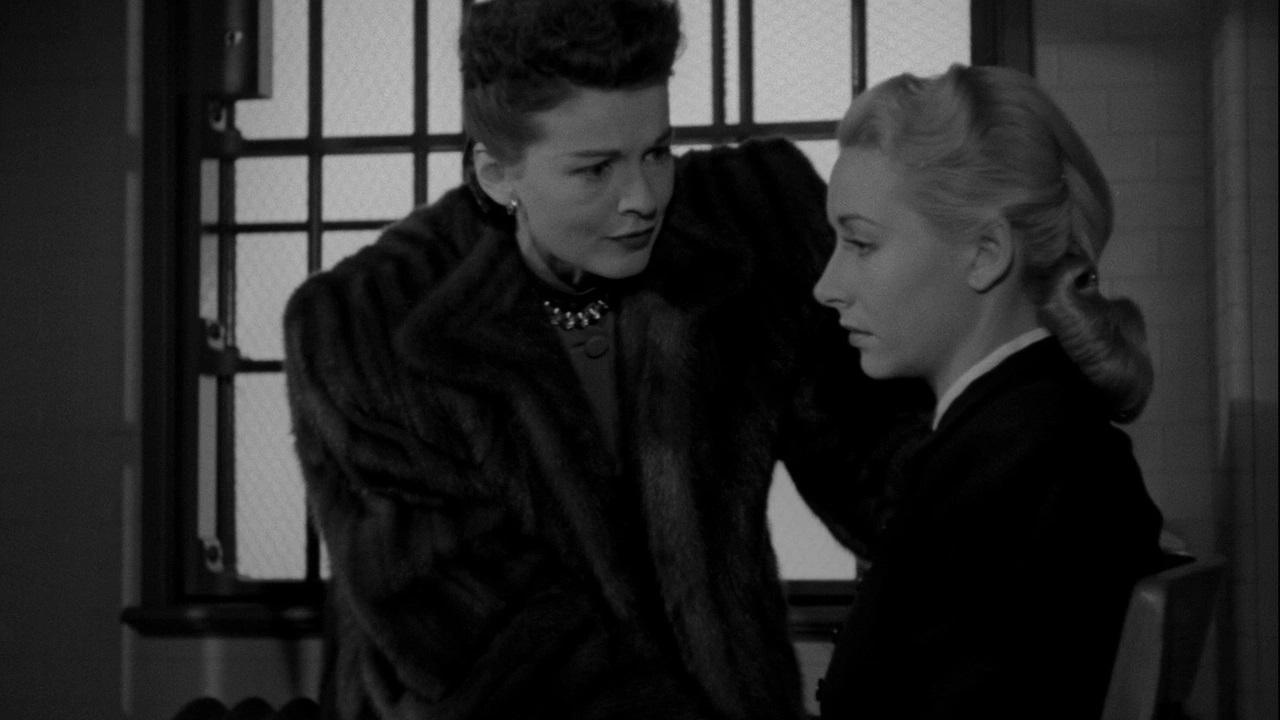
Reggie Lanning holds Ruth Hussey in a tight medium shot as Eve takes the stand, the courtroom gallery softened into a shallow grey blur behind her. The key light is placed high and slightly lateral, carving the left side of her face into shadow and leaving her expression half-legible – composed on one plane, stricken on the other. The camera does not cut to reaction shots during her testimony; it stays on Hussey, letting the frame accumulate the weight of what she is choosing to say.

The scene is the film's moral centre because Eve's testimony does not serve her self-interest, and Lanning's refusal to illustrate it with intercutting denies the audience the relief of other characters' responses. Eve is alone with what she knows, and the film insists we remain alone with her. What she reveals about Stephen indicts not only a man but a type – the returned veteran and thriving professional who has rearranged the past to fit his present comfort – and her willingness to speak it aloud is the act of conscience the film has been quietly building toward.

Visual Language

The Cinematography

🎞️
Reggie Lanning – Director of Photography

Reggie Lanning was Republic's most dependable craftsman of the mid-forties, and his work on I Jane Doe demonstrates how much low-budget studio noir could achieve through disciplined restraint rather than expressionist excess. Shooting largely on Republic's interior stages, Lanning uses practical-seeming sources – desk lamps, high courtroom windows, street-level signage glimpsed through glass – to anchor scenes in a legible social geography while still permitting the shadow work noir requires. His lens choices favour slightly longer focal lengths in dialogue scenes, which compress space and push characters into uncomfortable proximity with one another and with the frame's edges. In the trial sequences, overhead angles appear not to aestheticise but to isolate: the defendant is photographed from above as though already subject to the institutional gaze of the state. The cinematography does not impose moral commentary; it creates the conditions under which moral questions become unavoidable.

In the Catalogue

Themes & Motifs

Availability

Where to Watch

Also in the Directory

See Also