Films People Pull a Fast One Night Beat Reading Room On TV Shop
House of Numbers 1957
1957 Metro-Goldwyn-Mayer
★★★☆☆ Notable
Film Noir · 90 minutes · Black & White

House of Numbers

Directed by Russell Rouse
Year 1957
Runtime 90 min
Studio Metro-Goldwyn-Mayer
TMDB 5.5 / 10
"One man walks free – the other was never supposed to exist."

In San Quentin, Arnie Judlow is serving time for manslaughter. Outside, his twin brother Bill has been carrying on with Arnie's wife, Ruth – a arrangement that began in loneliness and has curdled into something more calculated. When Bill visits the prison and the two men are alone together, a plan takes shape: Bill will study Arnie's routines, mannerisms, and relationships closely enough to impersonate him and walk out in his place. The scheme requires the complicity of Ruth and the silent cooperation of a convict named Bradville, who has his own reasons for wanting Arnie gone.

The plan depends on precision and nerve, and it begins to fray almost immediately. The prison guard Nova watches the Judlow case with the kind of quiet attentiveness that suggests he knows more than he lets on. Inside the walls, Bradville's loyalty is transactional and therefore unreliable. Ruth, caught between a husband she married and a man she chose, finds that the geometry of her situation leaves her no clean exit. As the impersonation deepens, the brothers begin to blur in ways neither anticipated – and the question of which Judlow is more dangerous becomes genuinely difficult to answer.

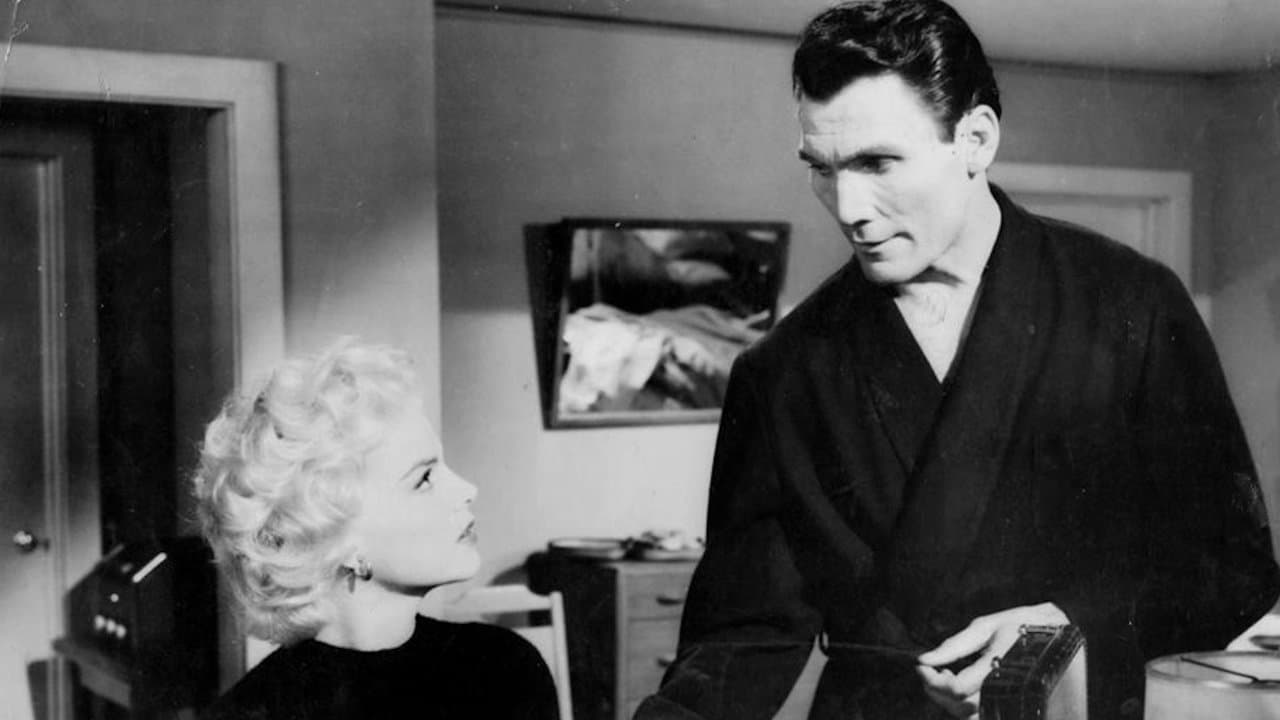
House of Numbers operates in the procedural wing of late noir, where the mechanics of crime are rendered with enough detail to expose their futility. Jack Palance's dual performance anchors a film that is less interested in suspense than in the slow revelation of moral equivalence – the idea that the man inside and the man outside may be separated by circumstance rather than character. The prison setting, used with unusual fidelity to the actual San Quentin facility, gives the film a documentary texture that sits in productive tension with its essentially fatalistic narrative.
Classic Noir

Russell Rouse was never a director who attracted sustained critical attention, and House of Numbers has largely been treated as a minor entry in the MGM crime cycle of the late 1950s. That assessment is not entirely unfair, but it misses what the film accomplishes within its constraints. The decision to shoot on location at San Quentin gives the film an institutional weight that studio-built prison pictures rarely achieve – the architecture itself becomes an argument about the permanence of punishment. Palance, working in a dual role that could easily tip into contrivance, keeps both men grounded in physical specificity; Arnie and Bill Judlow feel like two divergent outcomes of the same original temperament rather than a dramatic device. André Previn's score resists melodrama in ways unusual for the period. Where the film falls short is in its handling of Ruth, who is given motivation but not interiority, reduced finally to a plot function when the story demands resolution. Still, as a document of noir's procedural turn in the genre's final decade, the film repays attention.

– Classic Noir
3 ★★★☆☆ Notable
Credits

The Crew

DirectorRussell Rouse
ScreenplayDon Mankiewicz
CinematographyGeorge J. Folsey
MusicAndré Previn
EditingJohn McSweeney Jr.
Art DirectionEdward C. Carfagno
ProducerCharles Schnee
Performances

The Cast

Close Reading

The Signature Scene

House of Numbers – scene
The Prison Yard Exchange Two Men, One Shadow

George J. Folsey frames the scene with a flatness that reads as deliberate rather than passive – the yard's open expanse denying the shadows that noir conventionally uses to mark moral territory. The brothers stand close enough that the screen struggles to hold them as separate figures, and Folsey cuts between near-identical faces in a rhythm that begins to feel vertiginous. The light is midday institutional, undramatic and therefore merciless, flattening both men equally under the same California sun that falls on inmates and visitors alike.

The scene does the film's central argumentative work without stating it: if the visual register cannot reliably distinguish one Judlow from the other, neither can the system that has separated them. The prison's authority rests on the assumption that identity is stable and legible, and Folsey's camera quietly demonstrates that it is neither. What is being planned is not merely an escape but an interrogation of how guilt is assigned and to whom – and the film's willingness to leave that question unresolved is its most honest gesture.

Visual Language

The Cinematography

🎞️
George J. Folsey – Director of Photography

George J. Folsey, a cinematographer with roots in the MGM studio system stretching back to the silent era, brings a precise and somewhat austere visual intelligence to House of Numbers that works against the film's genre expectations. Rather than leaning on the expressionist shadow grammar that characterized classic noir cinematography, Folsey shoots the San Quentin locations with a near-documentary neutrality – wide lenses that keep architectural context visible, lighting that rarely dramatizes what it could simply observe. This restraint is a formal argument: the prison does not need shadows to be threatening. Interior scenes are handled with more conventional contrast, particularly in sequences involving Ruth, where the domestic space is rendered in the half-lit registers familiar from the noir tradition. The effect of moving between these two visual registers – institutional clarity outside, domestic chiaroscuro inside – reinforces the film's implication that danger is not confined to the side of the wall one might expect.

In the Catalogue

Themes & Motifs

Availability

Where to Watch

Also in the Directory

See Also