Films People Pull a Fast One Night Beat Reading Room On TV Shop
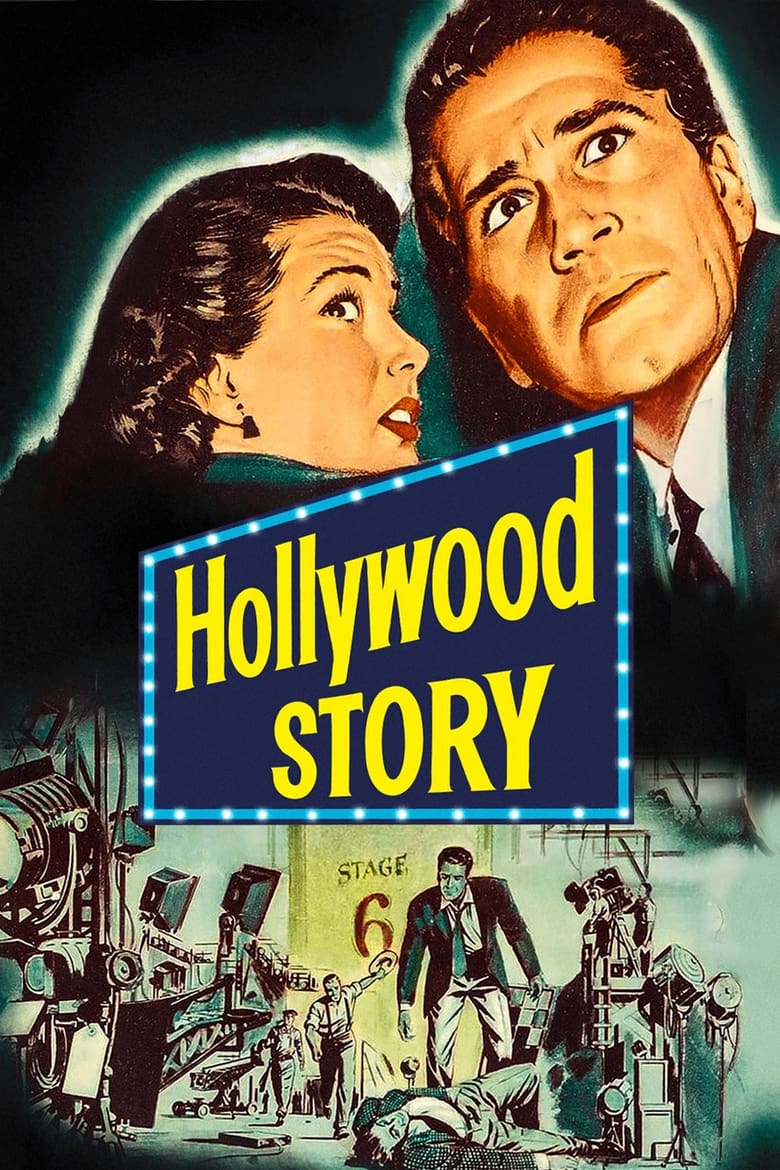
Hollywood Story 1951
1951 Universal International Pictures
★★★☆☆ Notable
Film Noir · 76 minutes · Black & White

Hollywood Story

Directed by William Castle
Year 1951
Runtime 76 min
Studio Universal International Pictures
TMDB 6.7 / 10
"A dead director's secret draws a young producer into the long shadow of an unsolved murder."

Larry O'Brien, a ambitious young producer newly arrived in Hollywood, acquires a derelict studio lot with plans to revive it. Almost immediately he becomes obsessed with a cold case: the unsolved 1929 murder of a silent-film director whose body was found on that very property. The victim's identity and the circumstances of his death have never been resolved, and O'Brien – part instinct, part stubbornness – begins pulling at threads the police long since set aside.

O'Brien's investigation draws him into the orbit of Sally Rousseau, whose connection to the original crime runs deeper than she first lets on, and the weathered Philip Ferrara, a figure from the old studio era who carries his own obscured relationship to the past. Police Lt. Bud Lennox, simultaneously a skeptic and a reluctant ally, tracks O'Brien's amateur sleuthing with mounting unease. The film weaves actual silent-era Hollywood figures into the margins of its fiction, lending the investigation an eerie documentary texture.

Hollywood Story uses the machinery of the cold-case procedural to interrogate the mythology of early Hollywood itself – the glamour that conceals violent commerce, the careers built on buried truths. The mystery at its center is less a puzzle than a moral excavation, and the studio-lot setting renders the past not merely present but inescapable, lurking beneath every familiar landmark.
Classic Noir

Hollywood Story occupies an understated but genuinely curious position within the Universal International noir cycle. William Castle, better remembered for later carnival-barker showmanship, demonstrates here a steadier hand than his reputation suggests, using the backstudio film format – a well-worn Hollywood subgenre by 1951 – to smuggle in something more unsettling: a meditation on institutional forgetting and the way the film industry buries its own crimes. The cameos from silent-era figures such as Francis X. Bushman and Betty Blythe are not mere nostalgia; they function as a kind of testimony, anchoring the fictional murder in a historically legible world of real exploitation and discarded careers. Richard Conte brings characteristic coiled restraint to O'Brien, preventing the role from collapsing into mere enthusiasm. The film is not without its procedural conventions, and its resolution is tidier than the questions it raises deserve, but as a document of postwar Hollywood's ambivalence toward its own origins, it rewards serious attention.

– Classic Noir
3 ★★★☆☆ Notable
Credits

The Crew

DirectorWilliam Castle
ScreenplayFrederick Kohner
CinematographyCarl E. Guthrie
MusicFrank Skinner
EditingVirgil W. Vogel
Art DirectionRichard H. Riedel
CostumesRosemary Odell
ProducerLeonard Goldstein
Performances

The Cast

Close Reading

The Signature Scene

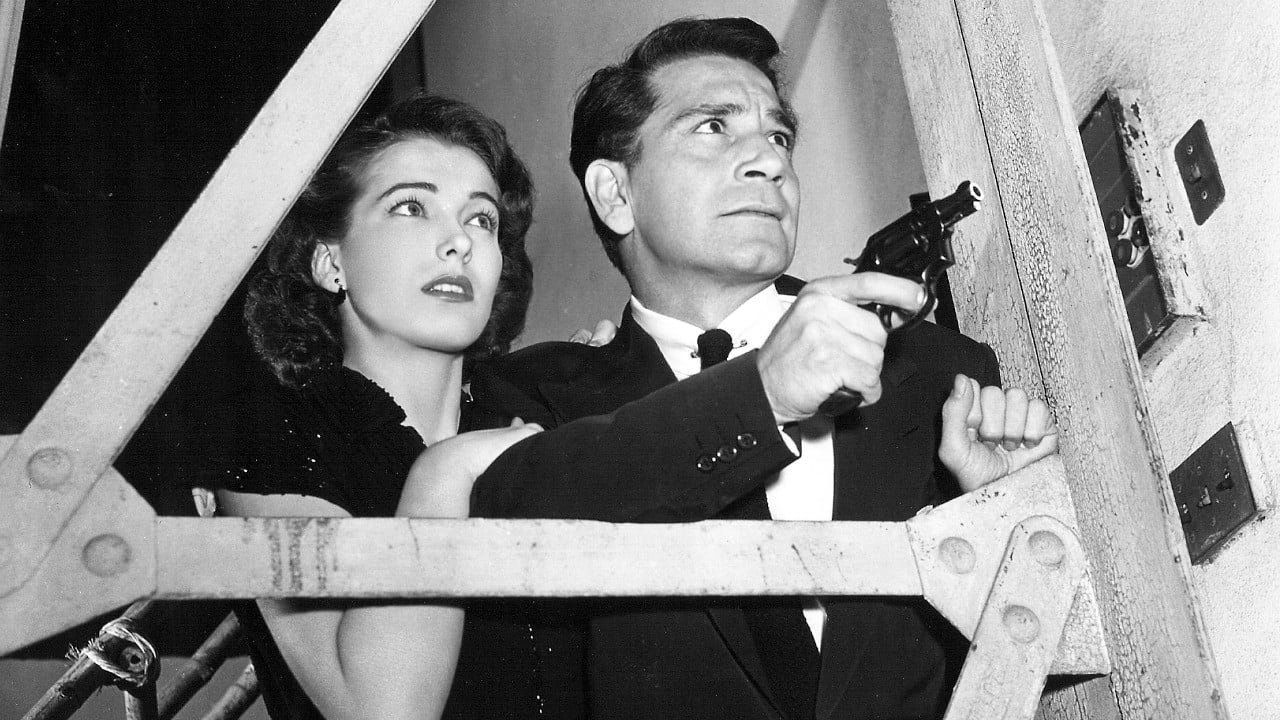
Hollywood Story – scene
The Silent Lot at Night Shadows Among Dead Sets

Carl E. Guthrie positions the camera at a low angle as O'Brien moves through the abandoned studio backlot after dark. The standing sets – facades without interiors, staircases leading nowhere – are lit with a single hard source raking across the surfaces at an oblique angle, producing shadows that stretch and distort against false storefronts. Guthrie holds the shot wide long enough that the human figure is dwarfed by the architecture of illusion around him, then cuts to a closer angle in which the light catches only O'Brien's face and the edge of a doorframe, the rest of the frame surrendering to black.

The sequence makes the film's central argument in visual terms: O'Brien is not simply investigating a murder but moving through the material residue of fabrication itself. The sets around him are constructions designed to produce the appearance of reality, and the crime he pursues is similarly layered – a truth hidden beneath surfaces built to deceive. The emptiness of the lot registers as the specific vacancy left when the machinery of illusion has been switched off and the human costs of running it remain unaddressed.

Visual Language

The Cinematography

🎞️
Carl E. Guthrie – Director of Photography

Carl E. Guthrie's cinematography on Hollywood Story is calibrated to exploit the ambiguity built into the subject matter. Working within Universal's house style of the period – efficient, low-budget, technically clean – Guthrie consistently finds ways to let the studio infrastructure itself become a visual argument. He uses the backlot locations not as convenient dressed exteriors but as geometric fields of light and shadow, emphasizing the false-front architecture through oblique lighting that reveals construction seams and hollow interiors. Interior scenes rely on tight pools of practical-source light, with key illumination placed to preserve deliberate shadow zones on faces, withholding the full countenances of characters whose loyalties remain unresolved. Guthrie avoids the expressionist extremes that a more theatrical noir sensibility might reach for; his is a quieter, more procedural darkness, which suits a film about investigation rather than passion. The camera placement is often slightly below eye-line, lending even ordinary dialogue exchanges a low-grade unease.

In the Catalogue

Themes & Motifs

Availability

Where to Watch

Also in the Directory

See Also