Jim Henry, a Korean War veteran passing through Las Vegas, wakes to find himself the prime suspect in the strangling death of a showgirl he had spent the previous evening with. With the police closing in and the evidence stacked against him, Henry flees into the Mojave Desert, hitching a ride with Mrs. Cummings, a wealthy and quietly imperious widow, and Susan Willis, a young woman of uncertain motive traveling in her company. The three are bound together by circumstance across sun-bleached highways, watched from a distance by Detective Lieutenant Joe White Eagle, a methodical investigator who does not share the law's simple certainty about Henry's guilt.
As the journey continues through gas stops, roadside diners, and the flat, indifferent landscape of the Southwest, the dynamics among the three travelers grow unstable. Mrs. Cummings carries herself with the composure of someone accustomed to controlling situations, and her relationship to Susan – and to the truth of the murdered woman – proves more complicated than it first appears. Henry, caught between suspicion and attraction, cannot easily read who is protecting him and who is quietly working against him. White Eagle's pursuit tightens, and the film turns on the question of whether any of these people are who they claim to be.
Highway Dragnet belongs to the cycle of wrong-man procedurals that ran through American B-noir in the early 1950s, films that used the open road less as freedom than as prolonged exposure – no walls to hide behind, no darkness deep enough. The desert setting strips away the urban architecture that so often shelters guilt in the genre, forcing character and deception into unforgiving light.
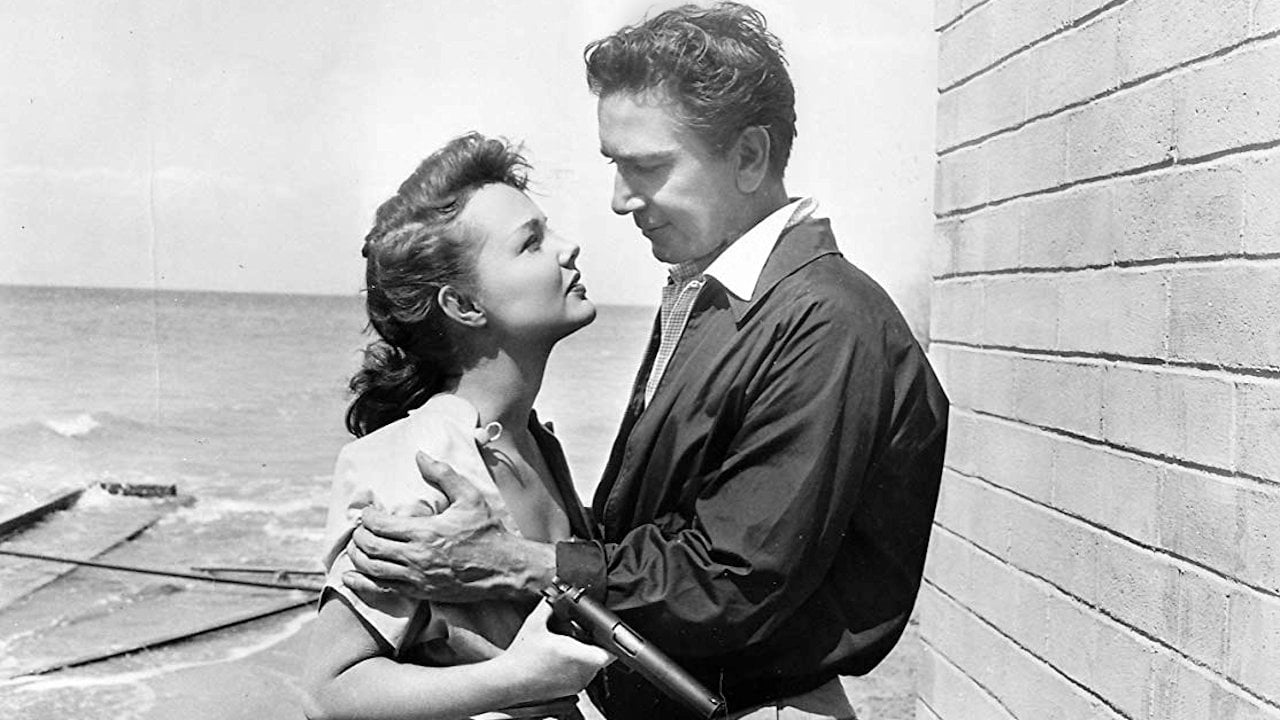
Highway Dragnet is a lean, functional piece of B-noir that rewards attention precisely because it operates without pretension. Nathan Juran, a director whose career crossed genre territory with efficient consistency, keeps the film moving at a pace that masks the modesty of its budget. Richard Conte brings the weight he always carried in these roles – the working-class man hemmed in by systems designed to process rather than discern – and Joan Bennett, already established through her Lang collaborations, lends Mrs. Cummings a controlled ambiguity that the script alone would not sustain. What the film captures, almost incidentally, is the specific anxiety of postwar masculine identity: the veteran who fought abroad and returned to a country that has already drawn its conclusions about him. The desert locations give the film a visual austerity that distinguishes it from studio-bound programmers of the period, and the procedural thread anchored by Reed Hadley's White Eagle adds a structural credibility that keeps the fugitive premise honest. It does not transcend its category, but it fulfills it with economy and occasional precision.
– Classic Noir
The camera holds a wide, flat composition: a car pulled to the shoulder of a desert highway, the road running hard to the horizon, the sky offering no shadow. John J. Martin does not reach for dramatic angles here. The frame is almost documentary in its stillness, the figures small against the expanse, the light direct and without mercy. When the shot cuts to interior, the harsh exterior light pushes through glass and falls across faces without the softening of conventional key lighting – there are no venetian-blind shadows, no expressionist diagonals. The light simply is, and there is nowhere to position yourself within it.
The scene makes the film's central argument visible: the wrong-man narrative typically uses darkness as its grammar, hiding guilt and innocence in shadow until the final revelation. Here, the open desert refuses that grammar. Henry is exposed not because anyone has found him out, but because the landscape has removed the very conditions under which concealment is possible. The scene suggests that the threat is not pursuit but transparency – and that transparency is its own kind of trap.
John J. Martin's cinematography on Highway Dragnet takes deliberate advantage of its location shooting in ways that low-budget productions of the period rarely managed to leverage as argument rather than economy. Martin shoots the Mojave with a flat, wide lens that resists pictorialism – the desert is not romanticized but rendered as condition, a space where the conventions of noir lighting (the controlled shadow, the engineered pool of darkness) simply cannot function. Interior scenes, filmed on modest studio sets, use a harder, more institutional light that echoes the documentary procedural strand of the film rather than its fugitive drama. The effect is tonal consistency between the two modes: whether outdoors or in a roadside diner, the world of this film is one where shadow offers no protection. Martin's work is not showy, but it is disciplined in service of a moral logic – the innocent man in noir usually hides; here, there is nowhere to hide, and that absence structures every frame.
Tubi has carried a number of William F. Broidy B-noir productions in its public-domain and licensed catalog; check current availability as titles rotate.
Archive.orgFreeHighway Dragnet has circulated in the public-domain archive and may be available here in a watchable if variable-quality print.
Amazon Prime VideoSubscriptionPeriodically available through Prime's rotating catalog of classic B-noir titles; verify current availability before seeking.