Don Rainsford, a big-game hunter grown weary of the kill, survives a shipwreck only to wash ashore on a remote island controlled by the cool, cultivated Erich Kreiger. The island's isolation is total, its hospitality a performance. Rainsford soon discovers that fellow survivor Ellen Trowbridge and her brother Robert have also found their way to Kreiger's compound, and that not all of them are expected to leave.
Kreiger's obsession quickly surfaces: he hunts human prey across his island, treating the exercise as a philosophical argument about predator and prey, civilization and savagery. Rainsford, who has built his identity around dominance over nature, is forced to reckon with what that identity looks like from the other side of the rifle. Ellen becomes both motivation and complication, a person whose survival depends on choices Rainsford has not yet proven himself capable of making.
Robert Wise's adaptation of Richard Connell's oft-filmed story strips the premise to its structural bones, foregrounding the noir genre's central preoccupation with men trapped by circumstance and their own prior selves. The island setting displaces the usual urban environment but preserves the essential claustrophobia, and the hunter-turned-hunted dynamic carries the moral weight that noir, at its most serious, insists upon.
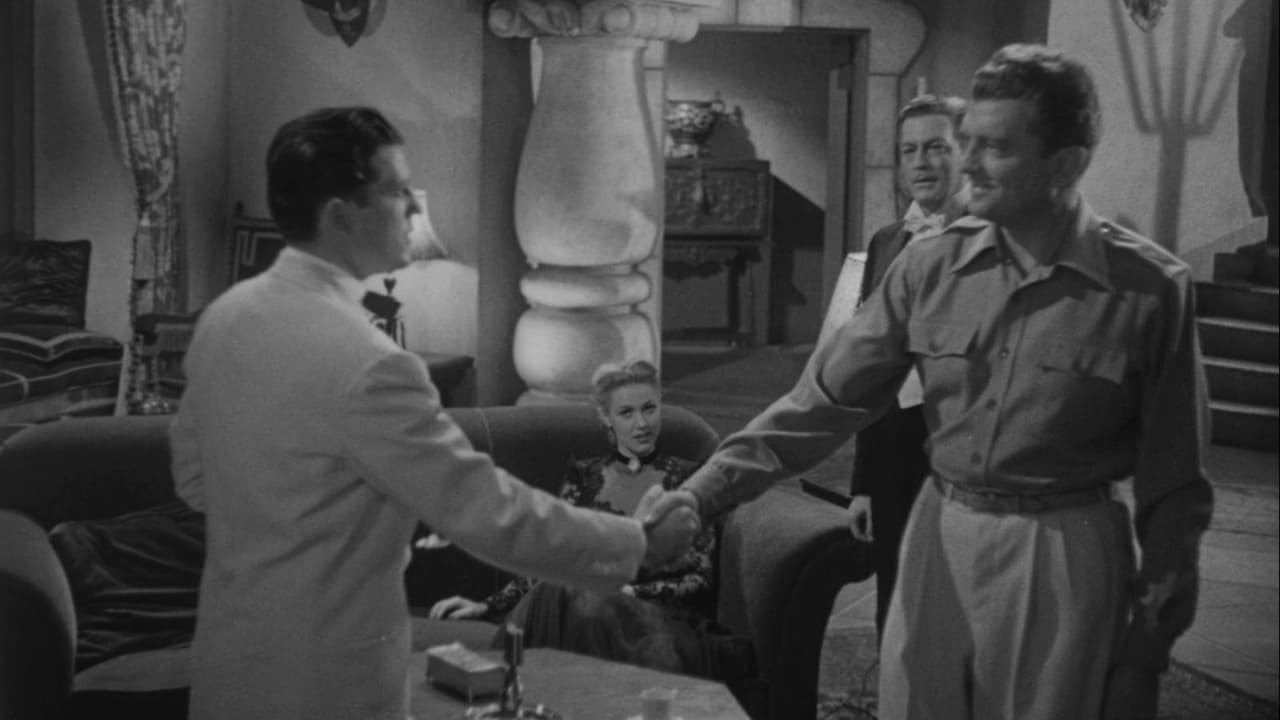
Game of Death is the third screen adaptation of Richard Connell's 1924 short story, following the 1932 RKO production that gave the source its most celebrated rendering. Wise, here working in his early directorial period and still close to the Val Lewton unit's economy of means, does not attempt to surpass that earlier version. Instead he narrows the focus, draining the Gothic extravagance and leaving a more functional, procedural thriller. What remains is instructive: a film that locates its noir credentials less in urban decay than in the logic of the hunt itself, in the idea that competence and violence are neighbors who share a wall. John Loder's restraint as Rainsford works in the film's favor – he carries the character's discomfort without telegraphing it. Edgar Barrier's Kreiger is controlled and articulate rather than baroque, which makes the villainy more coherent if less memorable. At 72 minutes, the film achieves compression without sacrifice, and J. Roy Hunt's lighting ensures that even the island exteriors retain the moral shadow that the story demands.
– Classic Noir
Hunt's camera tracks low through dense studio-constructed foliage, the frame compressed by overhanging branches that reduce the sky to narrow strips of negative space. Light sources are kept ambiguous – neither moonlight nor torchlight fully commits – so that Rainsford's figure moves in and out of legibility, a silhouette that the frame periodically refuses to resolve into a recognizable man. Shadow falls not in clean lines but in layered gradations, the forest rendered as a system of obscuring planes rather than a location.
What the sequence makes visible is the story's central reversal turned into form: the hunter cannot be seen clearly because he has become something other than himself, an object in someone else's taxonomy. Rainsford's loss of visual definition mirrors his loss of moral certainty. The camera's low angle places him below the treeline's horizon, subservient to the environment he believed himself to command, and that compositional subordination does the work that dialogue had been doing up to this point.
J. Roy Hunt, whose RKO career encompassed decades of genre work, brings to Game of Death the studio's house efficiency with low-key lighting, deploying it here in a context that inverts the usual noir geography. Without city streets or rain-slicked pavement, Hunt relies on the constructed island sets to generate shadow architecture, using tree-line silhouettes and strategic fill-light elimination to create a visual grammar of enclosure and threat. His lens choices favor moderate focal lengths that keep backgrounds in enough definition to register as oppressive rather than abstract – the viewer is always aware that there is more island, more darkness, more space in which to be lost. Interior scenes in Kreiger's house are lit with the controlled formality of a drawing room that has been subtly poisoned: warm sources are present but fail to warm, a lighting setup that supports the film's argument that civilization and barbarism are not opposites. The cinematography serves, finally, as moral commentary delivered through contrast ratios.
The film is in the public domain and available for free streaming and download in multiple resolutions; print quality varies, but several watchable transfers are accessible without registration.
TubiFreeTubi periodically carries public domain RKO titles from this period; availability shifts, so confirm before visiting.
Amazon Prime VideoSubscriptionAvailable through rotating public domain collections on Prime; the transfer on offer is generally comparable to other streaming versions of the title.