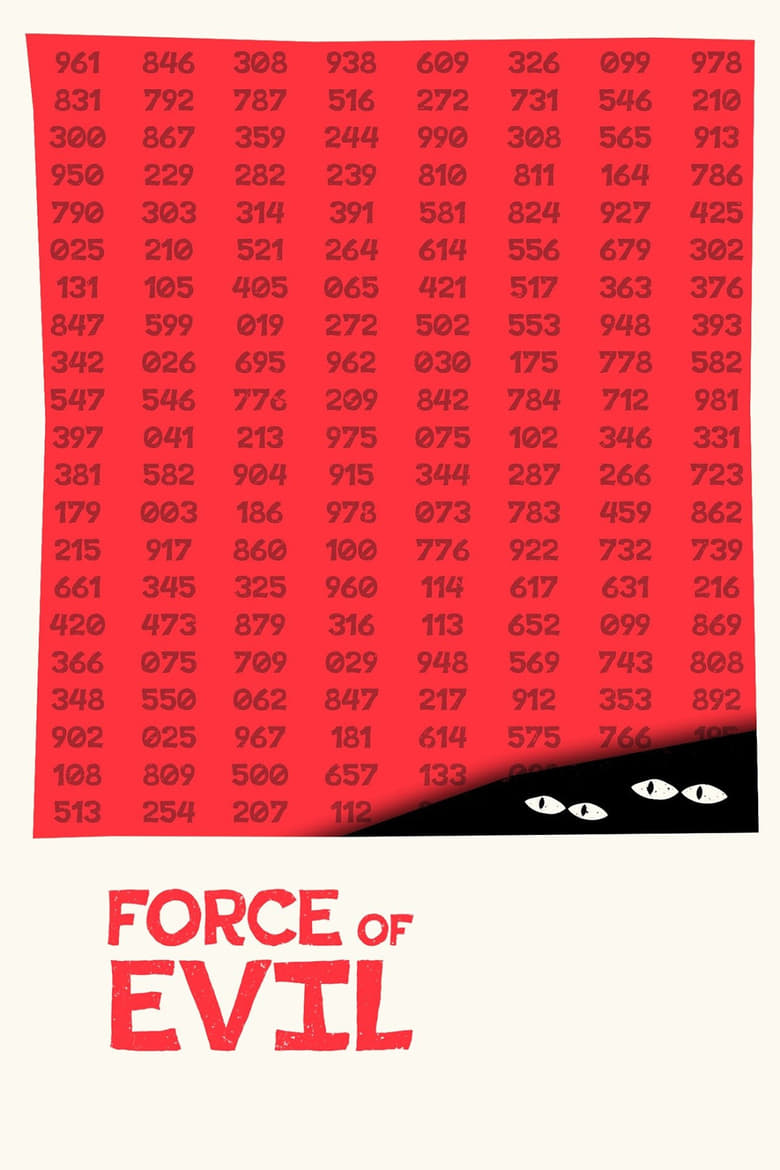
Joe Morse (John Garfield) is a sharp, self-possessed attorney working for numbers racketeer Ben Tucker (Roy Roberts), whose plan to corner New York's policy trade on July 4th – by rigging 776 as the winning number – requires absorbing every small operation in the city. Joe's older brother Leo (Thomas Gomez) runs one such small bank, a modest numbers parlor he regards as legitimate neighborhood commerce. Joe moves between Tucker's polished offices and the cramped world his brother inhabits, telling himself that legal cunning makes him different from the men he serves.
Leo refuses to be absorbed, and Joe finds himself unable to simply override a brother who raised him. Tucker's enforcer Bill Ficco (Paul Fix) applies pressure that Joe cannot fully control, and Edna Tucker (Marie Windsor), the racketeer's calculating wife, watches the Morse brothers with an interest that is neither innocent nor uncomplicated. Meanwhile Leo's bookkeeper Freddie Bauer (Howland Chamberlain), a frightened, consumptive man, becomes a liability when corrupt Detective Egan (Barry Kelley) begins circling the operation. Joe's attempts to manage every variable – protecting Leo, satisfying Tucker, maintaining deniability – produce not stability but acceleration toward disaster.
Force of Evil places its protagonist in a tradition of noir figures who mistake intelligence for immunity. Unlike the femme-fatale-driven stories that dominate the genre, the film locates its moral corrosion in institutional criminality – the numbers racket as a model of capitalist consolidation – making Joe's fall less a matter of passion than of complicity sustained too long. The film holds its ending in reserve long enough for Joe to understand exactly what his choices have cost.
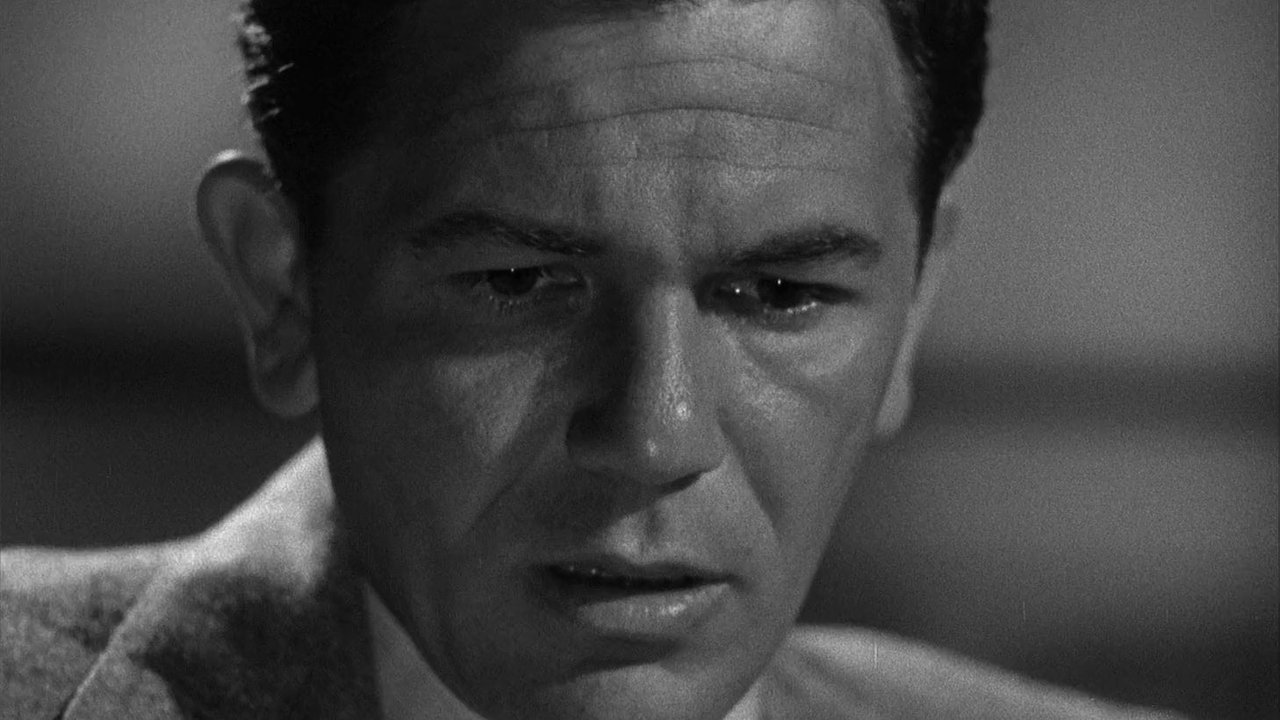
Force of Evil is among the most politically concentrated films noir produced in Hollywood. Abraham Polonsky, who would be blacklisted within two years of its release, structured the screenplay – adapted from Ira Wolfert's novel Tucker's People – around the proposition that organized crime and legitimate business share not merely methods but a common logic of accumulation. The film's use of blank verse rhythms in its dialogue is not ornament; it creates a formal distance that makes the moral argument legible without becoming didactic. John Garfield brings to Joe Morse a coiled, watchful quality that resists easy sympathy while never losing the audience entirely. Thomas Gomez's Leo is the film's ethical center, stubborn and doomed in equal measure. Made at the threshold of the blacklist era, Force of Evil carries the specific weight of a film that knows its moment is closing. It remains one of the most rigorously argued works the genre produced.
– Classic Noir
Polonsky and cinematographer George Barnes stage the film's final sequence on the actual rocks beneath the George Washington Bridge, shooting on location in flat early-morning light that strips the image of any expressionist comfort. The camera descends with Joe – physically, down stone steps and broken terrain – holding him in medium shot as the frame fills progressively with raw rock and grey water. There is no dramatic underlighting here, no chiaroscuro; Barnes uses the location's own bleached naturalism to produce an image that feels documentary and inexorable at once.
The descent literalizes what the film has argued in dialogue and architecture for seventy minutes: that Joe's trajectory was never upward mobility but a long fall dressed as ascent. Finding Leo's body at the river's edge, Joe registers not surprise but recognition. The scene does not permit catharsis. It closes the film's case – that every calculation Joe made was in service of a system that would eventually consume him and everyone he failed to protect.
George Barnes brings to Force of Evil a visual strategy that diverges from the studio-bound chiaroscuro dominant in American noir of the period. Shooting extensively on location in New York – Wall Street, the garment district, upper Manhattan – Barnes uses the city's existing architectural geometry to produce frames in which characters are consistently hemmed, dwarfed, or bisected by structural verticals. Interior scenes favor high-contrast sources that cast long shadows without the exaggerated theatricality of, say, German Expressionist influence; the lighting feels corporate and fluorescent in Tucker's offices, close and suffocating in Leo's back-room bank. Barnes resists glamorizing the city or its criminals. The choice to shoot the climactic riverbank sequence in available morning light is decisive: it refuses the film any visual escape from its own argument. The result is a noir that earns its darkness not through stylization but through the camera's willingness to look at ordinary spaces and find in them something morally airless.
The Criterion Channel streams a clean transfer and is the most reliable source for contextual material on Polonsky and the blacklist era.
MUBISubscriptionMUBI has carried Force of Evil in rotating windows; availability varies by region but the presentation is consistently high quality.
Archive.orgFreeA public domain print is available on Archive.org; transfer quality is inconsistent but the film is freely accessible without a subscription.