New York, the early twentieth century. Dr. Huntington Bailey, a psychiatrist of reasonable reputation and mild curiosity, meets a dying woman on a train who speaks of her brother Nick Bederaux with barely concealed dread. When she dies before saying more, Bailey finds himself drawn into the Bederaux household – a sealed, airless world presided over by Nick, a wealthy collector of obsessions, and his wife Allida, whose beauty is matched only by her apparent captivity. Nick receives Bailey with the calculated warmth of a man who has rehearsed hospitality until it no longer resembles the real thing.
As Bailey circles closer to Allida, the film complicates what might have been a simple rescue narrative. Nick is not merely a jealous husband; he is a systematic one, having constructed an entire domestic architecture designed to isolate and diminish. The presence of Nick's son Clag, an old associate named Claghorn, and the watchful maid Maggie each adds another layer of constraint. Bailey's professional detachment begins to erode, and with it his ability to read the situation clearly. Allida herself remains difficult to fully apprehend – a woman who has learned to guard her interior life as a condition of survival.
Experiment Perilous belongs to that wartime cycle of gothic domestic suspense that noir absorbed and rearranged, drawing equally on the gaslight tradition and the more clinical anxieties of mid-century psychology. What separates it from simple melodrama is Tourneur's refusal to let the menace become explicit too quickly. The film's danger is atmospheric rather than kinetic, rooted in what is withheld rather than what is shown – a formal choice that places it in the same register as the director's Val Lewton productions while anchoring it in a recognisably noir moral universe.
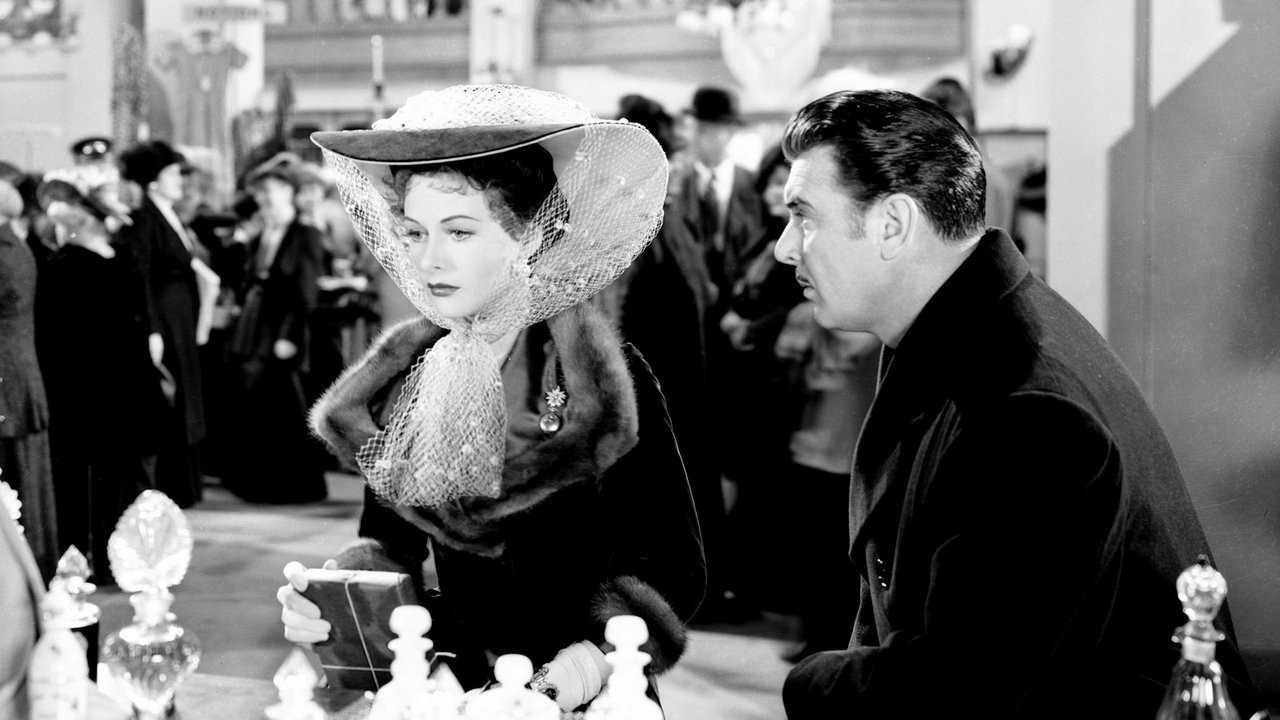
Jacques Tourneur made Experiment Perilous the same year he completed the Val Lewton cycle, and the inheritance is audible in every reticent shadow. The film is often filed under gothic melodrama rather than noir, but the distinction is less useful than it seems. What Tourneur constructs is a study in institutional control – the marriage as closed system, the home as instrument of psychological coercion – that speaks directly to the wartime moment without naming it. Paul Lukas, whose Oscar-winning benevolence in Watch on the Rhine RKO was presumably banking against, inverts that goodwill completely: his Nick Bederaux is charming in the manner of something that has learned charm as a strategy. Hedy Lamarr, rarely given material that acknowledged her intelligence, finds in Allida a woman who has compressed herself to fit a space not designed for her. The film's limitation is George Brent, whose placid decency gives Bailey insufficient interiority to anchor the psychological weight Tourneur places on him. Even so, Experiment Perilous is a more rigorous piece of work than its reputation suggests.
– Classic Noir
Tourneur and cinematographer Tony Gaudio frame Allida beneath a painted portrait of herself – a version of her rendered in Nick's preferred image, frozen and sanctioned. The camera holds at a slight distance, refusing to close in for easy sympathy, so that the living woman and the painted one occupy the same visual plane without resolving into each other. Gaudio lights Lamarr from slightly above and to one side, leaving one half of her face in controlled shadow – not the theatrical darkness of a villain's scene but the subtler dimming of someone present only in partial form. The drawing room's furnishings press into the edge of the frame, its density suggesting enclosure without requiring a locked door.
The scene makes the film's central argument in visual terms before any dialogue confirms it: that Allida has been replaced by a representation, that the portrait is Nick's preferred reality and her living self merely the inconvenient original. It also establishes the film's governing irony – that a psychiatrist trained to see beneath the surface must first recognise that the surface itself has been constructed by someone else. Bailey's gaze in this scene is engaged but not yet understanding, which is precisely where Tourneur needs him to be.
Tony Gaudio, a cinematographer whose career stretched back to the silent era and whose credits included Anthony Adverse and The Adventures of Robin Hood, brings to Experiment Perilous a control of interior space that is more disciplined than showy. Working on RKO soundstages built to approximate a sealed Edwardian world, Gaudio uses deep staging rather than expressive distortion – the widescreen vocabulary of noir expressionism is largely absent here, replaced by a more lateral sense of threat. Rooms feel inhabited by their own atmospheres before characters enter them. Shadows fall as architecture rather than symbol, outlining doorframes and skirting the edges of formal portraits in ways that make enclosure structural rather than decorative. The period setting allows Gaudio to work with practical light sources – candles, low-wattage table lamps, fireplaces – giving him logical justification for the low-key palette Tourneur requires. The result is a visual grammar in which darkness is not imposed on the narrative from outside but arises organically from the domestic world the film is describing.
TCM holds Experiment Perilous in regular rotation and typically presents it from a clean archival print; checking the schedule or the TCM app is the most reliable route to a quality viewing.
Archive.orgFreeA public domain version is available on Archive.org at no cost, though print quality varies and the transfer is inconsistent – acceptable for a first viewing, not ideal for close study.
Amazon Prime VideoRental / PurchaseA digital rental is typically available through Amazon and offers a more stable presentation than the public domain upload; verify current availability before purchase.