A young sailor on shore leave, Alex Winkler, wakes to find himself in possession of money he cannot account for and a vague, troubling memory of a woman he visited hours earlier. When he returns to her apartment and finds her dead, he panics – and turns for help to June Goffe, a dance-hall hostess with her own reasons for wanting to leave the city behind. Together they have until dawn to piece together what happened and who is responsible.
Their only ally is Gus Hoffman, an aging, philosophical taxi driver who takes up their cause with a quiet fatalism that cuts against the urgency around him. As June and Alex move through the city's late-night underworld – gambling dens, cramped apartments, the back rooms where people with compromised lives conduct their business – the circle of suspects widens. Val Bartelli, a small-time operator with a volatile wife, and the smooth, evasive Lester Brady each carry secrets that may connect to the dead woman. Allegiances shift with every new revelation, and what began as a straightforward question of guilt becomes something more difficult to resolve.
Adapted from a Cornell Woolrich novel by Clifford Odets, whose screenplay retains much of the source's claustrophobic dread, Deadline at Dawn uses the compressed time frame as both plot mechanism and moral pressure. The film belongs to that strand of noir concerned less with crime as spectacle than with ordinary people caught inside systems – social, economic, nocturnal – that were never designed to protect them.
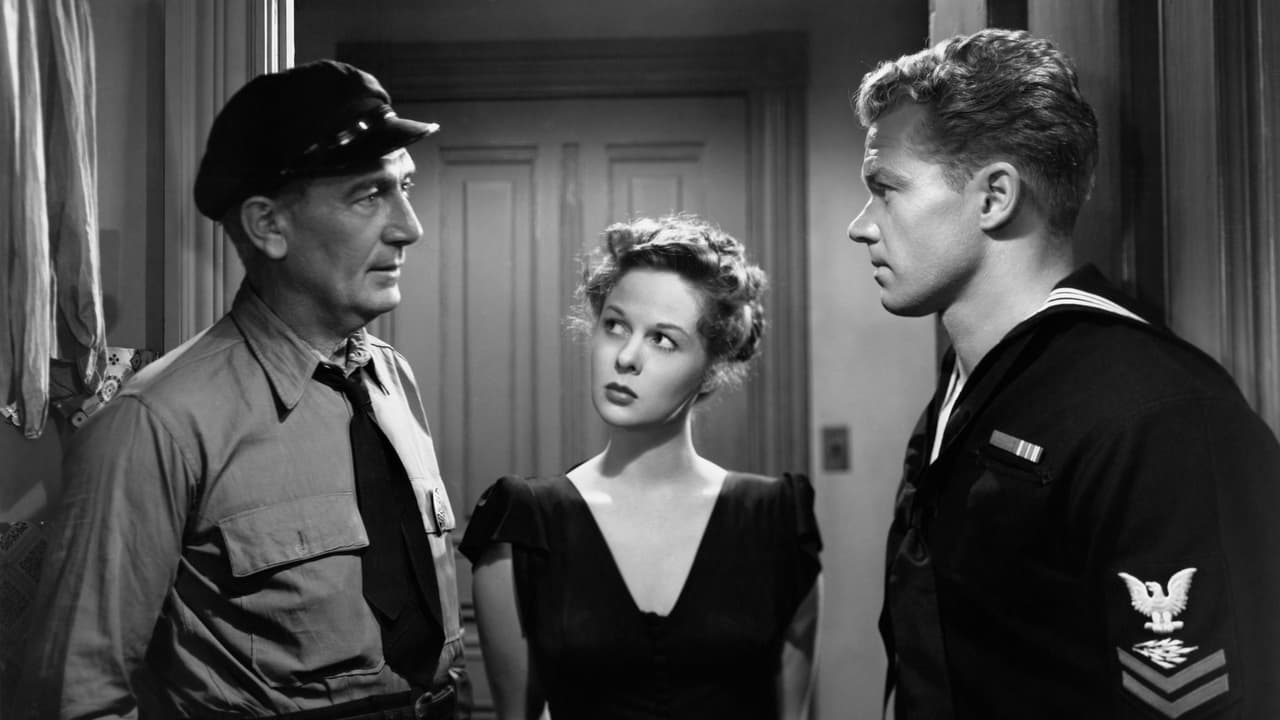
Deadline at Dawn is an anomaly in the RKO noir canon, directed not by a studio craftsman but by Harold Clurman, co-founder of the Group Theatre and one of the most politically engaged figures in American theatre of the 1930s. He directed only this one feature film, and the result is uneven in the ways one might expect – certain scenes feel staged rather than inhabited – yet the film carries an intellectual weight that distinguishes it from more polished product. Clifford Odets's screenplay, drawn from Cornell Woolrich's novel, pushes the genre toward something closer to a social fable: the guilty and the innocent are harder to separate than the plot initially suggests, and the city itself functions as an indifferent mechanism. Nicholas Musuraca's cinematography, developed across several key RKO productions, keeps the visual register tightly controlled. Paul Lukas brings a melancholy authority to Gus that quietly dominates the film's moral argument. Susan Hayward's June is one of her more restrained performances of the period, alert and skeptical in ways that serve the material. The film rewards attention as a document of left-leaning sensibility working inside genre conventions.
– Classic Noir
Musuraca frames Gus in the driver's seat so that the ambient light of the street enters the cab in near-horizontal bands, catching the side of his face and leaving the rest in gradated shadow. The interior of the taxi becomes a confessional space – shallow in depth, enclosed on three sides, with June and Alex visible in the back seat as partial presences, their faces caught between illumination and darkness. The camera holds on Gus with an unusual stillness, resisting the cut, as though the scene requires duration rather than momentum.
What the scene reveals is the film's quiet thesis: that experience accumulates into a kind of resigned wisdom, and that wisdom, in this world, is not much protection against anything. Gus is the moral center of Deadline at Dawn not because he acts heroically but because he understands the cost of acting at all. The composition – one aging man in weak light, speaking carefully – is the film's most honest image of what it means to know too much about how things end.
Nicholas Musuraca had, by 1946, developed a visual grammar at RKO that was as recognizable as any in the studio's output – his work on Cat People and Out of the Past established the terms of an approach that favored deep shadow, restricted light sources, and a sense of the frame as morally as well as spatially organized. On Deadline at Dawn he applies that grammar to a more confined canvas. The film is almost entirely nocturnal and almost entirely interior, and Musuraca treats the studio-built New York as a series of pressure chambers: low ceilings, windows that suggest the street without opening onto it, light sources that create pools rather than fields of illumination. The effect is not merely atmospheric but argumentative – the visual constriction reinforces the screenplay's insistence that these characters have nowhere to go that is genuinely outside the system trapping them. Shadow work throughout is controlled rather than expressionistic, serving character psychology more than genre convention.
The most likely home for a properly transferred print with contextual materials; confirm current availability before visiting.
TCMSubscriptionTCM has broadcast Deadline at Dawn periodically as part of noir programming blocks; check the schedule or the TCM app for on-demand access.
Archive.orgFreeA public-domain print may be available here, though transfer quality is variable and should be treated as a fallback option.