Vince Kane (George Raft) and Joe Farley (Pat O'Brien) are partners in a bail bond operation on the margins of legitimate society – men who traffic in other people's legal jeopardy for a living. When a young drifter named Claude Brackett (Bill Williams) skips bail after being bonded out, Kane goes looking for him, only to find Brackett's wife Lucy (Ella Raines) first. She is frightened, guarded, and clearly concealing something about her husband's involvement with a car theft ring run by the smooth and dangerous Jerry McKay (Roland Winters).
Claude turns up dead before Kane can bring him in, and the killing pulls Kane deeper into a web that implicates McKay's syndicate, a corrupt associate named Roy Collins (Robert Gist), and a woman named Elaine Storm (Betty Underwood) whose loyalties shift with the pressure applied. Kane's old friendship with police lieutenant Nick Ferrone (Jim Backus) becomes strained as the investigation moves into territory that cuts close to the bond business itself. Lucy, drawn to Kane despite her grief, becomes both a motive for his persistence and a complication that threatens his professional standing.
Dangerous Profession operates within the procedural strain of late-1940s noir, less interested in expressionist excess than in the slow erosion of professional boundaries by personal entanglement. Kane is not a detective by trade, but necessity and feeling push him into the investigator's role – a common noir displacement in which ordinary men are pulled across lines they did not intend to cross. The film uses its bail bond milieu with some economy, treating the business as a threshold zone between the law and its offenders, a morally ambiguous ground from which the story's complications naturally grow.
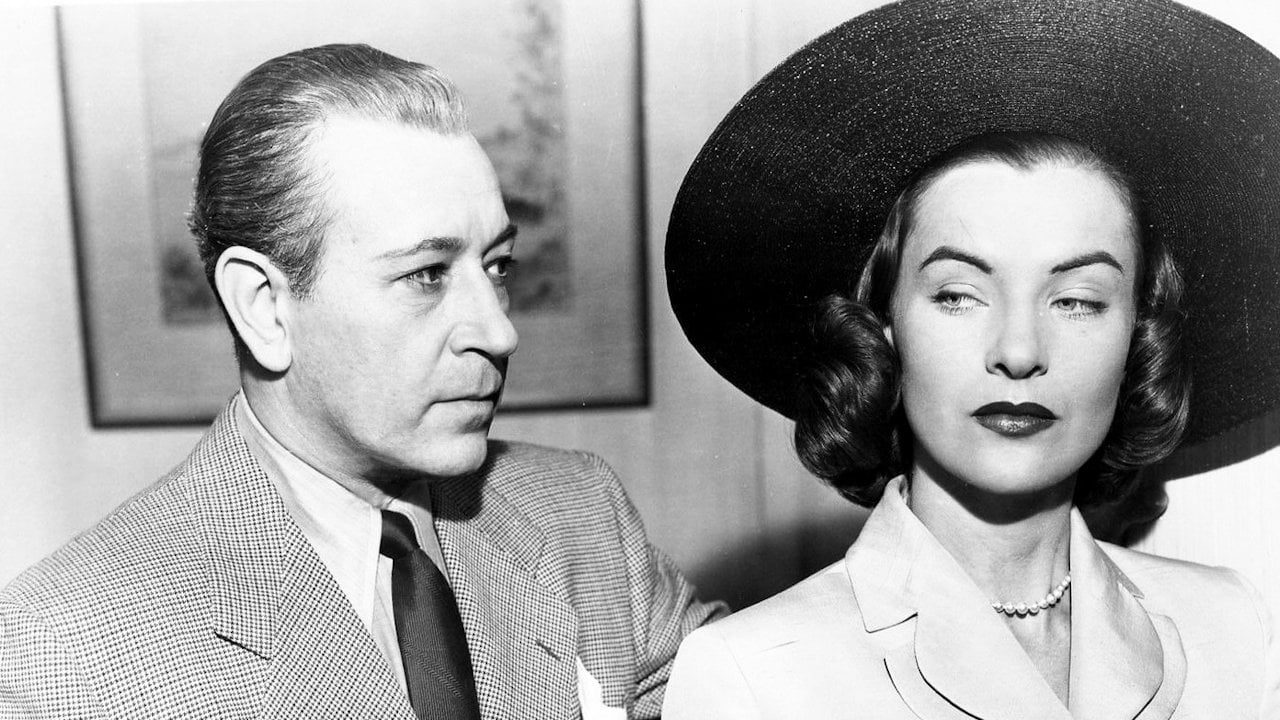
Dangerous Profession is a competent, unpretentious entry in RKO's mid-period noir output – neither among the studio's finest work nor negligible. Ted Tetzlaff, who had demonstrated genuine visual authority as a cinematographer before moving to directing, handles the material efficiently without transforming it. George Raft, by 1949 past the peak of his screen authority, fits the role of Vince Kane well enough: the character requires a kind of weathered stillness rather than range, and Raft provides it. Pat O'Brien brings professional ease to a part that might otherwise read as superfluous. What the film reveals about its era is the normalisation of the procedural noir – the story of a man who stumbles into a murder investigation not through romantic obsession or criminal ambition but through the mundane operations of a licensed trade. The bail bond setting is the film's most durable asset, locating the noir universe in a specific institutional crevice rather than the more theatrical locales the cycle favoured. It remains a reliable example of what the B-noir could achieve within commercial constraints.
– Classic Noir
Kane arrives at Lucy Brackett's apartment in the late afternoon, and Robert De Grasse's camera holds on the interior with disciplined restraint. The venetian blinds divide the light into horizontal bands that fall across Lucy's face and shoulders as she speaks, each movement shifting her in and out of shadow. The frame keeps Kane in three-quarter profile near the door, his figure darker than hers, establishing the geometry of suspicion before either character has said anything of consequence. De Grasse does not push the contrast into abstraction; the effect is controlled, almost domestic, which makes the underlying menace more credible.
The scene does the essential work of establishing that Lucy is not an innocent bystander – she knows more than she will say, and Kane knows that she knows. The visual language of partial illumination maps directly onto the film's informational structure: the truth about Claude and McKay's operation will only emerge in fragments, and De Grasse's lighting establishes that epistemological condition from the outset. Kane's position near the threshold – not quite inside, not outside – is the film's governing metaphor made spatial.
Robert De Grasse, a reliable craftsman of the RKO house style whose credits include several Astaire-Rogers pictures as well as tougher material like the original The Body Snatcher (1945), brings a measured and functional visual intelligence to Dangerous Profession. Working primarily on studio sets, he builds the film's noir atmosphere through controlled source lighting and selective shadow rather than the high-contrast excess associated with the cycle's more celebrated examples. His lens choices favour moderate focal lengths that keep characters anchored in recognisable environments, a decision consistent with the film's procedural, semi-documentary ambitions. The bail bond offices and apartment interiors are lit to suggest institutional fluorescence cut by venetian shadow – a combination that became something of a visual signature for late-1940s urban noir. De Grasse's shadow work is at its most purposeful when registering moral equivocation: characters who occupy ambiguous positions in the story are consistently framed at the edge of a light source, half-legible. The cinematography does not call attention to itself, which is appropriate for a film whose argument rests on the ordinary machinery of corruption rather than spectacular transgression.
Tubi has carried a number of RKO B-noir titles from this period; check current availability as the catalogue rotates.
Archive.orgFreeThe Internet Archive occasionally hosts public domain or freely available prints of RKO programme pictures from this era; image quality varies but access is unrestricted.
Amazon Prime VideoSubscription / RentalAvailable intermittently through Prime Video or as a low-cost rental via its classic film aggregators; confirm current listing before purchase.