Vic Barron, a former San Francisco detective, walks out of prison after three years – scarred, disfigured, and carrying the weight of a frame-up that cost him his career, his wife, and his daughter. The man responsible, he believes, is Tino Morelli, a West Coast syndicate figure who put Barron away to keep him quiet. Barron travels to Ketchikan, Alaska, where Morelli has retreated with his young daughter Marie, and where Peggy Harding – a local woman with her own complicated ties to the case – watches Barron's arrival with unease.
Barron's pursuit is not the clean work of a man seeking justice. His grief has curdled into something closer to obsession, and the line between vengeance and self-destruction blurs steadily as he closes in. Roxey Davis, a psychopathic killer in Morelli's employ, moves to intercept Barron, and the presence of Marie – an innocent child who has grown to love the father Barron wants to destroy – introduces a moral weight that neither Barron nor the film can easily set aside. Peggy, drawn to Barron but wary of where his rage is leading him, becomes the story's reluctant conscience.
Cry Vengeance belongs to the postwar cycle of revenge narratives in which the returning or damaged male figure discovers that the target of his fury is no longer the only problem – he is. The film works the tension between Barron's legitimate grievance and the cost of pursuing it, staging its final movements against the rugged Alaskan landscape in a way that trades the neon geography of urban noir for something colder and more exposed. What remains unresolved is not the plot but the moral residue it leaves behind.
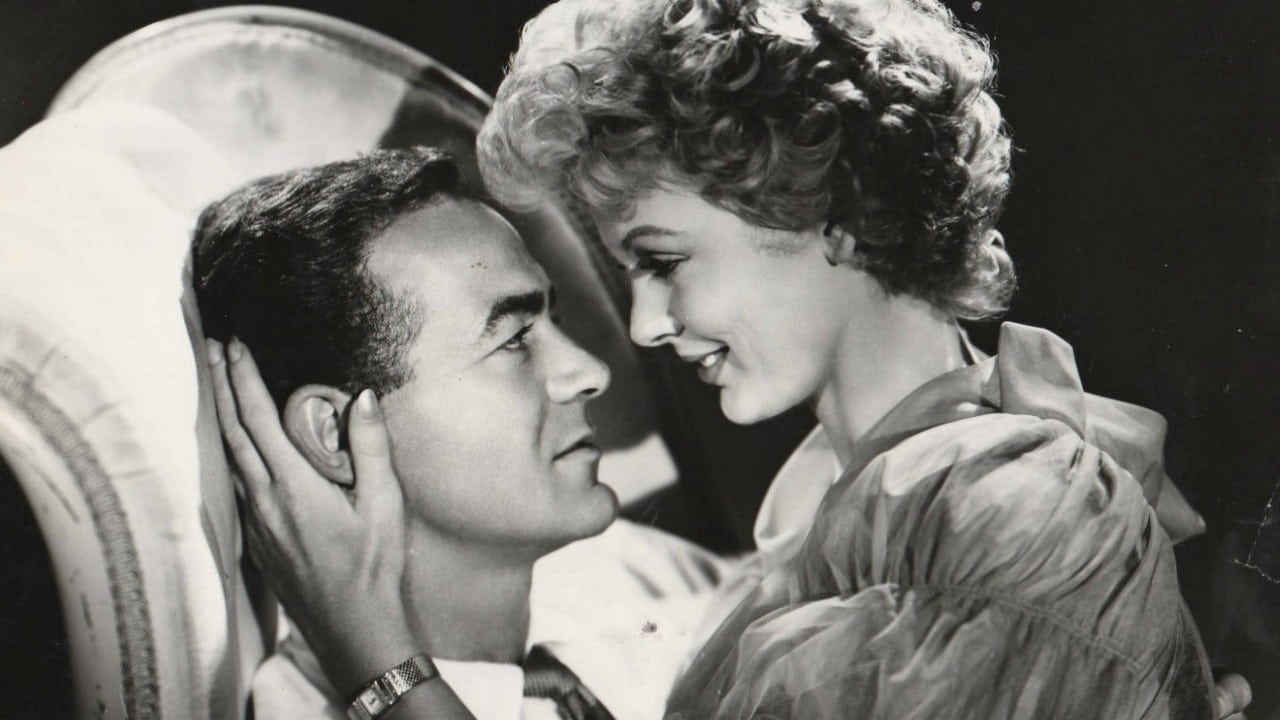
Cry Vengeance occupies a specific and underexamined corner of the mid-fifties noir cycle: the Allied Artists B-picture that compensates for budget constraint with location shooting and an unusually direct psychological focus. Mark Stevens, directing himself, brings an actor's instinct for internalized damage to Vic Barron – the performance is controlled rather than expressive, which suits a character whose emotions have been compressed into a single destructive purpose. The Alaska locations, rare for the genre, give the film a visual and moral openness that distinguishes it from the studio-bound revenge pictures of the same period. William Sickner's photography uses that northern light without sentimentalizing it. Skip Homeier's Roxey Davis, edgy and unpredictable, functions as the film's id – a figure who enacts the violence Barron is moving toward and thus clarifies what Barron risks becoming. The script is functional rather than literary, but it understands that the noir revenge plot is always, at some level, a story about whether the protagonist deserves to survive his own mission.
– Classic Noir
Sickner holds a wide shot of the harbor, the grey Alaskan sky pressing down on the frame, Barron's figure reduced to a dark vertical against the pale water. The camera does not move toward him. It observes, at the distance a surveillance camera might maintain, and the effect is of a man being watched by the landscape itself rather than by any human agency. When the cut comes to a closer angle, the scarring on Barron's face catches the diffused northern light in a way that refuses both glamour and pure grotesquerie – it simply registers damage as fact.
The scene argues, without dialogue, that Barron has traveled this far only to discover that the object of his vengeance exists in a context – a child, a community, an ordinary life – that his three years of focused hatred had no room for. The harbor does not care about his grievance. The stillness of the frame is not peaceful; it is the stillness of a man who has run out of the momentum that was keeping him functional.
William A. Sickner's photography on Cry Vengeance works against the conventions his budget might have enforced. Shooting on location in Ketchikan rather than on a back lot, Sickner forgoes the controlled chiaroscuro of studio noir in favor of a flatter, harder light that carries its own unease – shadows fall at obtuse angles, and the absence of deep blacks creates a world that feels exposed rather than hidden. Interior scenes compensate with tighter, lower setups that crowd the frame around Barron and Roxey, using architectural constriction where a larger production might have used shadow pools. The scarring on Stevens's face is never lit for shock effect; Sickner treats it as a topographical fact, something the light simply reports. Paul Dunlap's score is spare enough that silence has room to function as its own commentary. The visual language overall serves the film's moral argument: there is nowhere to hide in this story, not in the landscape, not in the frame, and not in the logic of revenge.
Tubi has carried Allied Artists titles from this period with reasonable transfers; confirm availability in your region before viewing.
Archive.orgFreeThe film's public domain status makes Archive.org a reliable fallback, though transfer quality varies by upload.
Amazon Prime VideoRental/PurchasePaid digital copies from Amazon typically offer the cleanest available scan of public domain titles sourced from better elements.