In a cramped New York neighborhood, street gang leader Frankie Dane rules his block with cold authority. When a local man named McAllister reports the gang to authorities after a violent incident, Frankie decides the only answer is murder. He recruits two reluctant lieutenants – the emotionally unstable Angelo 'Baby' Gioia and the malleable Lou Macklin – to carry out the killing, setting in motion a plan that exposes the fragile loyalties holding the group together.
Ben Wagner, a settlement-house social worker, moves through the same streets with a different kind of conviction, attempting to pull Frankie and the younger boys back from the edge. Wagner reads Frankie clearly enough to know the danger, but the system offers him little leverage. Meanwhile, Angelo's father, a proud and bewildered man, and Frankie's own exhausted mother register the weight of what their neighborhood has produced without fully understanding how to stop it. The murder plot advances as each member of the trio begins to fracture under pressure.
Crime in the Streets belongs to a strand of mid-fifties noir that relocated genre darkness from the private detective's office to the public housing block, treating juvenile delinquency not as sensationalism but as social pathology. Siegel keeps the film tightly compressed – nearly single-location in its claustrophobia – and the question the film poses is less whether the crime will occur than whether any force, institutional or personal, can interrupt a young man already committed to violence.
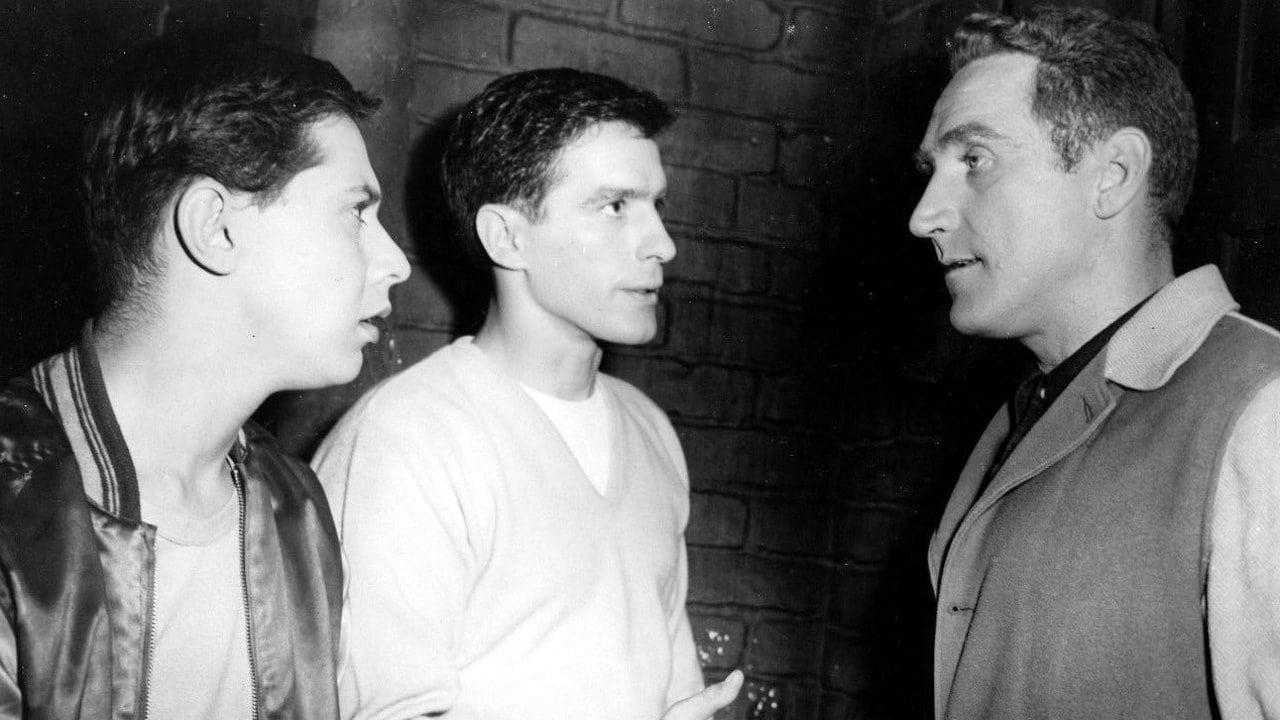
Don Siegel made Crime in the Streets one year after Riot in Cell Block 11 and one year before Baby Face Nelson, and it belongs to that productive middle period when his instinct for confined spaces and male aggression was sharpest. The film began as a Reginald Rose teleplay, and the stage origins show in its compression – most of the action unfolds on a single tenement block – but Siegel turns the limitation into atmosphere rather than excuse. John Cassavetes, still two years from directing his own first feature, brings an intelligence to Frankie Dane that resists easy pathology; this is not a hoodlum performed for audience comfort. Sal Mineo's Angelo operates in a register closer to raw nerves, and the contrast between the two is the film's most productive tension. James Whitmore's social worker avoids the genre's usual trap of the wise outsider; Wagner is effective without being redemptive. The film sits at the intersection of noir fatalism and the era's sociological anxiety about American youth – neither purely one nor the other, and more honest for the ambiguity.
– Classic Noir
Siegel and cinematographer Sam Leavitt place Cassavetes against a brick wall at night, light falling from a single high source that hollows his eye sockets and leaves the lower half of his face in near-total shadow. The frame keeps Frankie slightly off-center, the alley receding into blackness behind him, so that the composition itself implies there is nowhere to retreat to – only the narrow lit column of the present moment. The camera holds at medium distance rather than cutting to close-up, which refuses the audience the intimacy of sympathy.
The restraint of the setup is the scene's argument: Frankie is not examined, he is observed. The distance Leavitt maintains mirrors the distance Wagner cannot close, no matter how many conversations he initiates. What the scene reveals is that Frankie's danger comes not from irrationality but from a settled, almost bureaucratic certainty about what he intends to do. The frame's refusal to move in is the film's clearest statement about the limits of intervention.
Sam Leavitt, who would shoot Anatomy of a Murder three years later, brings to Crime in the Streets a visual discipline suited to Siegel's preference for economy over decoration. Working largely on constructed sets designed to replicate New York tenement exteriors, Leavitt uses high-contrast lighting that owes something to the street photography of the period – pools of artificial light separated by genuine darkness, with little of the atmospheric fill that softened comparable productions. His lens choices favor moderate focal lengths that preserve the geometry of walls and pavement, so that the architectural confinement reads as moral confinement. Shadow work is deployed selectively: Cassavetes receives the heaviest chiaroscuro treatment, Whitmore somewhat less, the choice visually encoding who is caught inside the noir logic and who stands partially outside it. The result is a visual scheme that serves Siegel's argument without announcing itself.
Tubi has carried Crime in the Streets as part of its classic crime catalog; check availability, as titles rotate.
Archive.orgFreeA public domain print is available on Archive.org – quality varies, but it is the most reliably accessible option at no cost.
Amazon Prime VideoRentalAvailable for digital rental through Amazon in a cleaner transfer than most free sources; confirm current availability before purchase.