Joe Manning, a drifting, hard-drinking artist, regains consciousness in a small California town to find a young woman murdered nearby and no memory of the preceding hours. The local police, led by the methodical Detective Sergeant Hollander, move quickly to build a circumstantial case against him. Joe's only immediate ally is Frances 'Slacks' Bennett, a nightclub singer with reasons of her own for keeping Joe out of custody – and out of her past.
As Joe pushes back against Hollander's investigation, his search draws him into the orbit of Philip Rowen, a man of local standing whose wife Christy harbors a visible unease, and of Red Waller, a bartender's associate whose loyalty cannot be assumed. The murdered woman, Irene Crescent, proves to have intersected with nearly everyone in Joe's blurred evening, and the web of prior acquaintance begins to suggest that the killing was neither random nor impulsive.
Crime Against Joe works the familiar noir template of the falsely accused ordinary man – cornered by circumstance, betrayed by gaps in his own recollection – and presses it through the conventions of the small-town procedural. The film is compact in its construction, economical in its character work, and honest about the degree to which innocence, without proof, offers no reliable protection.
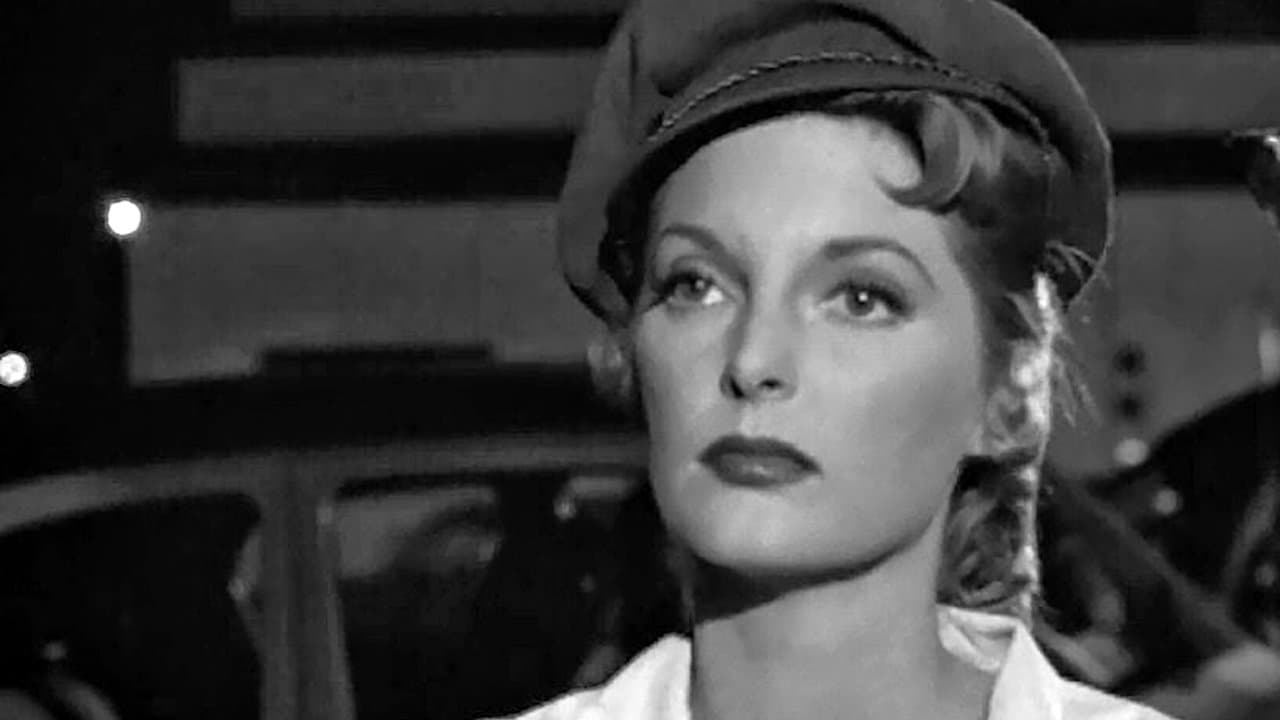
Crime Against Joe belongs to the mid-decade cycle of low-budget noirs produced by independent outfits like Bel-Air that kept the genre alive as the major studios turned elsewhere. At seventy minutes, the film has no room for digression, and Lee Sholem – a director more associated with efficiency than distinction – uses that constraint productively. The amnesia premise, well worn by 1956, is handled with enough procedural specificity to sidestep its own clichés, and John Bromfield's performance as Joe has a credible exhaustion to it, the quality of a man whose options have been narrowing long before the current emergency. Julie London, cast here before her recording career fully overtook her screen work, brings to 'Slacks' Bennett a watchfulness that the script never quite earns but that the film benefits from regardless. What the picture finally reveals about its moment is a persistent postwar unease: the sense that male identity, unmoored from purpose, is one bad night away from annihilation by institution.
– Classic Noir
Margulies holds the frame tight inside the bar's interior, cutting available light with low-angle sources that push the back wall into near-total shadow. Hollander stands at the midground, his figure blocking the exit in the composition rather than in the geography of the room, while Joe sits slightly below the frame's center line – a positioning that reads as suppression without requiring explicit staging. The lens works close enough that neither man can retreat into background.
The scene crystallizes the film's central argument: institutional pressure does not require malice to destroy. Hollander is not corrupt; he is simply certain, and his certainty occupies the same visual space as Joe's dwindling credibility. The framing offers no neutral ground. Joe's innocence, if it exists, has nowhere to stand in this room.
William Margulies, whose work across Bel-Air productions demonstrated a reliable command of low-key noir lighting on constrained budgets, shoots Crime Against Joe largely on interior sets dressed to suggest a California town of no particular prosperity. He favors practical-source motivation – bar fixtures, desk lamps, a single street-facing window – to justify high-contrast pools that isolate faces from their surroundings. The camera rarely moves extravagantly; Margulies trusts the cut and the static frame, positioning characters within compositions that encode power and vulnerability before dialogue arrives. The night exteriors, sparse as they are, use shallow pools of light against undifferentiated dark rather than the expressionist geometry of earlier noir, a choice consistent with the period's drift toward a flatter, more documentary visual register. Shadow work here is not decorative but functional: it marks the limits of what Joe can know about his own night and what Hollander is willing to see.
Tubi has carried several Bel-Air Productions titles and is the most likely free streaming home for this film; availability should be confirmed before viewing.
Archive.orgFreeAs a low-budget independent production whose rights history is uncertain, a public-domain or freely uploaded version may be accessible here, though print quality will vary.
Amazon Prime VideoSubscription / RentalClassic B-noirs of this period appear intermittently on Prime Video through third-party channels; check current availability.