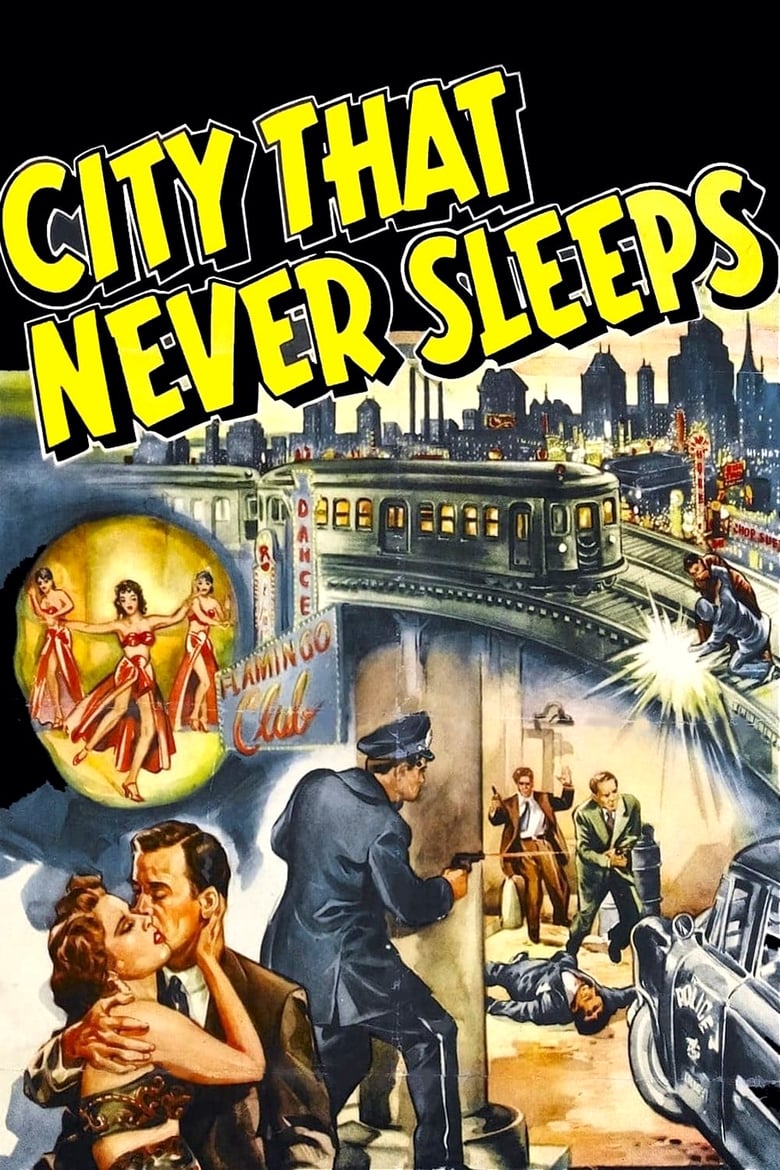
Chicago patrolman Johnny Kelly (Gig Young) is a man caught between the life he has and the life he wants. Unhappy in his marriage to the steady, patient Kathy (Paula Raymond) and drawn toward Sally Connors (Mala Powers), a nightclub performer known as Angel Face, Johnny has already decided to quit the force and run. The only obstacle is money – and money, in this city, has a way of arriving with conditions attached.
The conditions arrive in the person of Penrod Biddel (Edward Arnold), a powerful attorney with underworld ties who offers Johnny a sum sufficient to disappear, in exchange for one night's work: escorting Hayes Stewart (William Talman), a wanted man, safely out of the city. What Johnny does not yet understand is the full geometry of the arrangement – that Stewart is dangerous, that Biddel's restless wife Lydia (Marie Windsor) has her own designs on the evening, and that the city itself, personified by the sardonic disembodied Voice of Chicago (Chill Wills), is watching every move with something close to contempt.
City That Never Sleeps unfolds across a single night shift, using Chicago's streets, clubs, and precinct houses as a moral landscape in which every choice Johnny makes narrows the ones remaining to him. The film belongs to that strand of postwar noir concerned less with crime as spectacle than with the slow erosion of a man's capacity to choose honestly, and it places that erosion squarely within the institutional world of the police – a world that is neither corrupt nor clean but simply indifferent to the distinction.
City That Never Sleeps occupies an underexamined position in Republic Pictures' modest noir output – a film with more structural ambition than its B-picture origins might suggest. John H. Auer's decision to compress the action into a single night shift gives the film a unity that its occasionally schematic screenplay needs, and the device of the Voice of Chicago – Chill Wills as a kind of sardonic civic conscience – is strange enough to register as something more than a gimmick. The film's real subject is institutional loyalty and its limits: Johnny Kelly is not a corrupt cop but a man who has allowed small dissatisfactions to metastasize into larger compromises, and Gig Young plays that particular variety of moral fatigue with precision. Marie Windsor, characteristically, does more with Lydia Biddel than the role requires. What the film captures, almost despite itself, is the texture of postwar urban masculinity – the sense that the city itself is a pressure system, and that the men moving through it are always one shift away from a decision they cannot take back.
– Classic Noir
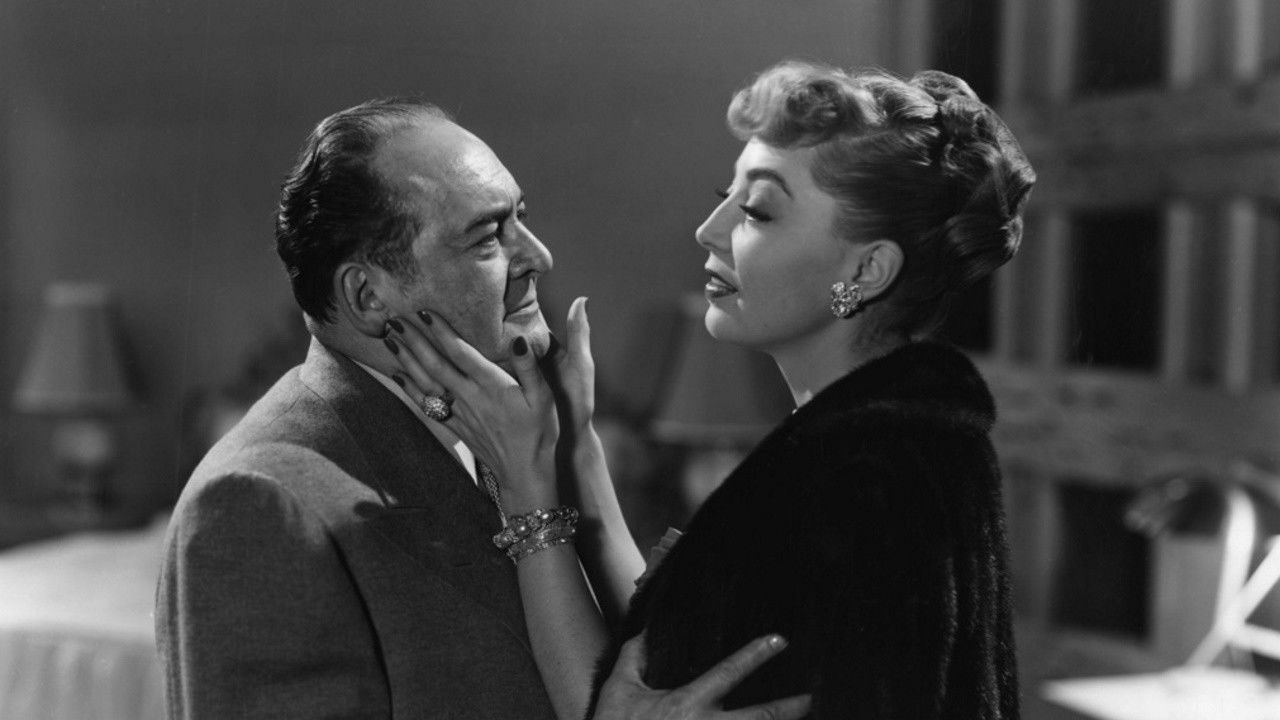
The scene is composed in close quarters, the frame tightened by low ceilings and a single practical lamp that throws hard lateral light across Marie Windsor's face while leaving the wall behind her in near-total darkness. John L. Russell's camera holds at a slight low angle, giving Windsor a physical authority over the space even as the dialogue works to diminish her. The shadows on her far cheek deepen as she turns, and the effect is less glamour than exposure – a face being read rather than admired.
What the scene establishes is the film's underlying argument about knowledge and power: Lydia Biddel knows exactly what her husband has arranged, knows what it costs, and has decided to extract her own price from the transaction. Windsor plays the moment without self-pity, and it is in that absence of self-pity that the film briefly touches something harder than its genre machinery usually allows – the recognition that in this city, complicity is not weakness but policy.
John L. Russell, who would later shoot much of Alfred Hitchcock's Psycho, brings to City That Never Sleeps a location-inflected style that distinguishes the film from Republic's more obviously studio-bound productions of the same period. Actual Chicago locations – Michigan Avenue, the elevated rail infrastructure, the nighttime lakefront – are cut against studio interiors in a way that keeps the city present as a physical argument rather than mere backdrop. Russell uses hard-source lighting in interior scenes to maintain continuity with the location footage's available-light quality, and his shadow work in the nightclub and precinct sequences relies on shallow depth of field to isolate faces from their environments, suggesting characters who are defined by the immediate moment rather than any stable context. The overall visual grammar reinforces the script's insistence on a single night's duration: the city outside is always visible, always moving, and Russell's framing consistently positions his actors against that movement as though they are trying, and failing, to stand still.
Tubi has carried this title as a free ad-supported stream and is the most reliably accessible option for most viewers, though print quality varies.
Archive.orgFreeAs a Republic Pictures production whose copyright status has lapsed into the public domain, the film is available on Archive.org, though transfers differ widely in quality.
Amazon Prime VideoRentA rental option through Amazon occasionally surfaces with a cleaner transfer than public-domain prints; availability should be confirmed at time of viewing.