Andy Doyle, a seasoned investigator working a hit-and-run case, begins pulling at a thread that the official inquiry has already let go. The victim is dead, the file is thinning, and the department is content to let the matter settle. Doyle is not. His partner Steve Nordstrom is younger, more deferential to procedure, and increasingly uneasy as Doyle pushes into territory that implicates people with reasons to push back.
The trail moves through a modest social world of mid-century American respectability – doctors, women with careful manners, men with alibis that almost hold – and Doyle's investigation begins to disturb allegiances that looked settled. Claire Ramsey and Harriet Owens occupy positions in the case that shift as new evidence surfaces. Det. Sgt. Mike Duncan applies institutional pressure. Carl Fowler, volatile and cornered, represents the unpredictable human element that no chain of evidence can fully account for.
Chain of Evidence operates within the procedural wing of noir, where the crime is less a rupture than a revelation of what was already wrong beneath the surface. The film is interested in the mechanics of guilt – who can be proven responsible, and whether proof and truth arrive at the same destination.
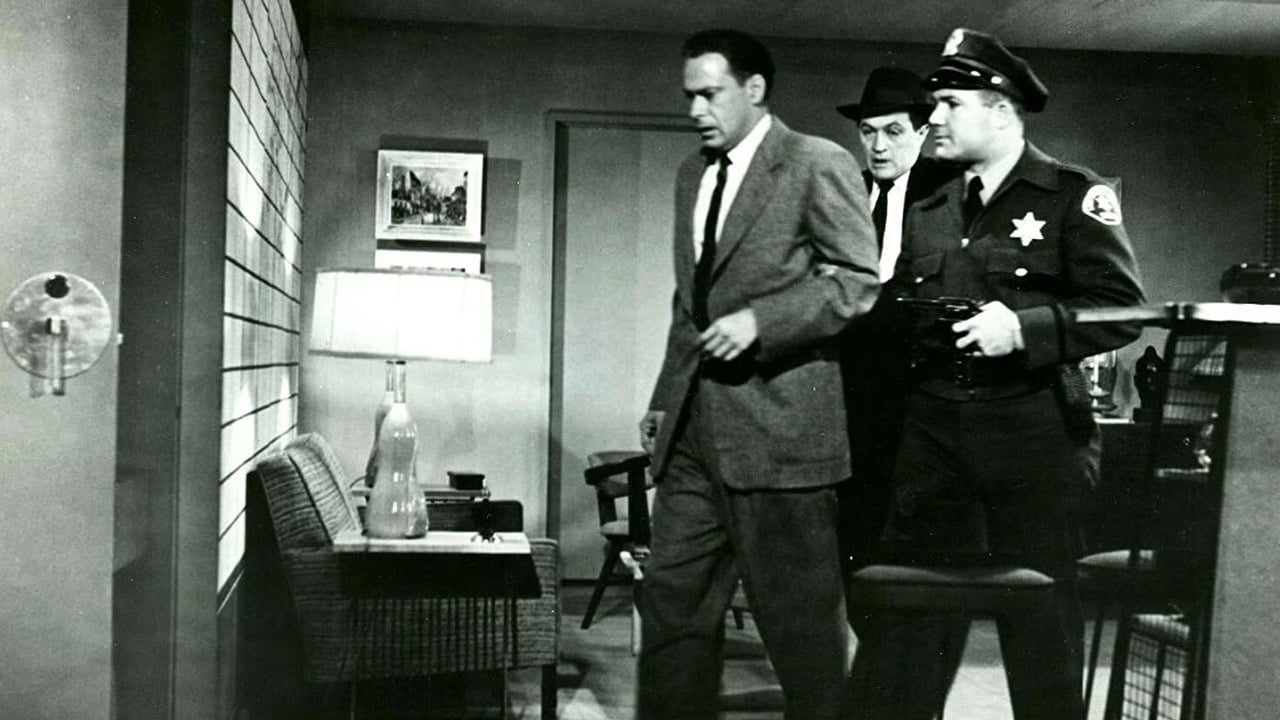
Chain of Evidence belongs to the late cycle of B-noir procedurals that Allied Artists produced with economical efficiency in the mid-1950s, films that traded expressionist shadow for the flatter, more institutional light of the police drama. Paul Landres directs without excess, keeping the film inside its 64-minute frame with discipline rather than haste. Bill Elliott, by this point in his career a reliable presence in low-budget crime pictures, brings a weathered credibility to Doyle that the script alone would not supply. Timothy Carey, in a supporting role, contributes the film's one genuinely unsettling note – his particular gift for performing instability at low volume was rarely better deployed than in these minor assignments where no one was watching him closely enough to soften the effect. The film does not transcend its budget or its studio context, but it reflects accurately the period's anxiety about institutional reliability: whether the chain of evidence leads to justice or merely to a convenient conclusion.
– Classic Noir
The camera holds at a middle distance, declining to dramatize the space with angles. A single overhead source pushes down onto the table and catches the edge of Fowler's jaw and one shoulder, leaving his eyes in a partial shadow that is not quite enough to conceal his expression. The frame is spare – two men, a table, a wall with no distinguishing features – and the composition refuses to grant either figure dominance.
What the scene argues, quietly, is that the machinery of investigation is itself a form of pressure regardless of guilt. Fowler's volatility, held barely in check, suggests a man shaped by previous encounters with exactly this room. Doyle watches rather than performs, and his stillness against Carey's contained agitation defines the film's central tension: control versus the thing control is always trying to manage.
The cinematographer for Chain of Evidence is not confirmed in surviving production records, a gap that is itself characteristic of Allied Artists' minor productions of the era, where technical credits were inconsistently preserved. What the film's visual approach suggests is a practitioner comfortable with available-light logic – interiors are lit to read as functional rather than atmospheric, and the shadow work is restrained, closer to the television crime drama aesthetic that was reshaping low-budget noir in the mid-1950s than to the chiaroscuro of the classic period. Location and studio material appear to have been integrated without particular effort to distinguish them, which gives the film a consistent flatness that suits its procedural temperament. The lens choices favor mid-range focal lengths that keep faces readable without the distortion that wider glass would bring. It is a visual language that prioritizes clarity over mood – appropriate to a film whose subject is the reliability of evidence.
Allied Artists B-pictures of this period circulate on Tubi with some regularity; check availability as catalogue rotation applies.
Archive.orgFreePublic domain prints of Allied Artists productions from this era are frequently available here, though print quality varies.
Amazon Prime VideoSubscriptionMay appear via third-party classic film channels aggregated under Prime; availability is not guaranteed and should be confirmed.