In December 1947, a group of convicts at the Colorado State Penitentiary in Canon City execute a carefully planned mass escape. The film reconstructs the actual event with near-documentary fidelity, drawing on prison records and the cooperation of state authorities. Among the principals are Sherbondy (Scott Brady), a calculating lifer who provides the scheme's cold operational logic, and the younger, more volatile New (Stanley Clements), whose impulses threaten the group's cohesion from the outset. The warden and his officers are rendered as competent, unglamorous men doing institutional work under pressure.
Once the men breach the walls and scatter across the Colorado landscape, the film's center of gravity shifts outward. Schwartzmiller (Jeff Corey) and Heilman (Whit Bissell) take a civilian hostage, introducing a thread of menace that complicates any sympathy the audience may have extended to the escapees. Smalley (DeForest Kelley, in one of his earliest screen appearances) reveals a separate capacity for violence. The surrounding community becomes a perimeter, ordinary citizens drawn into a manhunt that the film frames as a collective civic emergency rather than a heroic pursuit.
Canon City belongs to the cycle of semi-documentary crime films that Eagle-Lion and affiliated producers developed in the late 1940s, a cycle that includes T-Men and He Walked by Night. It shares with those films a reliance on institutional authority as its moral anchor, positioning the state not as a sinister apparatus but as a practical necessity. The film's tension derives less from sympathy with its criminals than from the procedural question of containment, making it an outlier within noir's usual grammar of complicity and desire.
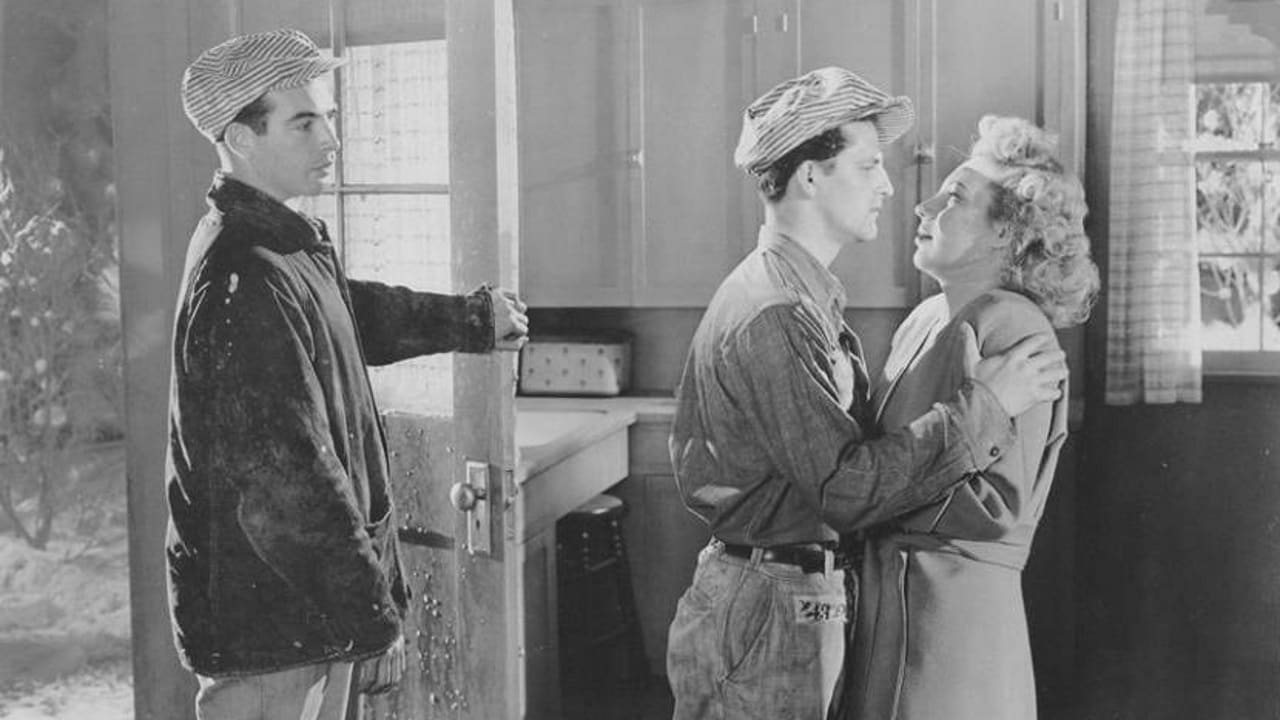
Canon City arrives at an intersection that American cinema of the late 1940s kept returning to: the space between documentary authenticity and genre momentum. Bryan Foy's production secured cooperation from the Colorado State Penitentiary and shot extensively on location, lending the film an observational surface that distances it from studio-bound noir convention. What Crane Wilbur understands, and what the film demonstrates with some consistency, is that the penitentiary itself functions as a noir environment without requiring any expressionist embellishment – its geometry of walls, yards, and watchtowers already codes confinement and surveillance. The ensemble of convicts, none of whom registers as a conventional protagonist, diffuses the moral architecture that the genre usually concentrates in a single fall. This is a structural choice with real consequences: the film generates unease rather than identification, which is less comfortable and arguably more honest about what mass incarceration looks like from the outside. It is not a major work, but it is a purposeful one.
– Classic Noir
John Alton photographs the post-escape pursuit across the Colorado flatlands with a severity that refuses pictorialism. The horizon line is kept low, compressing the escapees into a narrow band between frozen ground and pale winter sky. There is little shadow to shelter in; the light is even, merciless, the kind that offers no gradation between visibility and exposure. The camera holds wide, allowing distance to function as threat rather than freedom.
In this landscape, the men are not fugitives in any romantic sense – they are simply visible, their silhouettes legible against terrain that refuses to absorb them. The scene argues, without commentary, that escape and capture are not moral categories here but spatial ones. The world outside the walls turns out to be another form of enclosure, and Alton's framing makes that argument before any dialogue is required.
John Alton, whose work on T-Men and He Walked by Night had already established him as the defining visual intelligence of the semi-documentary cycle, brings to Canon City a more restrained palette than his nightclub and warehouse interiors typically permit. Shooting on location in Colorado forced a discipline that Alton turns to thematic purpose: the prison's interior spaces are lit with hard sources that cast structural shadows along cell blocks and corridors, emphasizing the institution's geometry as a visual system of control. Outside, he abandons chiaroscuro for an unsparing flatness, using wide lenses to register the exposed terrain as a form of captivity in itself. The contrast is not decorative – it articulates the film's central proposition that the boundary between confinement and freedom is less categorical than the men believe. Alton understands that documentary realism and expressionist shadow are not opposites; here, he uses their tension to give a procedural subject a moral undertow.
Canon City is in the public domain and streams in full on Archive.org, making it the most readily available option, though print quality varies by upload.
TubiFreeTubi has carried public domain titles from this cycle; availability may shift, but it is worth checking for a more stable streaming presentation.
KanopyFree with library cardKanopy occasionally hosts Eagle-Lion and independent noir titles of this period; confirm availability through your local library system.