Films People Pull a Fast One Night Beat Reading Room On TV Shop
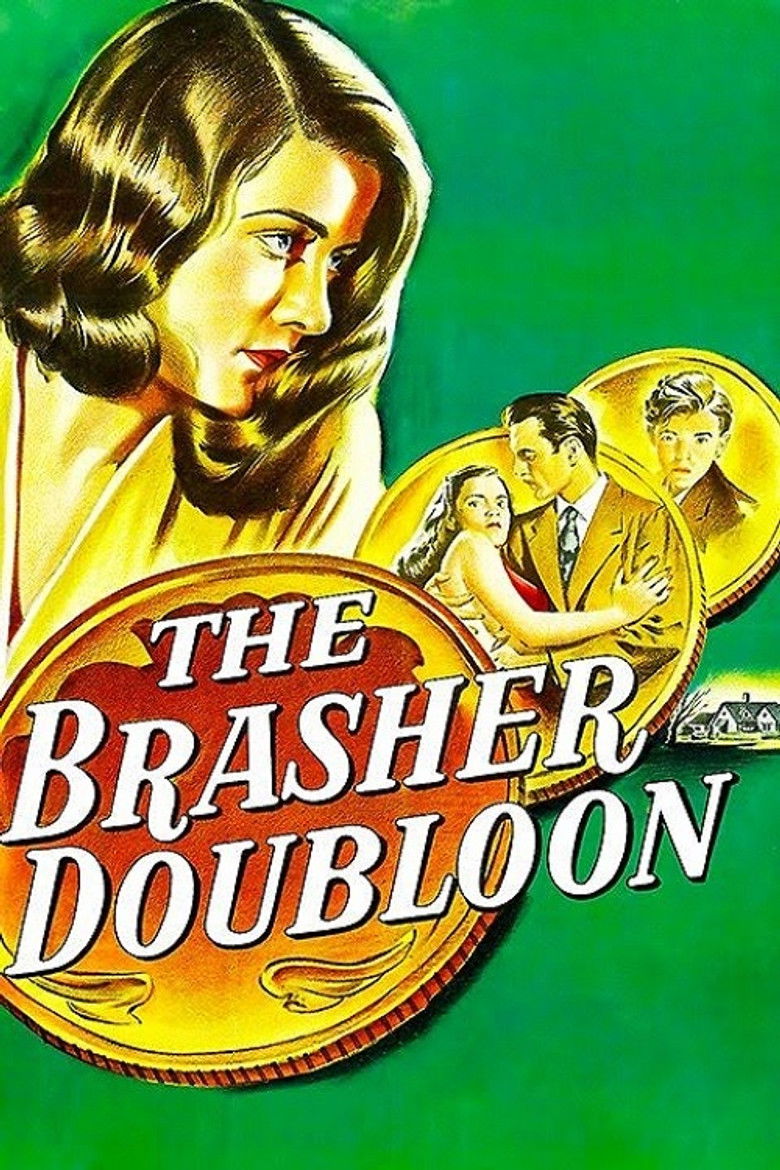
Brasher Doubloon 1947
1947 20th Century Fox
★★★☆☆ Notable
Film Noir · 72 minutes · Black & White

Brasher Doubloon

Directed by John Brahm
Year 1947
Runtime 72 min
Studio 20th Century Fox
TMDB 5.9 / 10
"A rare coin and a dead man's secret draw Marlowe into a house where money has curdled into madness."

Philip Marlowe is hired by the imperious, wheelchair-bound Mrs. Murdock to recover a rare seventeenth-century gold coin – the Brasher Doubloon – stolen from her collection. Her household is a study in suppressed desperation: a feckless son, Leslie, drowning in debt, and Merle Davis, the young secretary whose fragile nerves and selective memory make her as much a puzzle as a witness. From the first exchange, Marlowe reads the assignment as something dirtier than a missing-property case.

The trail leads to Vannier, a blackmailer who has been extracting payments from Mrs. Murdock with photographs that implicate her in something she refuses to name. When Vannier turns up dead, the coin becomes secondary to the question of who in this closed circle of wealth and neurosis pulled the trigger – and whether Merle's dissociated memory holds the answer or only the appearance of one. Allegiances shift with each new piece of information, and Marlowe finds himself navigating a case where every party has a reason to lie.

The Brasher Doubloon is the last of the 1940s Philip Marlowe adaptations and the only one produced by 20th Century Fox. It occupies a particular position in the Chandler cycle: less celebrated than The Big Sleep or Murder, My Sweet, but faithful enough to the source novel – The High Window – to preserve Chandler's interest in psychological damage and the exploitation of the vulnerable by the entrenched wealthy. The film works the detective formula with economy, treating the mystery less as a puzzle to be solved than as a symptom of a corrupt social order.
Classic Noir

The Brasher Doubloon is a modest and largely undervalued entry in the Chandler-on-film canon, adapted from The High Window by screenwriter Dorothy Hannah and directed by John Brahm with the same controlled atmosphere he brought to Hangover Square and The Lodger. George Montgomery's Marlowe is a cooler, less internally conflicted figure than Dick Powell's or Humphrey Bogart's, and that flatness has cost the film critical esteem it may not entirely deserve. What the film achieves is a precise social portrait: Mrs. Murdock's mansion is rendered as a site of generational rot, and Florence Bates's performance as the matriarch is one of the production's genuine distinctions – imperious, calculating, and finally pitiable. Fritz Kortner brings a European menace to Vannier that grounds the blackmail subplot in something more than genre convention. At 72 minutes, the film does not overstay its purpose. Lloyd Ahern's cinematography keeps the moral geography legible without descending into self-conscious expressionism. It is a workmanlike noir that takes Chandler's recurring theme – the destruction of the weak by the powerful – seriously enough to earn a second look.

– Classic Noir
3 ★★★☆☆ Notable
Credits

The Crew

DirectorJohn Brahm
ScreenplayDorothy Bennett
CinematographyLloyd Ahern Sr.
MusicDavid Buttolph
EditingHarry Reynolds
Art DirectionRichard Irvine
ProducerRobert Bassler
Performances

The Cast

Close Reading

The Signature Scene

Brasher Doubloon – scene
Vannier's Apartment The Photograph Behind the Door

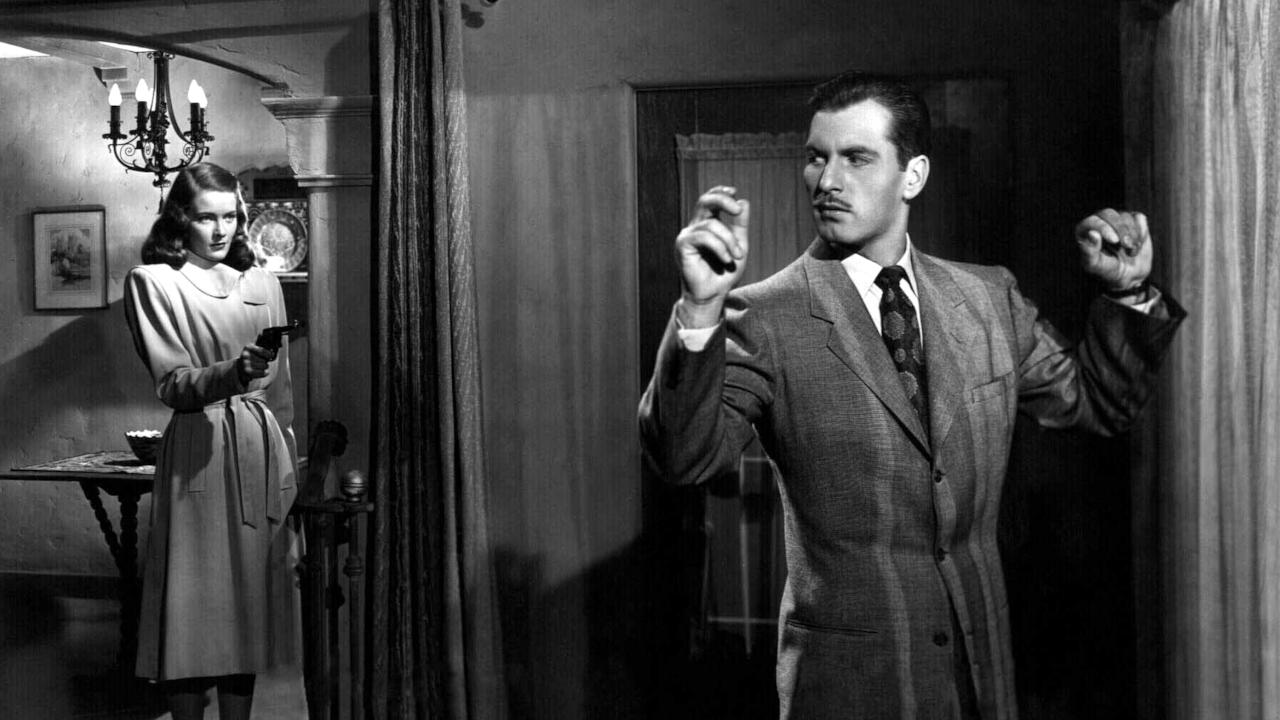
Marlowe enters Vannier's apartment to find the blackmailer dead at his desk. Ahern's camera approaches the body from a low angle, the desktop lamp casting a hard cone of light that isolates the hand and the revolver while leaving the upper register of the room in shadow. The frame is deliberately tight, denying the audience spatial comfort – the room feels sealed, its geometry closing inward. A cutaway to the incriminating photograph on the desk is held just long enough to register the stakes without melodrama.

The scene crystallises the film's argument about the economics of secrets: Vannier's entire leverage over the Murdock household resided in a single image, and now both the man and his power are extinguished with equivalent abruptness. Marlowe moves through the space with professional detachment, and that detachment is itself a moral position – not indifference, but the practiced refusal to be surprised by what greed and fear produce. The dead man is less a victim than a closed account.

Visual Language

The Cinematography

🎞️
Lloyd Ahern Sr. – Director of Photography

Lloyd Ahern Sr. shoots The Brasher Doubloon with a restrained expressionism suited to a story where the horror is social rather than supernatural. Working on Fox studio sets that convincingly evoke both the Murdock mansion's sealed grandeur and the seedier Los Angeles of Vannier's world, Ahern relies on motivated light sources – desk lamps, sidelights, a single overhead in the interrogation register – to establish moral contrast without over-signaling it. His lens choices favour moderate focal lengths that keep characters in readable relation to their environments rather than distorting them for effect; the film's darkness is quotidian, not operatic. Shadow work in the mansion sequences falls across walls and doorframes with architectural precision, implying confinement rather than chaos. Where other Chandler adaptations of the period reach for baroque shadow play, Ahern keeps the palette spare, which serves Brahm's interest in character over atmosphere. The result is a visual language that earns its moments of genuine menace by refusing to spend stylistic capital freely.

In the Catalogue

Themes & Motifs

Availability

Where to Watch

Also in the Directory

See Also