Films People Pull a Fast One Night Beat Reading Room On TV Shop
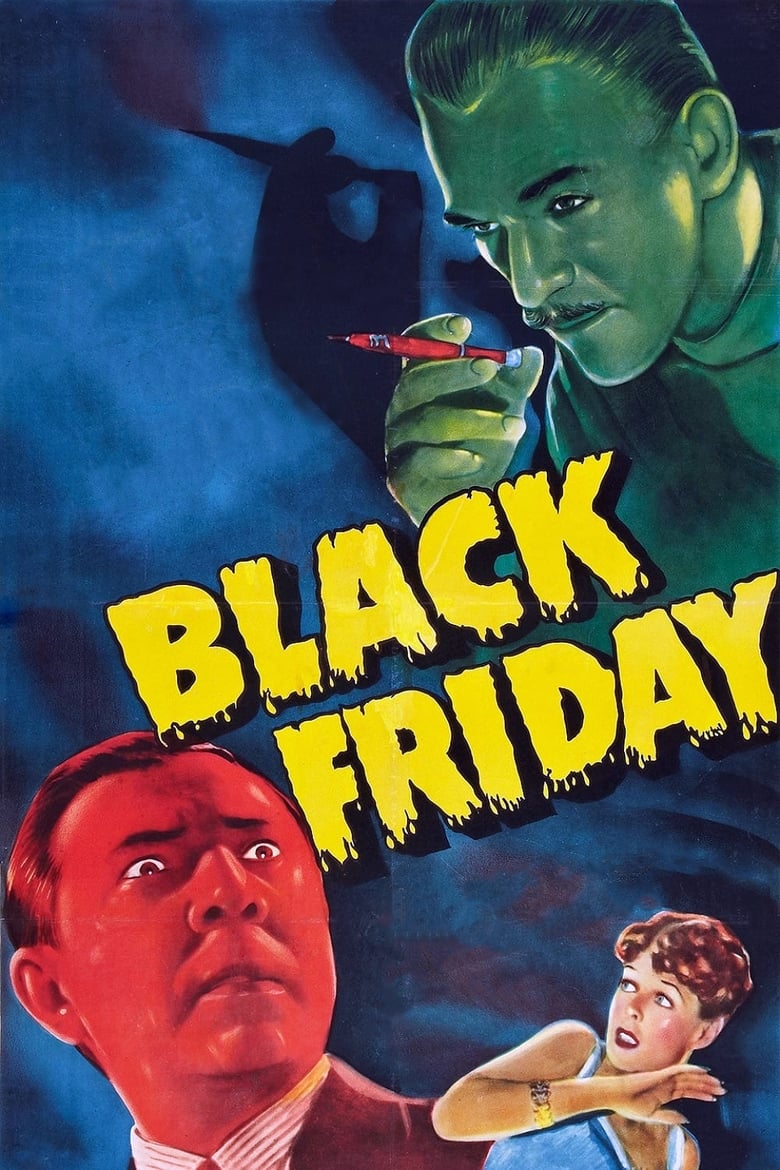
Black Friday 1940
1940 Universal Pictures
★★★☆☆ Notable
Film Noir · 70 minutes · Black & White

Black Friday

Directed by Arthur Lubin
Year 1940
Runtime 70 min
Studio Universal Pictures
TMDB 6.0 / 10
"A surgeon remakes a dying man and releases something he cannot put back."

When respected university professor George Kingsley is caught in the crossfire between warring gangsters, he suffers a fatal brain injury. His close friend and colleague Dr. Ernest Sovac performs a desperate experimental surgery, transplanting a portion of the brain of dying mobster Red Cannon into Kingsley's skull. The professor survives – but not entirely as himself.

Sovac has a private motive for saving Kingsley: Cannon had hidden a quarter-million dollars before his death, and Sovac intends to use the resurrected man to locate it. As Kingsley drifts between his own gentle identity and Cannon's brutal criminal personality, Sovac maneuvers him through the criminal underworld, manipulating both the man and his dangerous alter ego. Gang lieutenant Eric Marnay, suspicious and volatile, closes in as the money's location draws nearer and the professor's two selves grow harder to separate.

Black Friday occupies the intersection of the mad-scientist horror film and the gangster picture, a hybrid that Universal was then well-positioned to produce. Its noir credentials rest less on visual expressionism than on a sustained unease about identity, scientific hubris, and the ease with which a respectable man becomes an instrument of crime. The film asks, quietly and without resolution, where one man ends and another begins.
Classic Noir

Black Friday arrives at an interesting fault line in studio genre history – the moment when Universal's horror machinery began absorbing the conventions of the gangster film, producing something that belongs fully to neither tradition. Arthur Lubin directs with functional economy rather than visual ambition, and the film's real engine is Stanley Ridges, whose performance in the dual Kingsley/Cannon role carries a conviction that neither Karloff nor Lugosi – despite their marquee billing – are given adequate material to match. Karloff, cast against type as the rationalizing scientist rather than the monster, brings a credible moral deterioration to Sovac: a man who tells himself each compromise is the last. The script's engagement with identity dissolution and medical transgression prefigures preoccupations that would become central to psychological noir in the following decade. What the film lacks in stylistic rigor it partially recovers through its structural irony: the monster here wears a laboratory coat, and the creature is also a victim.

– Classic Noir
3 ★★★☆☆ Notable
Credits

The Crew

DirectorArthur Lubin
ScreenplayCurt Siodmak
CinematographyElwood Bredell
MusicFrank Skinner
EditingPhilip Cahn
Art DirectionJack Otterson
CostumesVera West
Performances

The Cast

Close Reading

The Signature Scene

Black Friday – scene
The Hotel Confrontation Two Voices, One Face

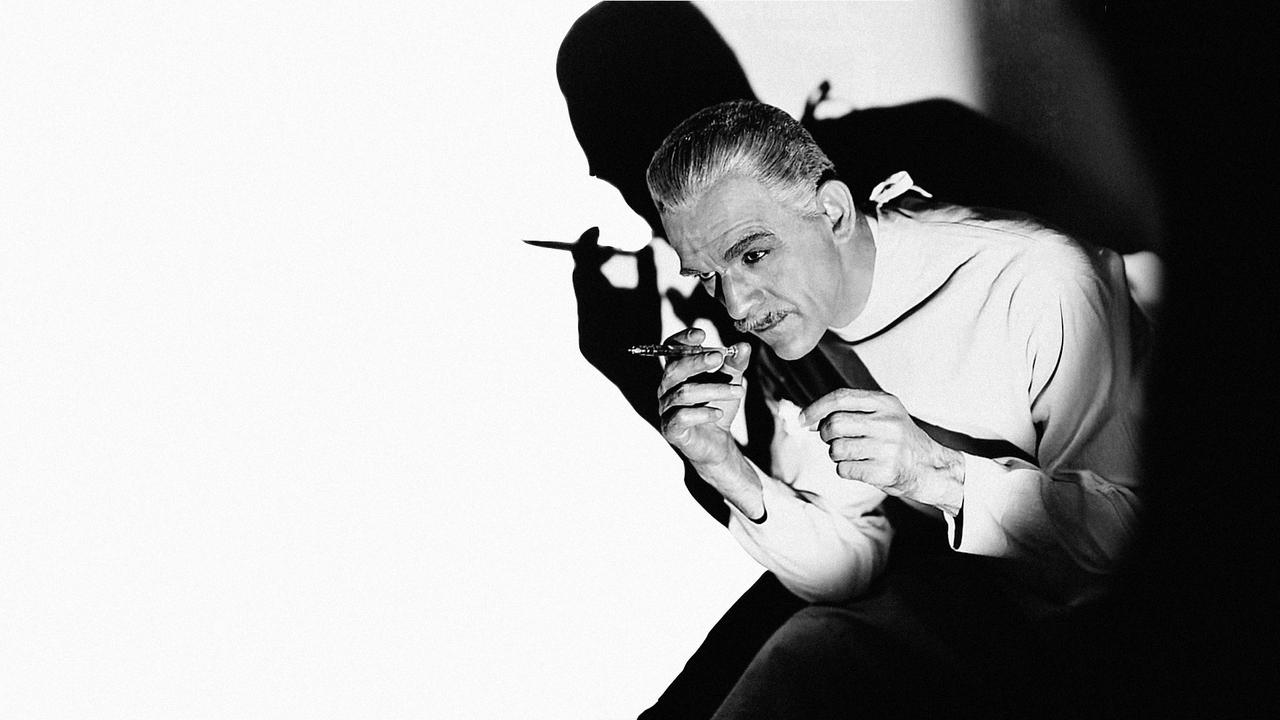
Elwood Bredell holds the camera close on Ridges as Kingsley's mild affect begins to fracture. The lighting splits his face along a near-vertical axis – the side nearest the lamp rendered in sharp clarity, the other falling into shade – a compositional choice that literalizes the duality without announcing it as symbol. The room behind him is spare: a bed, a window with drawn curtains admitting a thin line of exterior light. There is almost no camera movement. The stillness amplifies the instability in the performance.

The scene distills the film's central argument about the self as something contingent rather than fixed. Kingsley does not transform dramatically; he shifts, incrementally, his posture tightening, his diction flattening, his eyes losing their habitual softness. What Bredell's framing insists upon is that there is no clean boundary between the two men – the shadow does not simply replace the light. Sovac, watching from the doorway, understands in this moment that he has not saved a friend. He has manufactured a tool that he may not be able to put down.

Visual Language

The Cinematography

🎞️
Elwood Bredell – Director of Photography

Elwood Bredell, who would bring considerably more expressive force to Phantom Lady three years later, works here within the constraints of a modest production schedule and Universal's studio-bound sets. His lighting strategy favors high-contrast pools – practical sources motivating key lights that leave walls and corners largely unresolved – a setup that suits the film's moral atmosphere even if it rarely achieves the rigorous shadow geometry of the decade's strongest noir work. The studio interiors, dressed as hotel rooms, gang offices, and a college campus, are photographed to feel enclosed regardless of their ostensible scale. Bredell uses shallow depth selectively, pushing backgrounds into soft ambiguity when the scene requires psychological interiority. His work on Black Friday is more craft than art, but it is honest craft, consistently placing light and darkness in service of a story about a man whose interior has been permanently compromised.

In the Catalogue

Themes & Motifs

Availability

Where to Watch

Also in the Directory

See Also