Films People Pull a Fast One Night Beat Reading Room On TV Shop
Big Frame 1952
1952 Tempean Productions
★★★☆☆ Notable
Film Noir · 67 minutes · Black & White

Big Frame

Directed by David MacDonald
Year 1952
Runtime 67 min
Studio Tempean Productions
TMDB 4.5 / 10
"A man wakes up in a stranger's life, and the evidence keeps pointing at him."

Paul Smith, an American visiting London, finds himself implicated in a murder he has no memory of committing. When a body turns up and the circumstantial evidence assembles itself around him with suspicious neatness, Smith has little choice but to push back against the frame being constructed in his name. Inspector Foster of Scotland Yard watches from a professional remove, neither fully convinced of Smith's guilt nor inclined to take his word for innocence.

The complications deepen through Louise Parker, whose loyalties resist easy categorization, and Clark Sutton, whose interest in the case runs beyond the professional. John Parker and Dr. Derek Morrison occupy the edges of the conspiracy, their roles clarifying slowly as Smith presses further into territory where the truth and the trap begin to look alike. Dianne Wrigley and her husband Tom carry knowledge that implicates several parties at once, and the allegiances among them are subject to the kind of revision that money and fear produce.

Big Frame belongs to a cycle of postwar British noirs that borrowed American personnel and genre conventions while grounding their anxieties in London's particular atmosphere of institutional suspicion and social constraint. The wrong-man plot here is less about existential dread than about the mechanics of a deliberately constructed deception, and the film is more interested in procedure and pressure than in psychology – a distinction that places it firmly within the transatlantic B-picture tradition.
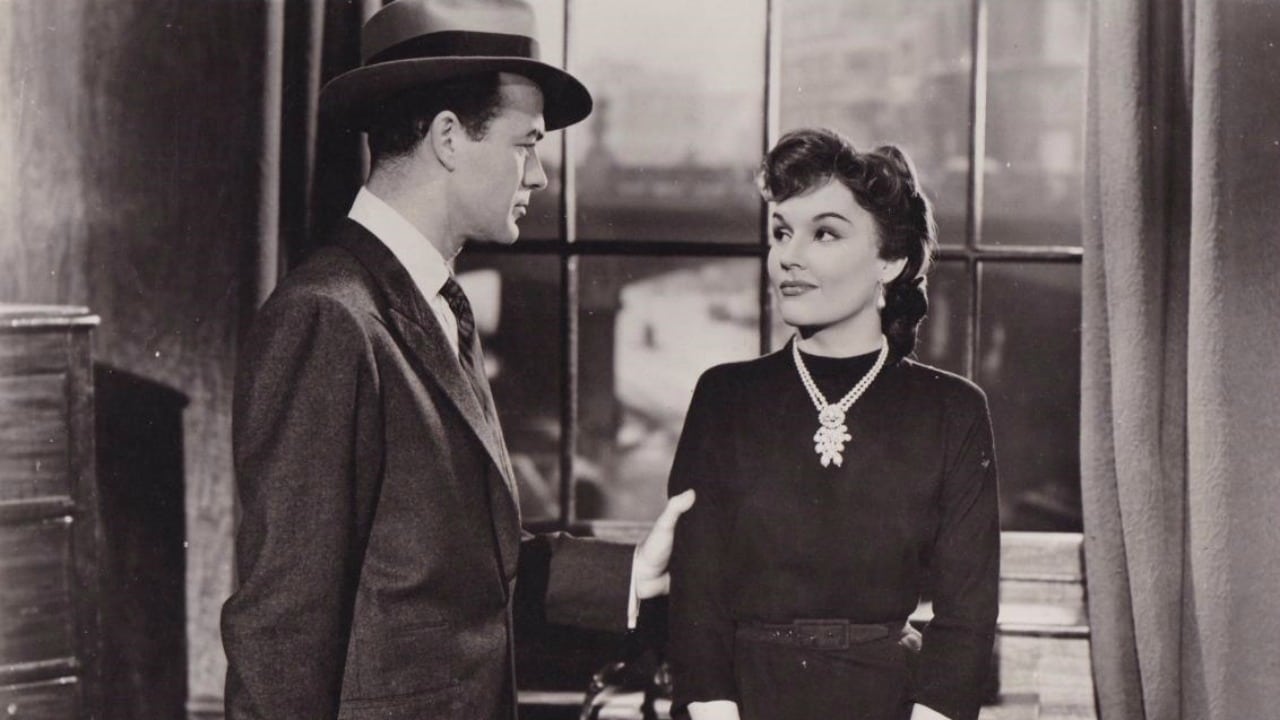
Classic Noir

Big Frame is a modest but competent entry in the cycle of Anglo-American co-productions that Tempean Films generated throughout the early 1950s, pairing imported Hollywood talent with British crews and London locations to produce programmers calibrated for double-bill consumption on both sides of the Atlantic. Mark Stevens, by 1952 no longer a first-tier Hollywood name, brings a workmanlike credibility to the wrong-man premise, and David MacDonald directs without waste, keeping the 67-minute runtime honest. What the film reveals about its era is less about noir's psychological register than about its commercial one: the wrong-man plot had become sufficiently portable by this point that it could be assembled in a British studio with American facing and sold as genre product. Jean Kent supplies the ambiguity the plot requires, and the Scotland Yard procedural machinery provides a distinctly British friction against the American protagonist's instinct to solve things himself. The film earns its place in the catalogue not through ambition but through efficiency.

– Classic Noir
3 ★★★☆☆ Notable
Credits

The Crew

DirectorDavid MacDonald
ScreenplayJohn Gilling
CinematographyMonty Berman
MusicWilliam Hill-Bowen
EditingReginald Beck
Art DirectionAndrew Mazzei
ProducerMonty Berman
Performances

The Cast

Close Reading

The Signature Scene

Big Frame – scene
The Evidence Room Confrontation Facts Laid Against Him

The camera holds at a measured distance as the evidence is arrayed on a table between Smith and Foster, the objects lit with a flat institutional clarity that drains them of innocence. Monty Berman keeps the frame composed around the table's surface rather than the faces above it, so that the audience reads guilt and suspicion through physical objects – a wallet, a time-piece, a hotel receipt – before either man speaks. Shadow falls at the room's perimeter, not at its centre; the darkness here is bureaucratic, not atmospheric.

The scene makes the film's central argument visible: in this world, the frame is built from facts, not from lies, and that is what makes it so difficult to dismantle. Smith's innocence cannot compete with the weight of material evidence on a table, and the composed stillness of the shot communicates precisely how trapped a man becomes when reality has been arranged against him.

Visual Language

The Cinematography

🎞️
Monty Berman – Director of Photography

Monty Berman, who photographed a significant portion of Tempean's output during this period, brings to Big Frame the disciplined, economical visual approach that characterised British B-picture cinematography of the era. Working largely on studio sets that stand in for London interiors, Berman uses tight pools of key light to define space rather than illuminate it, keeping peripheral areas in shadow that suggests concealment without theatrical excess. His lens choices favour modest focal lengths that keep the frame honest and the geometry legible – this is not a film interested in distortion or expressionist unease, but in the pressure that comes from ordinary spaces made to feel surveilled. The location work, where it appears, is handled with the same restraint, London's streets providing ambient authenticity without pictorial indulgence. Berman's lighting consistently serves the story's moral logic: clarity is the property of institutional authority, while the protagonist moves through a slightly underexposed middle register where certainty is unavailable.

In the Catalogue

Themes & Motifs

Availability

Where to Watch

Also in the Directory

See Also