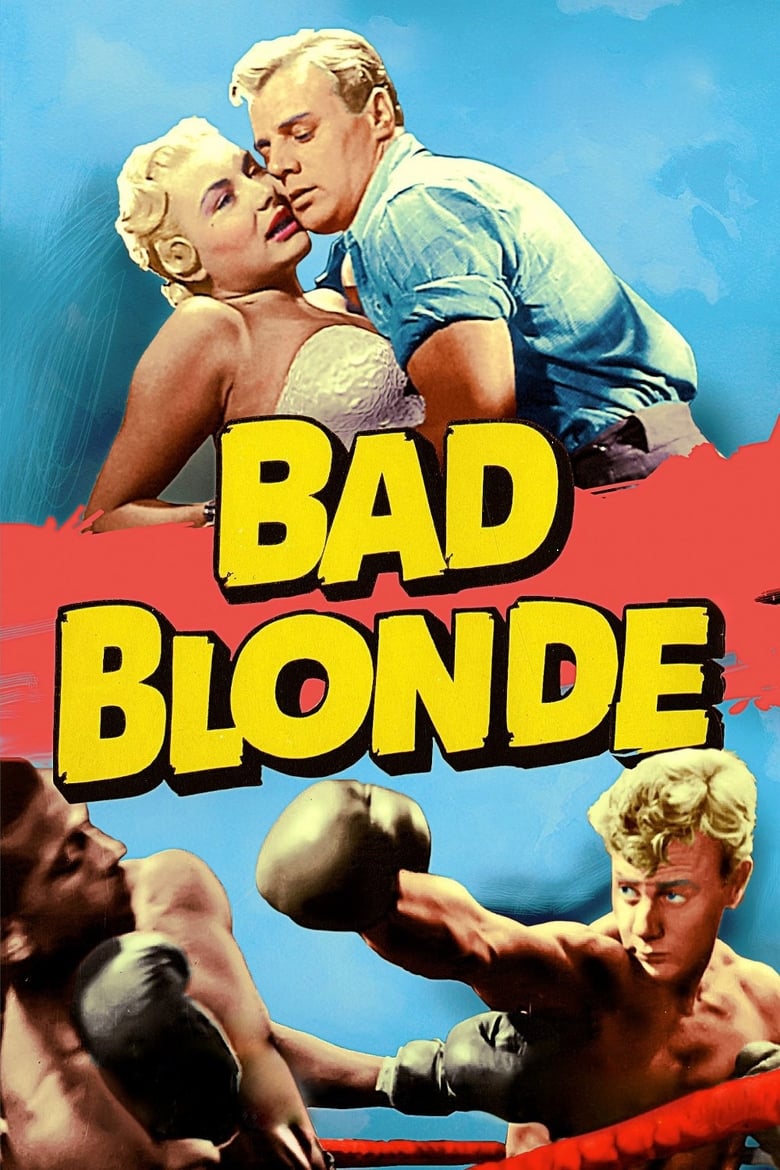
In postwar London, aging Italian boxing promoter Giuseppe Vecchi takes on a new fighter, the ambitious Johnny Flanagan, and installs him in his household. Vecchi's much younger American wife, Lorna, is restless, contemptuous of her husband's milieu, and drawn immediately to Flanagan. The domestic arrangement is precarious from the first frame: Lorna moves through the Vecchi home like a woman already planning her exit.
Lorna and Johnny begin an affair that both accelerates and corrodes. Vecchi's associate Sharkey – a fixer with his own calculations – and the promoter's manager Charlie Sullivan observe the household's deterioration with varying degrees of complicity. When the affair tilts toward violence, the question of who is manipulating whom becomes genuinely unstable. Vecchi's protective family circle, including his sister and her husband, begins to close in on the younger couple, and Johnny discovers that loyalty to Lorna carries a price he had not priced correctly.
Bad Blonde works the femme fatale template with a degree of social specificity unusual for the British quota quickie context in which it was produced. The film is less interested in suspense mechanics than in the corrosive arithmetic of desire and self-interest, placing it closer to the psychological strand of noir than to the procedural. Hammer's early 1950s programme of American-inflected crime pictures provides the framework, but the Anglo-Italian setting and cast give the film a texture that distinguishes it from its transatlantic models.
Bad Blonde is a minor but honest entry in Hammer's early-decade cycle of noir imports – productions designed to satisfy the British quota requirement while trading on American genre conventions. Reginald Le Borg, a journeyman director with genuine competence in low-budget crime material, keeps the film moving without drawing attention to its constraints. Barbara Payton, already in personal and professional decline by 1953, brings an authentic edge of desperation to Lorna that no purely technical performance could manufacture; the biographical freight she carries into the role is inseparable from what the camera finds in her. Frederick Valk's Vecchi is more than the cuckolded patriarch the script requires – he registers genuine pathos. What the film reveals about its era is the anxiety attending transgressive femininity in the early 1950s: Lorna is punished not simply because she commits a crime but because she refuses the domestic settlement postwar culture expected women to accept. The British setting sharpens that argument, placing American sexual candor against a backdrop of Old World obligation.
– Classic Noir
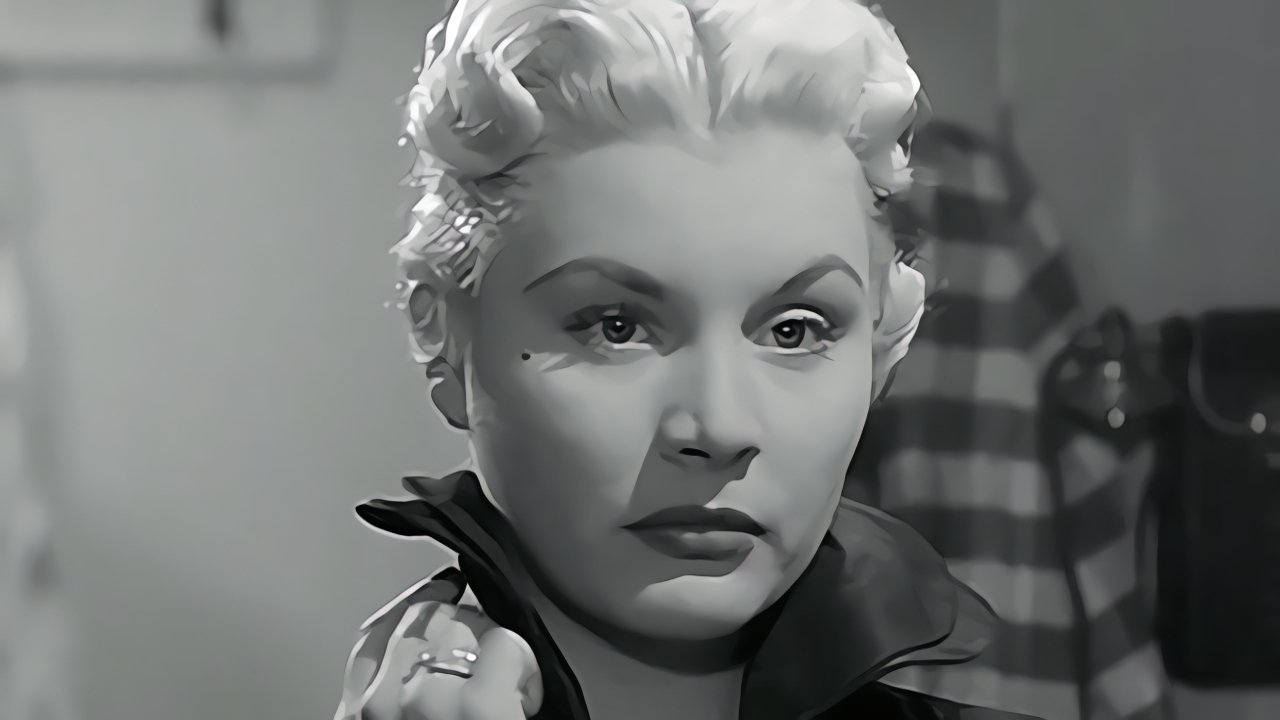
The scene is lit from a single practical source – a bedside lamp that catches Lorna in three-quarter profile while leaving the doorway behind her in near-total shadow. Walter J. Harvey holds the composition tight, with Lorna's face occupying the left third of the frame and the unlit room pressing in from the right. The camera does not move; it waits, the way an interrogator waits. When Johnny enters, he enters the dark side of the frame first, his face only partially resolved before he steps into the lamp's radius.
The geometry of the shot encodes the film's central argument: Lorna is the visible thing, the legible danger, while the men around her are defined by how much of themselves they choose to reveal. The stillness of Harvey's camera refuses to editorialize – it presents Lorna without the destabilizing close-up intensity that a more expressionist treatment would impose, which makes her calculation feel colder and, finally, more credible. The scene establishes that she has already decided; the conversation that follows is performance.
Walter J. Harvey shoots Bad Blonde as a studio picture that knows its limits and works within them with economy. The film was made at Bray in controlled conditions, and Harvey uses that control to build a consistent moral atmosphere through shadow gradients rather than through location texture. His lighting setups favor strong lateral sources that produce hard-edged shadows on domestic walls, converting ordinary interiors into spaces of entrapment. There is no wasted light in Harvey's scheme: Vecchi's home looks prosperous but sealed, and Harvey uses ceiling shadows to lower the apparent height of rooms, producing a mild but persistent claustrophobia. The lens work is conservative – standard focal lengths without the wide-angle distortion that American noir was increasingly deploying in the same period – which keeps the performances central and the environment secondary. That choice suits the film's psychological priorities. Harvey's cinematography on Bad Blonde does not announce itself, but it is doing precise moral work: every frame suggests a world in which there is no clean exit.
Tubi has carried several Hammer noir titles from this period and is the most likely free streaming source for Bad Blonde, though availability varies by region.
Archive.orgFreePublic domain prints of early Hammer productions occasionally appear on Archive.org; image quality is variable but access is unrestricted.
Amazon Prime VideoSubscription / RentalAmazon's catalog of British B-pictures from the 1950s includes several Hammer titles; availability as a Prime inclusion or a low-cost rental is plausible but should be verified.