
When Chris Emery's husband is found dead in Trinidad under circumstances that suggest suicide, the local police are not entirely convinced. Into this unresolved situation arrives Steve Emery, the dead man's brother, skeptical of the official account and openly suspicious of Chris herself. She is a nightclub performer – glamorous, composed, and carrying secrets she is not yet prepared to share. The colonial island setting, with its heat and transient population, provides cover for men who prefer their activities unexamined.
Chris is, in fact, working at the direction of British intelligence, cultivating the patronage of Max Fabian, a wealthy and well-connected figure suspected of operating a spy network with Cold War implications. Steve's arrival threatens to expose her arrangement before it yields results, and his antagonism toward her – rooted partly in grief, partly in an attraction he refuses to acknowledge – places both of them in increasing danger. Fabian is perceptive, his associate Veronica Huebling is watchful, and the circle around them is not one that tolerates loose ends.
Affair in Trinidad belongs to the cycle of postwar studio noirs that situated Cold War paranoia within the conventions of the romantic thriller. The intelligence plot gives the film a geopolitical dimension that the domestic noir rarely admitted, while the pairing of Rita Hayworth and Glenn Ford – reunited nearly a decade after Gilda – invites the audience to read the tension between them as something older and more personal than the mission at hand.
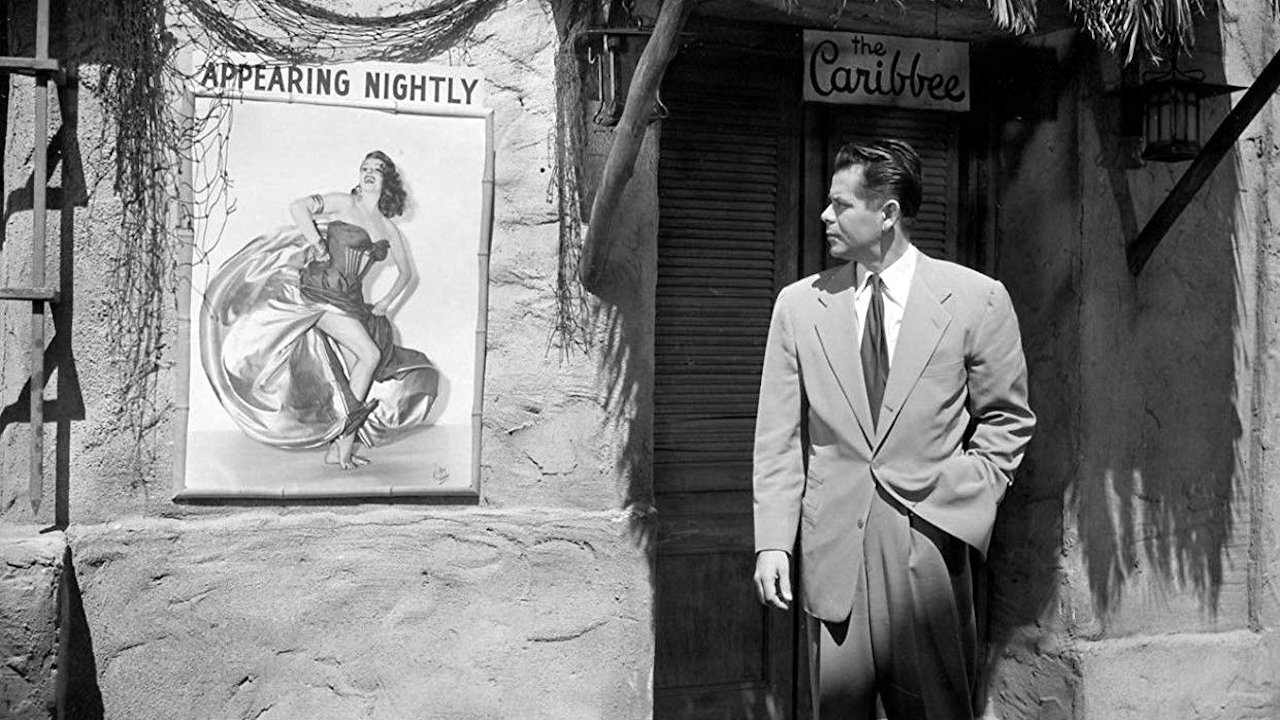
Affair in Trinidad arrives weighted with expectation it cannot fully satisfy. Columbia's attempt to recapture the chemical friction of Gilda results in a film that is competent, periodically tense, and finally hemmed in by its own caution. Vincent Sherman directs with professionalism but without the pressure that Charles Vidor brought to the earlier picture; scenes that should feel dangerous resolve too cleanly. What the film does achieve is a credible portrait of a woman using performance as a survival strategy – Chris Emery's nightclub routines are not incidental, they are how she manages what knows and controls what others see. Hayworth brings that understanding to the role even when the screenplay does not fully articulate it. The Cold War scaffolding, with its network of European émigrés and shadowy syndicates, reflects the anxieties of 1952 more than it deepens them. As a document of a particular moment in the studio system's management of its female stars – controlled, exhibited, and ultimately protected from genuine moral ambiguity – the film repays attention.
– Classic Noir
Joseph Walker lights the nightclub sequence with a hard central spot that isolates Hayworth against a mid-ground darkness where the tables and their occupants become shapes rather than faces. The camera holds at a middle distance that places her body fully in frame while allowing the edges of the composition to crowd with watching figures. There is no glamour lighting in the conventional sense – the fill is minimal, and the shadows that fall across the surrounding crowd suggest enclosure rather than atmosphere. When the camera does move, it tracks laterally, keeping her in the light while the background shifts, reinforcing the sense that the performance is a fixed point around which threat circulates.
The scene is the film's argument in miniature: Chris performs because she must, and the act of performance is indistinguishable from the act of surveillance. She is watched by Fabian, by Steve, by the camera itself, and her control over what she reveals – in the dance, in her expression, in the practiced neutrality of her body – is the only agency the narrative allows her. The watching men believe they are reading her; the film suggests they are seeing only what she has chosen to show.
Joseph Walker, whose career at Columbia extended back to Frank Capra's Depression-era work, brings to Affair in Trinidad a lighting grammar shaped more by studio efficiency than by the low-key expressionism associated with noir's canonical examples. That restraint is not without purpose. Walker's interiors favor controlled contrast – enough shadow to establish unease, enough fill to keep Hayworth's face legible to an audience that has paid to see it. The Caribbean exteriors, a mixture of location material and studio reconstruction, are handled with a flat, documentary brightness that makes the island feel less like an exotic refuge than a place where normal rules have been suspended rather than abolished. His lens work keeps focal lengths conventional, avoiding the wide-angle distortions that noir cinematographers used to signal psychological instability. The visual stability is itself a choice: in a film about concealment, a world that looks normal is more threatening than one that announces its danger.
TCM holds strong rights to the Columbia library of this period and airs Affair in Trinidad with some regularity; the broadcast print is typically the most reliable source for the film at correct aspect ratio.
Amazon Prime VideoRentalAvailable to rent in HD through Amazon's digital storefront, making it accessible without a cable or streaming subscription.
TubiFree (Ad-Supported)Tubi has carried the film in rotation; print quality varies, but it represents the most accessible no-cost option for casual viewing.