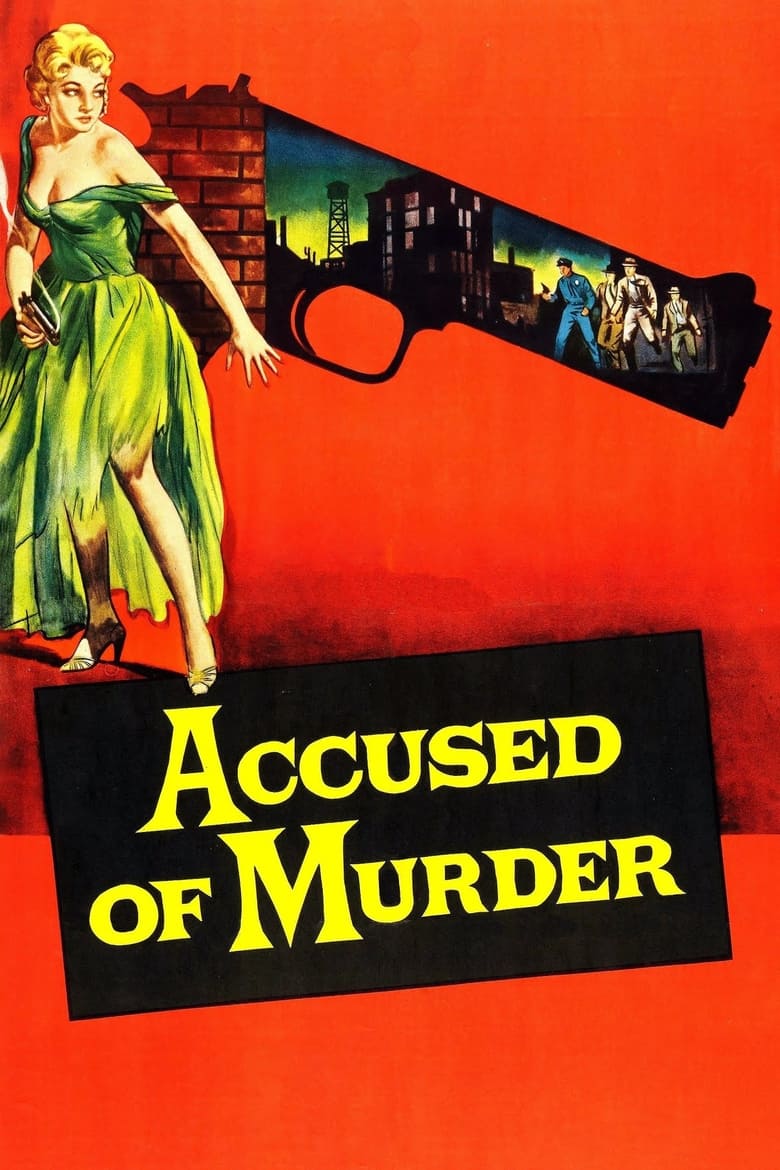
When a powerful attorney named Frank Hobart is found shot dead, suspicion falls on Ilona Vance, a nightclub singer who had been seen with him shortly before his death. Police Lieutenant Roy Hargis leads the investigation, a methodical and not entirely incorruptible cop who finds himself drawn to Ilona even as the evidence against her accumulates. Sandra Lamoreaux, a woman with her own entanglements in Hobart's orbit, complicates the picture from the outset.
As Hargis digs deeper, the underworld figure Stan 'Scarface' Wilbo emerges as a presence that neither the police nor the witnesses can comfortably ignore. Allegiances shift among those who knew Hobart, and the boundary between witness and suspect proves permeable. Hargis's partner, Sergeant Emmett Lackey, and Captain Smedley push for a swift resolution, while Hargis resists the tidiness of the obvious conclusion, sensing that the case has been arranged for him rather than discovered.
Accused of Murder works within the procedural branch of noir, where the investigator's moral clarity is tested not by his own corruption but by the system's appetite for a convenient answer. Republic Pictures produced it on a modest budget that keeps the film intimate rather than expansive, and that intimacy serves a story fundamentally concerned with what a detective chooses to see and what he allows himself to overlook.
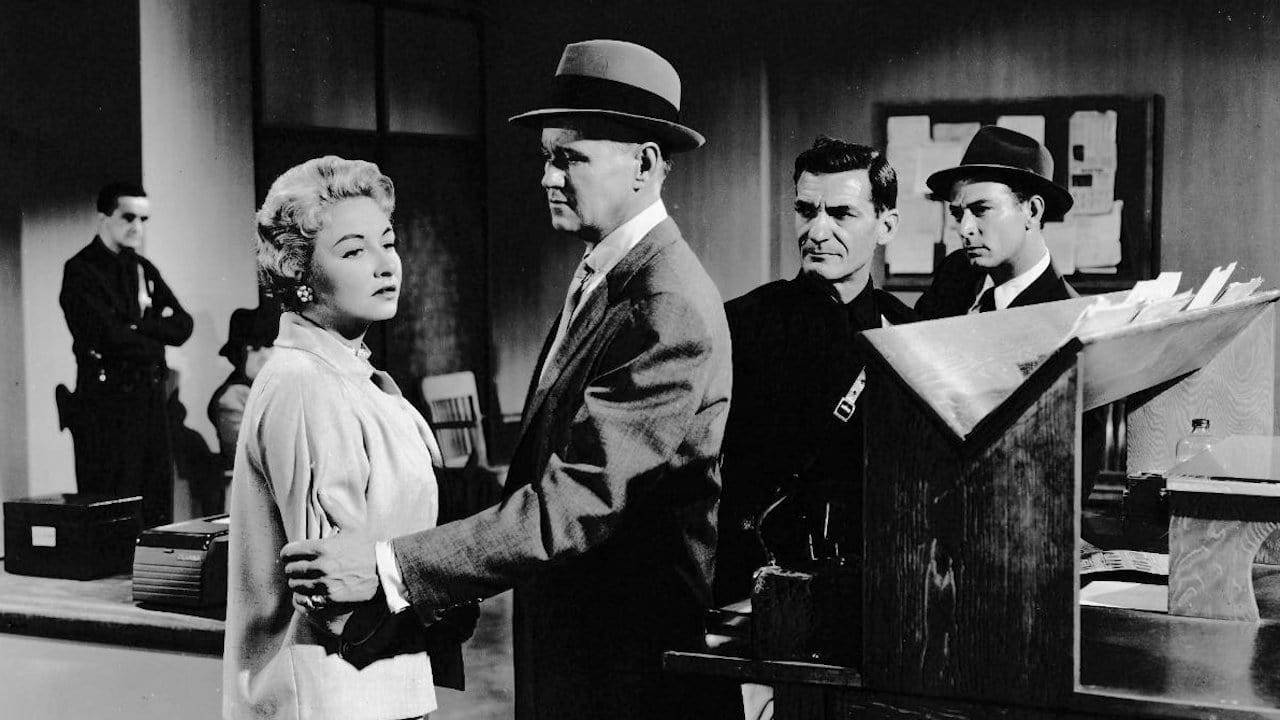
Accused of Murder occupies a specific and underexamined position in the Republic Pictures noir cycle of the mid-1950s – a studio-system procedural that subordinates flashiness to function. Joseph Kane was primarily a Western director, and that background inflects the film's rhythm: confrontations are direct, geography is legible, and moral stakes are stated rather than insinuated. What distinguishes the film from routine programmatic noir is the casting tension between David Brian's blunt authority and Vera Ralston's studied composure, which generates an ambiguity the script sometimes struggles to sustain. Lee Van Cleef, billed beneath the principal cast, delivers the film's most precisely calibrated performance as Sergeant Lackey – menace worn quietly, as was his habit at this stage of his career. The film reflects a moment when the classical noir template was being absorbed into television procedural conventions, and that absorption produces a hybrid: efficient, undecorated, and more attentive to institutional pressure than to individual psychology.
– Classic Noir
Bud Thackery positions the camera at table level, holding Ilona in a three-quarter frame with a single overhead practical source cutting hard shadow beneath her cheekbones. Hargis remains partially outside the frame to the left, present as voice and shoulder rather than face, so that the interrogation reads as pressure from an unseen source. The background is a flat grey wall with no softening element – no window, no texture – which compresses the space and removes any suggestion of exit.
The composition externalises the film's central argument: Ilona is not simply a suspect but a figure reduced by institutional process to a legible object. Her stillness in the frame refuses the camera's demand for guilt or innocence, and Hargis's physical absence from the shot registers as an abdication – a detective who has already begun to exempt her from the logic he is professionally required to apply.
Cinematographer Bud Thackery worked predominantly within the Republic Pictures system, developing a studio-bound visual economy that maximised shadow contrast on constrained budgets. On Accused of Murder he employs a largely fixed-lens approach in medium and close range, avoiding the expressive wide-angle distortions common to bigger-budget noir and instead relying on the placement of single-source lighting rigs to do moral work. Interior scenes use practical lamp sources motivated by nightclub fixtures or desk lamps, with fill light suppressed to a degree unusual even for the genre, leaving significant portions of supporting characters in obscurity. The visual logic is consistently associative: those who hold institutional power – police captains, senior counsel – are lit in fuller, flatter light, while Ilona and the underworld figures occupy a more fragmentary chiaroscuro. Whether this reflects deliberate authorial intent or the efficient habits of a craftsman working quickly, the effect is a consistent grammar that gives the film's moral ambiguity a visual correlative.
Tubi regularly carries Republic Pictures titles from this era and is the most reliably accessible free option for this film.
Archive.orgFreeA public domain print may be available here, though image quality can vary significantly between uploaded versions.
Amazon Prime VideoSubscription or RentalRepublic mid-decade titles surface periodically through Prime's rotating catalogue; availability should be verified at time of viewing.