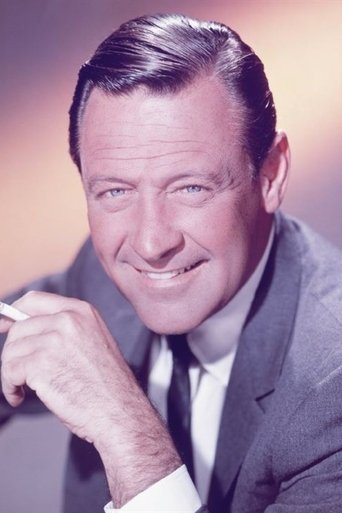
William Franklin Beedle Jr. was born in O'Fallon, Illinois, in 1918, the son of a petroleum executive and a former actress. After attending Pasadena Junior College and participating in local theatre, he was spotted by a Paramount talent scout and signed with the studio in 1937, spending his early years in supporting roles and B-pictures, gradually building a reputation as a reliable leading man. His breakthrough came during World War II service with the Army Air Forces, after which he returned to cinema with renewed dramatic authority. By the late 1940s, Holden had become one of Hollywood's most bankable stars, capable of anchoring both commercial vehicles and ambitious character studies.
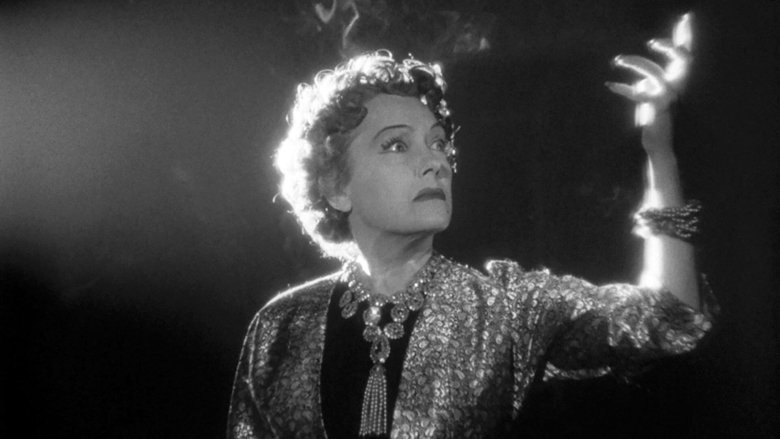
His entry into noir came through a series of calculated collaborations that revealed unexpected depths in his persona. In Billy Wilder's Sunset Boulevard (1950), Holden played Joe Gillis, a struggling screenwriter fatally attracted to faded silent-film star Norma Desmond, delivering perhaps the most self-aware performance in American cinema–a man narrating his own moral dissolution from beyond the grave. The role required him to balance charm with desperation, innocence with complicity, making Gillis simultaneously sympathetic and condemnable. This performance established Holden as an actor capable of exploring the psychological complexities that distinguished noir from mere melodrama.
Holden's subsequent noir work deepened his exploration of masculine vulnerability and professional corruption. In Rudolph Maté's Union Station (1950), he played a railroad detective racing against time to prevent a kidnapping, while in Maté's The Dark Past (1948), he had portrayed a psychologically damaged fugitive holding a family hostage — roles that required him to project both menace and moral complexity in equal measure. William Dieterle's The Turning Point (1952) cast him as a crusading attorney compromised by loyalty and ambition. These roles allowed Holden to modulate his naturally affable demeanor into something more unsettling — a surface competence concealing inner fracture. Unlike the hard-boiled archetypes of Mitchum or Bogart, Holden's noir men were recognizably modern, educated, and initially sympathetic, which made their moral failures more psychologically penetrating and philosophically troubling.
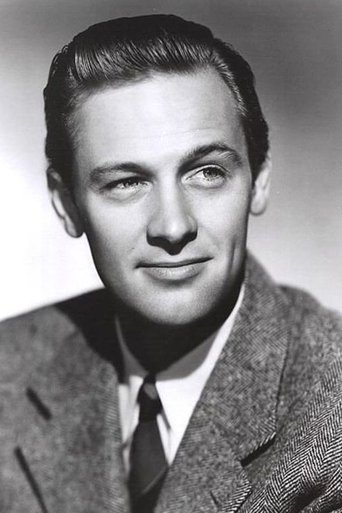
Beyond noir, Holden maintained a distinguished career spanning five decades, earning three Academy Award nominations and winning Best Actor for Stalag 17 (1953). He became known for his professionalism, intelligence, and versatility, working with directors from Frank Capra to David Lean. His later years saw him increasingly concerned with wildlife conservation in Africa. Holden died in Santa Monica in 1981, leaving behind a legacy as one of cinema's most human and psychologically acute actors.
Holden embodied the noir protagonist who begins as fundamentally moral yet finds himself ensnared by circumstance, desire, or a fateful encounter. His performances revealed the fragility of respectability and the ease with which ordinary men could descend into complicity and moral compromise, making him the era's most convincing portrait of American vulnerability.