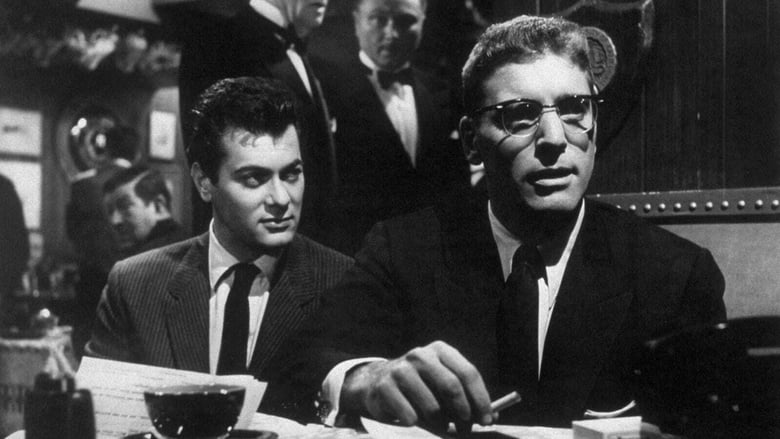
Bernard Schwartz entered Hollywood in the mid-1940s as a contract player for Universal, his early work marked by conventional leading-man roles in costume dramas and light comedies. His real opportunity came when he began accepting darker, more complex parts that aligned with the emerging noir sensibility. By the early 1950s, Curtis had positioned himself as a versatile performer willing to inhabit morally compromised characters–a willingness that distinguished him from his studio-system peers and opened doors to the era's most prestigious crime films.
Curtis's noir period coincided with his transition from supporting player to bankable star. His brief dance cameo in director Robert Siodmak's Criss Cross (1949)—in which Burt Lancaster starred as armored-car guard Steve Thompson—gave Curtis an early on-screen moment before his own starring career took hold. Though his role was a mere cameo, the film would prove significant context for his later noir work. The film's success validated his ambition to tackle substantive dramatic material.
Sweet Smell of Success (1957), his collaboration with director Alexander Mackendrick, remains his noir masterpiece. As Sidney Falco, the scheming press agent servile to a powerful gossip columnist, Curtis delivered one of cinema's most uncomfortable and penetrating portrayals of moral degradation. The role required him to suppress traditional movie-star charisma in favor of oily desperation and verbal dexterity. Critics and fellow actors recognized the performance as a landmark achievement, demonstrating that Curtis possessed rare range and commitment to complex characterization.

Though Curtis would continue acting through multiple decades and genres, his noir work remains his most artistically significant contribution to American cinema. Those films–particularly Criss Cross and Sweet Smell of Success–revealed an actor capable of profound psychological authenticity when given material that challenged rather than flattered him. His willingness to play unsympathetic, flawed characters helped redefine the leading man for a generation.
Curtis embodied the driven, somewhat desperate young man clawing upward through crime and moral compromise. His roles often featured charm masking vulnerability–a figure caught between aspiration and the criminal underworld's seductive gravity. He brought unexpected depth to morally ambiguous climbers who discover the cost of their own ambition.