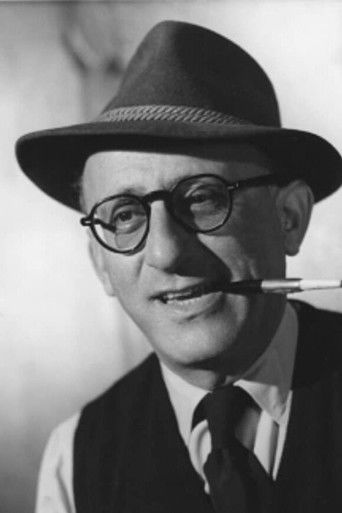
Robert Siodmak was born in Dresden, Germany, to a German-Jewish family and spent his formative years in Leipzig, Germany. He entered the film industry during the Weimar period, working as a screenwriter and editor before transitioning to direction in the late 1920s. His early German films established him as a versatile craftsman, but the rise of Nazism forced him to flee Europe in 1933. He worked briefly in France and England before arriving in Hollywood in 1940, where he would achieve his greatest recognition and influence.
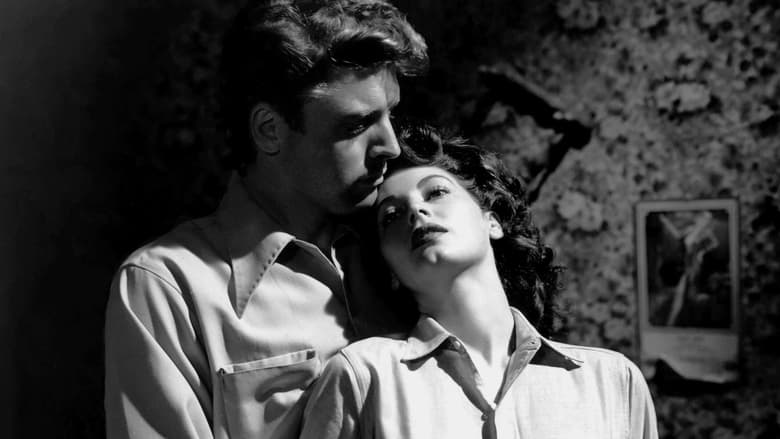
Siodmak's Hollywood career crystallized during the war years and immediate postwar period, when he became Universal's master of psychological thriller-noirs. Unlike his American contemporaries who favored crisp realism, Siodmak favored oblique angles, deep shadows, and subjective camera work derived from German cabinet cinema. His collaboration with cinematographer Elwood Bredell and composer Miklós Rózsa produced a distinctive visual vocabulary–one where the frame itself seemed warped by the protagonist's internal anguish. Films like *Phantom Lady* (1944) and *The Killers* (1946) established him as Hollywood's preeminent visualizer of fractured consciousness.
The mid-1940s represented Siodmak's artistic apex. *The Killers*, adapted from Hemingway, announced the arrival of a major directorial voice, while *Criss Cross* (1949) perfected his technique of spatial disorientation and moral ambiguity. His films featured doomed protagonists trapped by circumstance, desire, or their own psychology–men who discover that escape is impossible and redemption merely nostalgic fantasy. Though less prolific than some peers, Siodmak's influence on noir's visual grammar proved immeasurable, particularly in his treatment of female characters as complex agents of destiny rather than mere objects.
By the 1950s, Siodmak's star dimmed as production trends shifted and the noir cycle waned. He continued working steadily but never recaptured the creative fervor of his Universal years. His later films, while competent, lacked the psychological intensity and formal innovation that defined his masterworks. Siodmak relocated to Europe in his later years and died in 1973, respected by younger filmmakers but increasingly overlooked by critics who had moved on to new auteurs. His legacy was eventually restored through retrospectives and the rediscovery of his expressionist innovations in the nouvelle vague and modern psychological thrillers.
Siodmak brought European expressionism and Freudian psychology to American noir, constructing labyrinthine narratives where visual style overwhelms plot. His films are baroque chambers of guilt and paranoia, where camera angles and lighting become instruments of inner torment rather than mere decoration.