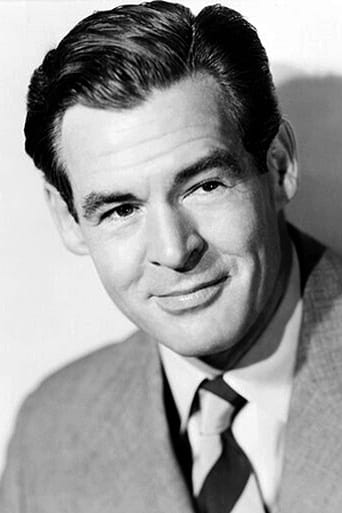
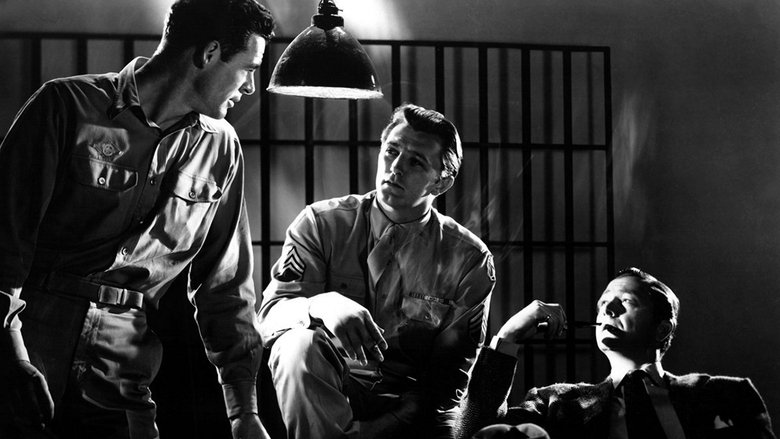
Robert Bushnell Ryan Jr. was born in Chicago, Illinois, the son of a newspaper publisher and ranching family. He studied drama at Dartmouth College and served in the United States Marine Corps during World War II, experiences that would inform the steely authenticity he brought to postwar cinema. After his discharge, Ryan moved to Los Angeles and signed with RKO Pictures, initially typecast in minor roles before his talent and physical presence–a lean, angular frame combined with penetrating eyes–attracted the attention of directors seeking complex masculine leads.
Ryan's emergence as a noir icon coincided with the genre's maturation in the mid-1940s. His role as the bigoted soldier in Edward Dmytryk's Crossfire established him as an actor capable of portraying moral complexity and social commentary with devastating precision. Unlike many of his contemporaries, Ryan refused easy heroism; his protagonists were flawed, tormented men grappling with systemic injustice. His collaboration with Robert Wise on The Set-Up produced one of noir's most unflinching examinations of corruption and moral compromise in the boxing world.
Throughout the 1950s, Ryan became increasingly selective with his roles, preferring scripts that engaged serious social themes. His later work in Odds Against Tomorrow demonstrated his range as an actor willing to explore the psychology of desperation and racial conflict. Ryan brought Shakespearean gravity to pulp material, elevating B-pictures into meditations on American violence and complicity. His very presence on screen suggested a man at war with himself and the world around him.
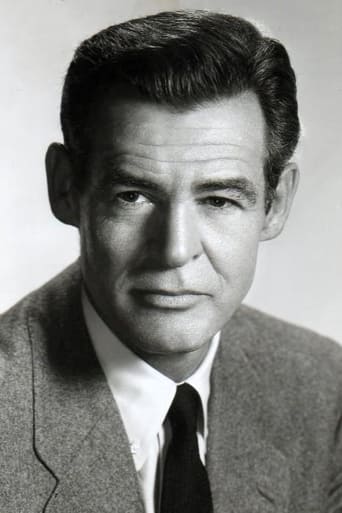
Beyond noir, Ryan maintained a distinguished career in theater and prestige dramas, but his legacy remains inseparable from the genre's greatest moral examinations. He died in Los Angeles in 1973, having established himself as one of cinema's most principled and intellectually rigorous actors. His work stands as a rebuke to the notion that noir was mere entertainment; in Ryan's hands, it became a vehicle for social conscience.
Ryan embodied the noir protagonist driven by conscience rather than cynicism, a man willing to confront corruption and prejudice even when the system conspired against him. His characters possessed a restless integrity that made them dangerous to the status quo, transforming him into noir's most ideologically committed hero.