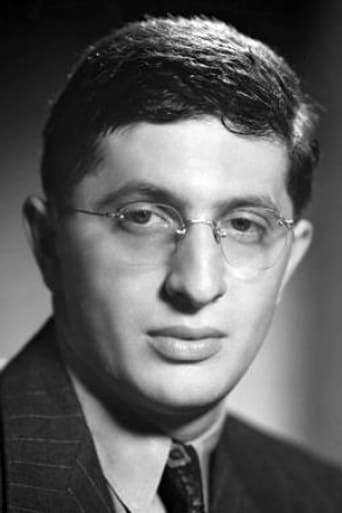
Bernard Herrmann was born in New York City in 1911, the son of a Russian-Jewish pharmacist and a concert pianist. He studied at New York University and the Juilliard School, where his precocious talent earned him early recognition. By his twenties, Herrmann had already established himself as a composer and conductor, leading orchestras and writing concert works that drew attention from the American avant-garde. His transition to film scoring came through radio–he composed for CBS Radio broadcasts throughout the 1930s, developing the narrative instincts that would define his cinema work.
Herrmann's collaboration with Orson Welles on Citizen Kane (1941) established him as cinema's most innovative voice, though the film's complex scoring actually belongs more to the realm of American realism than noir proper. His true noir period began in the mid-1940s, when he worked extensively with director Fritz Lang. Herrmann's approach was revolutionary: he rejected the lush romanticism of traditional Hollywood scoring in favor of stark, angular themes that mirrored noir's visual expressionism. His use of unusual instruments–vibraphone, theremin, and unconventional string arrangements–created an unsettling modernity that perfectly captured the genre's post-war malaise.
Throughout the 1950s, Herrmann became increasingly associated with psychological thrillers and crime films, scoring masterpieces like Vertigo for Alfred Hitchcock. His partnership with Hitchcock would become legendary, but it was his noir work that established the template: music as a character itself, as a manifestation of inner torment. Herrmann's scores for films like The Trouble with Harry and Marnie demonstrated his ability to make the mundane sinister, to suggest menace beneath ordinary surfaces–the very essence of noir sensibility.
Herrmann remained a towering figure in American cinema through the 1960s, though his uncompromising artistic vision and combative personality often put him at odds with studios and producers. He died in 1975, having fundamentally altered how composers understood their role in cinema. His influence on film scoring remains immeasurable; generations of composers have studied his work to understand how music could transform narrative into psychological experience.
Herrmann represents the composer as storyteller–one who understood that film noir's visual darkness demanded an equally complex sonic landscape. His scores didn't merely accompany noir's moral ambiguity; they embodied it, using dissonance, unconventional orchestration, and leitmotif to externalize the protagonist's psychological deterioration.