Films People Pull a Fast One Night Beat Reading Room On TV Shop
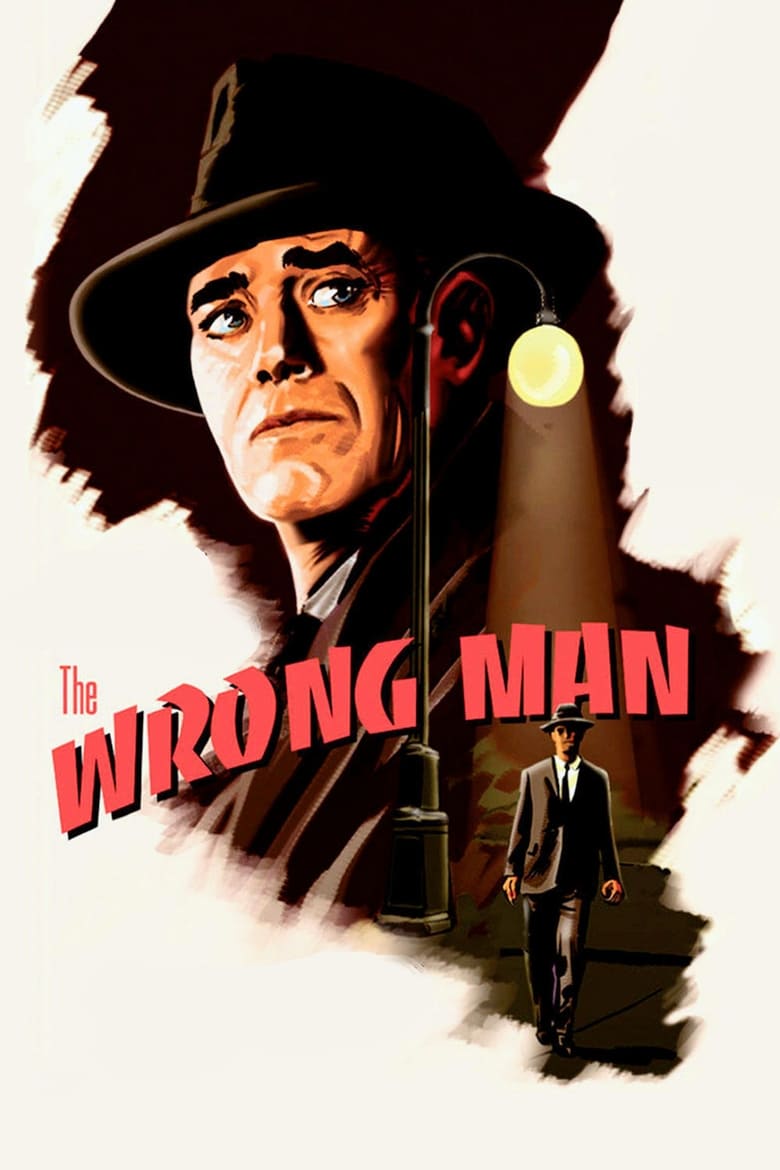
Wrong Man 1956
1956 Warner Bros. Pictures
★★★☆☆ Notable
Film Noir · 105 minutes · Black & White

Wrong Man

Directed by Alfred Hitchcock
Year 1956
Runtime 105 min
Studio Warner Bros. Pictures
TMDB 7.1 / 10
"An innocent man watches the machinery of justice grind forward, indifferent to the truth."

Manny Balestrero is a bass player at the Stork Club in New York City, a quiet family man struggling to keep pace with his household bills. When he visits an insurance office to inquire about borrowing against his wife's policy, the clerks recognize him – or believe they do – as the man who robbed them months earlier. Within hours, Manny is in police custody, processed through a system that treats resemblance as evidence and silence as guilt.

Rose Balestrero, already fragile under the pressure of the family's finances, begins to fracture as the legal ordeal extends. Attorney Frank O'Connor takes the case and works methodically through witnesses and alibis, but each avenue closes. Rose withdraws into a breakdown that the film treats not as melodrama but as a logical response to an irrational world. Manny, sustained by a faith both religious and temperamental, continues to maintain his innocence against a bureaucratic current that has already decided otherwise.

The Wrong Man occupies an unusual position in the noir canon: it is based on a true case, and Hitchcock foregrounds that fact from the opening frames. The film does not traffic in femmes fatales or criminal conspiracies. Its dread is procedural and institutional – the fear that identity itself can be a liability, that the state's mechanisms of order are also mechanisms of destruction.

Classic Noir

Hitchcock called The Wrong Man his most realistic film, and the claim holds under scrutiny. Shot largely on location in Queens and Manhattan, it refuses the expressionist distortions that noir conventionally uses to signal moral disorder. The disorder here is embedded in ordinary rooms, fluorescent-lit corridors, and the bureaucratic rituals of arrest and arraignment. That plainness is the argument. Henry Fonda's performance is stripped of the charisma that typically anchors innocent-man narratives; Manny is passive, bewildered, almost colorless, which is precisely the point. Vera Miles's deterioration is the film's most demanding work, a portrait of a mind collapsing not from weakness but from the weight of a situation with no rational resolution. Bernard Herrmann's score operates at the edge of silence, threading anxiety through restraint rather than crescendo. In its refusal of catharsis and its clinical attention to institutional process, The Wrong Man stands as one of the period's most clear-eyed statements about the relationship between the individual and the state.

– Classic Noir
3 ★★★☆☆ Notable
Credits

The Crew

DirectorAlfred Hitchcock
ScreenplayAngus MacPhail
CinematographyRobert Burks
MusicBernard Herrmann
EditingGeorge Tomasini
Art DirectionPaul Sylbert
ProducerAlfred Hitchcock
Performances

The Cast

Close Reading

The Signature Scene

Wrong Man – scene
The Police Lineup Faces Behind the Glass

Manny stands in a lineup behind a one-way mirror, the light falling hard and flat on his face while the witnesses remain invisible in darkness on the other side. Robert Burks frames Manny in a medium shot that gradually tightens, the institutional walls closing in without any camera movement dramatic enough to announce itself. The witnesses' voices arrive disembodied, off-screen, reducing Manny to an object of scrutiny. The composition holds him slightly off-center, surrounded by strangers who share only his height and coloring.

The scene distills the film's central terror: the gaze of accusation is structurally anonymous, and the accused has no recourse against it. Manny cannot argue, explain, or appeal to character. The system requires only that he stand still and be looked at. It is the noir condition rendered in its purest institutional form – guilt assigned not through evidence of action but through the act of being seen.

Visual Language

The Cinematography

🎞️
Robert Burks – Director of Photography

Robert Burks, Hitchcock's principal cinematographer through much of the 1950s, makes a deliberate departure in The Wrong Man from the controlled studio work they shared on films like Rear Window and Vertigo. Shot on location across New York City – the Stork Club, the Queens streets, the actual courthouse and jail where the real Balestrero was processed – Burks employs a narrower tonal range than noir convention demands. Shadows are present but not theatrical; lighting tends toward the harsh and institutional, particularly in the police procedural sequences, where overhead fluorescents strip away any romantic ambiguity. Burks and Hitchcock resist the wide-angle distortions associated with guilt and paranoia, reserving visual compression for specific moments of psychological collapse. The effect is a film that looks almost like a documentary until the moment it doesn't, when a slow spiral into Rose's breakdown requires the camera to finally break from its own restraint. The visual language earns its one moment of expressionism by withholding it so long.

In the Catalogue

Themes & Motifs

Availability

Where to Watch

Also in the Directory

See Also