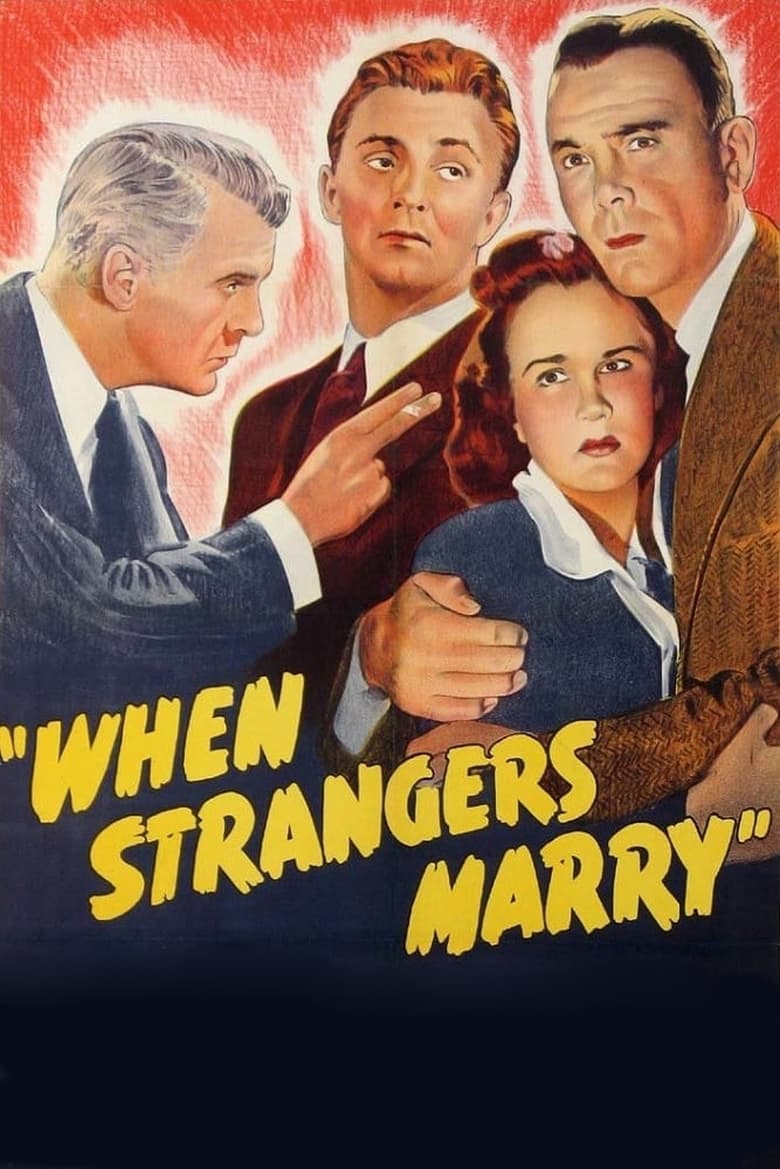
Millie Baxter arrives in New York having recently married Paul Baxter, a traveling salesman she barely knows. She checks into a hotel and waits for him to appear, passing the hours in a city that offers her no comfort and no familiar face. When Paul finally arrives, the reunion is uneasy – he is evasive about his recent movements, and Millie, despite her relief, cannot quite suppress a growing unease about the stranger sharing her room.
A series of murders has been troubling the city, and Detective Lieutenant Blake is working the case with methodical patience. Fred Graham, an old acquaintance of Millie's who carries feelings for her that have not entirely faded, re-enters her life and begins to notice inconsistencies in Paul's account of himself. The question of where Paul was during the killings hangs over the marriage like weather, and Millie finds herself caught between loyalty to her husband and the evidence her own instincts are accumulating.
When Strangers Marry constructs its suspense not from elaborate plot mechanics but from the psychological pressure of intimacy with an unknown quantity. The film belongs to the wartime cycle of domestic noir – stories in which the home offers no refuge and the person closest to you may be the source of the threat. It is a film about what a woman is asked to trust, and what it costs her when that trust is tested.
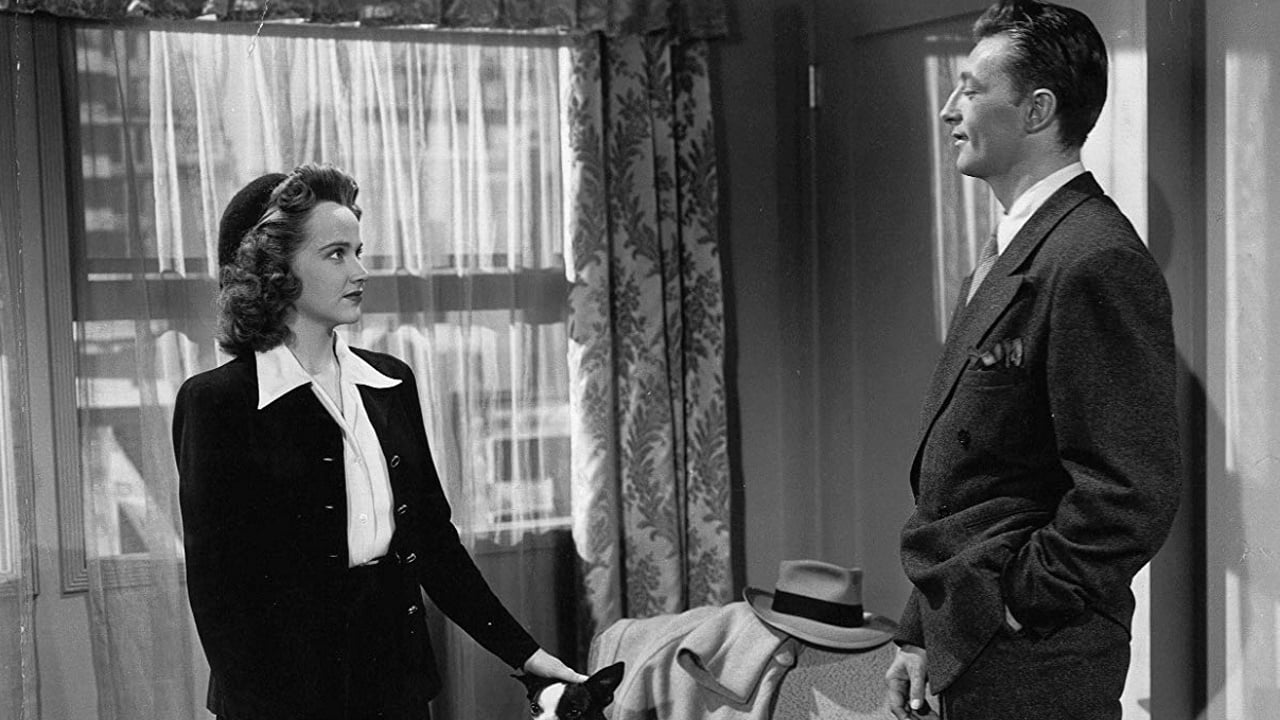
Made on a budget that would barely cover a single day of studio shooting at a major lot, When Strangers Marry is a minor-key achievement that repays close attention. William Castle, still years from his carnival-barker period, directs with a restraint that serves the material well – the film's tension depends on withholding, on the gap between what Millie knows and what the audience suspects. Dean Jagger brings genuine ambiguity to Paul, never quite tipping into guilt or innocence, and Kim Hunter's Millie is a credible center: perceptive rather than passive, her loyalty tested rather than simply exploited. Robert Mitchum, in an early supporting role, registers with the minimal effort that would soon make him a star. The film fits squarely within the wartime anxiety cycle – marriages formed quickly, strangers sharing lives before they understand each other – and Castle channels that social reality into something economical and genuinely unsettling. At sixty-seven minutes, it wastes nothing.
– Classic Noir
Castle and cinematographer Ira H. Morgan frame Millie in a medium shot inside the hotel room, the light source low and practicalfalling from a single bedside lamp that leaves the corners of the room in soft darkness. The door to the corridor occupies the far edge of the frame, slightly out of focus but present as a constant visual possibility. When a sound registers from outside, Morgan holds the camera on Hunter's face rather than cutting to the source – the effect is to locate the scene's tension entirely in her perception, in what she expects or fears the door to reveal.
The scene argues, economically, that the domestic space is not neutral ground. The hotel room – transient, anonymous, neither his nor hers – functions as a visual correlative for the marriage itself: a temporary arrangement whose permanence has not yet been established. Millie's stillness in the frame is not passivity but vigilance, and the scene's refusal to confirm or deny the threat outside the door positions her as a woman who must interpret the world without adequate information – which is, the film suggests, precisely the situation marriage has placed her in.
Ira H. Morgan shoots When Strangers Marry with the disciplined economy that low-budget production demands and that noir, fortunately, rewards. Working predominantly on studio interiors dressed to suggest New York transience – hotel corridors, cheap lobbies, rain-slicked streets implied rather than shown – Morgan relies on concentrated key lighting and controlled shadow pools rather than the diffuse studio fill that would have softened the film's moral edges. His lens choices favor a slightly compressed middle-focal-length range that keeps characters in plausible spatial relation to their environments without the distortion of wide-angle expressionism. The shadow work is not decorative; it tracks the distribution of knowledge in each scene, leaving characters partially obscured at precisely the moments when their intentions are most in doubt. The result is a visual language in which what cannot be seen carries as much weight as what can, and in which the frame's limited depth mirrors the limited information available to Millie – and, by design, to the audience.
The film is in the public domain and available for free streaming and download in multiple transfers of varying quality.
TubiFreeTubi has carried public domain noir titles from this period and is worth checking for a more stable streaming presentation than Archive.org.
Amazon Prime VideoSubscriptionAvailable periodically through Prime or as a low-cost rental via third-party channels; confirm current availability before seeking.