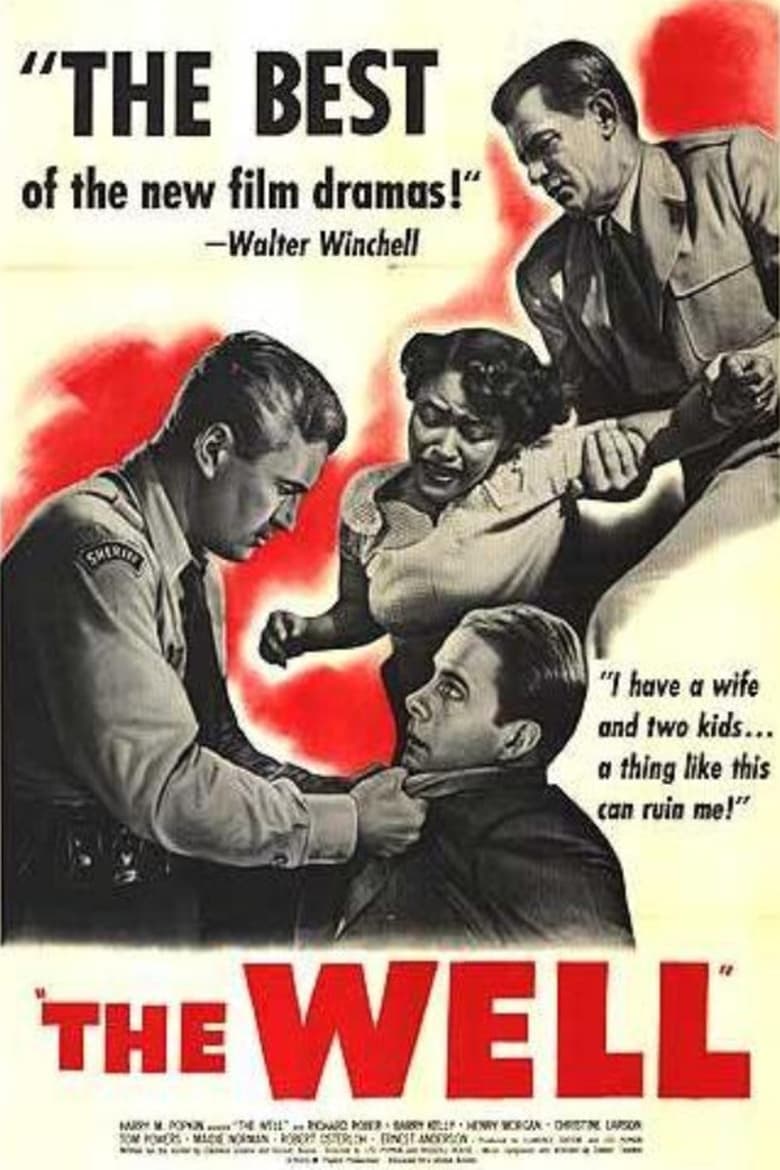
In a small California community, a young Black girl named Carolyn Crawford vanishes after falling into an abandoned well on the outskirts of town. Her father Ralph and mother Martha, working-class people with little standing in the county, are the first to raise the alarm. Reporter Ben Kellogg arrives to cover what seems a routine local tragedy, only to find the story expanding faster than anyone can contain it.
As rescue workers and volunteers converge on the site, the operation becomes a spectacle, drawing crowds, media attention, and competing authorities whose priorities have little to do with the child below. Racial tensions, long suppressed beneath the town's surface civility, begin to fracture as the community's response reveals who it considers worth saving and on what terms. Kellogg finds himself implicated in the machinery of sensation he came to document.
The Well works within the social-problem strand of postwar American noir, using the physical fact of a trapped child as a lens through which systemic indifference and collective guilt are examined. Russell Rouse constructs the film as a kind of procedural in reverse: rather than solving a crime, the investigation keeps exposing new ones, none of them punishable by law.
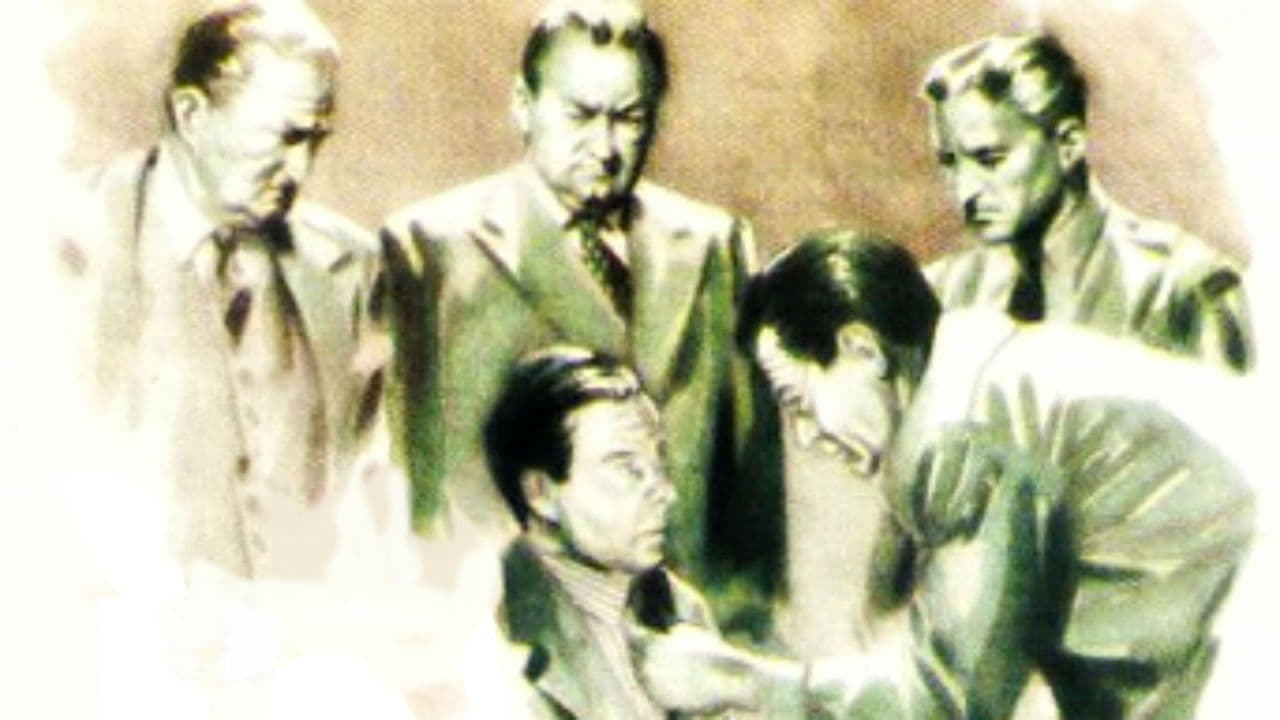
The Well is a film that does not flinch from its subject, though its methods are those of restraint rather than provocation. Russell Rouse and co-writer Clarence Greene use a child-in-peril scenario to excavate racial fault lines in postwar American civic life, and the result belongs to a precise and uncomfortable subgenre: the crisis film in which institutional response is itself the indictment. The casting of Gwendolyn Laster and the decision to foreground the Crawford family's dignity against the town's reflexive suspicion give the film a moral seriousness that most of its contemporaries avoided. Ernest Laszlo's location photography grounds the film in a physical reality that studio production could not have replicated. Where The Well exceeds its immediate social-problem ambitions is in its structural irony: the rescue effort, which should be the story's redemptive center, becomes instead a theatre of competing self-interests. The film received an Academy Award nomination for editing and has been largely absent from serious noir discussion, an omission that reflects genre taxonomy's tendency to privilege style over argument.
– Classic Noir
Laszlo composes the scene from above and at a slight angle, the well's circular opening cutting a hard geometric shape into the dirt. Portable work lights ring the perimeter, casting overlapping pools that illuminate the faces of the workers nearest the edge while leaving the crowd behind them as a mass of indistinct silhouettes. The camera holds its position rather than cutting, allowing the viewer to feel the duration of waiting. Sound does most of the work at the frame's edges – voices, equipment, radio static – while the image maintains its stillness.
What the scene argues, through composition alone, is the distance between effort and result, between the visible labor of rescue and the invisible fact of a child at the bottom of a shaft no light can fully reach. The well mouth functions as the film's governing symbol: a void that the community's best energies circle without entering, a darkness they can illuminate only at the rim. The geometry makes plain what the screenplay handles with more caution – that proximity is not the same as rescue, and attention is not the same as care.
Ernest Laszlo shoots The Well with an attention to actual topography that distinguishes it from the studio-bound social-problem films of its moment. Working on location in Fillmore, California, Laszlo uses wide-angle lenses to situate human figures within the landscape rather than against it, making the scrubland and the well site feel indifferent to the drama playing out above them. His lighting strategy at night involves practical sources – work lights, car headlamps, flashlights – used as diegetic illumination rather than cinematic convention, which gives the night sequences a documentary credibility unusual for 1951 independent production. Shadow work in the interior and crowd sequences emphasizes what falls outside the frame of official concern: the Crawford family is repeatedly composed in partial darkness while officials and reporters occupy the lit foreground. Laszlo's later work on Judgment at Nuremberg and Fantastic Voyage demonstrates a range few DPs of his generation matched, and The Well shows his instinct for moral geometry already fully formed.
Tubi has carried The Well in a watchable public-domain print; confirm availability before viewing as catalog titles rotate.
Archive.orgFreeArchive.org hosts a freely accessible version; print quality varies but it remains the most reliably permanent option.
KanopyFree (Library)Kanopy's classic film holdings occasionally include titles from independent 1950s production; check availability through your local library system.