Films People Pull a Fast One Night Beat Reading Room On TV Shop
Tight Spot 1955
1955 Columbia Pictures
★★★☆☆ Notable
Film Noir · 97 minutes · Black & White

Tight Spot

Directed by Phil Karlson
Year 1955
Runtime 97 min
Studio Columbia Pictures
TMDB 6.5 / 10
"A woman who knows too much is worth exactly as much as she is useful."

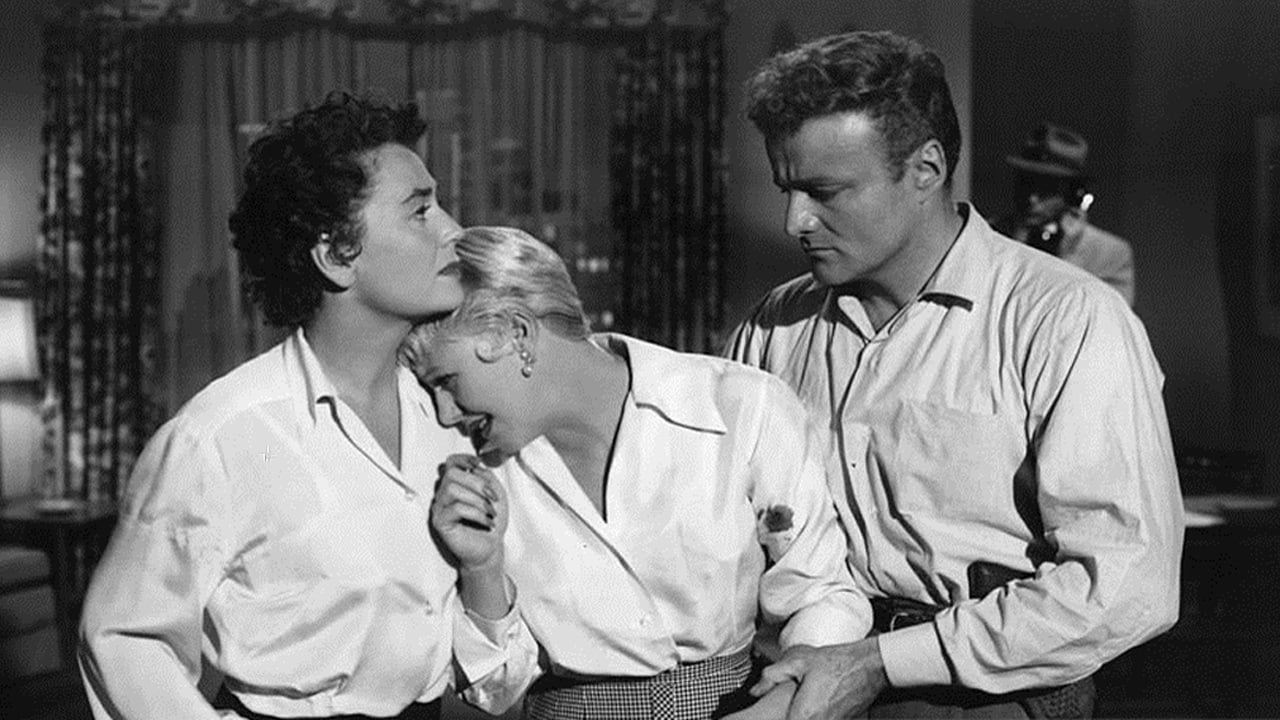
Sherry Conley (Ginger Rogers) is a small-time criminal serving time in a women's prison when federal prosecutor Lloyd Hallett (Edward G. Robinson) arrives with a proposition: testify against Benjamin Costain (Lorne Greene), the ruthless syndicate boss whose men have silenced every other potential witness, and she walks free. Sherry is moved to a hotel room under the watch of detective Vince Striker (Brian Keith), where the state's case against Costain depends entirely on whether she can be kept alive long enough to reach the courtroom.

Confined to the hotel suite, Sherry and Striker develop a wary, combative intimacy that neither fully trusts. Hallett, a man of rigid prosecutorial conviction, applies pressure from above while Costain's organization applies it from below – bribing hotel staff, threatening Sherry's family, and staging a near-successful assassination attempt within the building itself. Sherry, calculating her odds with the detachment of someone who has survived on instinct, must decide whether Hallett's promised immunity is worth the very real possibility that she will not survive to collect it.

Tight Spot belongs to a mid-decade cycle of procedural noirs in which the machinery of law enforcement is shown to be as compromised and coercive as the criminal networks it pursues. The film uses the confined hotel setting not merely as a practical staging ground but as a pressure chamber in which the moral distance between the state and the syndicate steadily collapses. Rogers, working against her established comic persona, delivers a performance of controlled calculation that anchors the film's skepticism about institutional protection.
Classic Noir

Tight Spot arrives in 1955 at a moment when studio noir was beginning to interrogate its own procedural certainties. Phil Karlson, whose career had already demonstrated a facility for institutional rot in films like Kansas City Confidential, uses the confined hotel setting to compress a question the genre had been circling for years: what exactly separates the state's leverage over a witness from the syndicate's? Edward G. Robinson's Hallett is not a villain, but the film refuses to let him be a hero either – he is a mechanism of prosecution, and Sherry Conley is his instrument. Rogers earns her place in the film's moral architecture by refusing to make Sherry sympathetic in the conventional sense; she is shrewd, self-interested, and entirely rational given her circumstances. Lorne Greene's Costain, cold and largely offscreen, functions less as a character than as a structural force. Burnett Guffey's cinematography keeps the hotel rooms visually oppressive without resort to expressionist excess. The film is not among the decade's most formally inventive noirs, but its procedural skepticism and Rogers's performance give it a durability that outlasts its modest reputation.

– Classic Noir
3 ★★★☆☆ Notable
Credits

The Crew

DirectorPhil Karlson
ScreenplayWilliam Bowers
CinematographyBurnett Guffey
MusicGeorge Duning
EditingViola Lawrence
Art DirectionCarl Anderson
ProducerLewis J. Rachmil
Performances

The Cast

Close Reading

The Signature Scene

Tight Spot – scene
The Hotel Room, Night Shadows Across the Threshold

Burnett Guffey frames Sherry alone in the hotel room's outer sitting area, the single practical lamp on the desk throwing a cone of light that barely reaches the far wall. The camera holds at mid-distance, refusing to move closer, so that Sherry occupies only the center of the frame while the room's margins dissolve into shadow. When a sound comes from the corridor, Guffey cuts to a low angle at the door – the gap beneath it lit from outside, a thin line of light that could mean a guard or something worse. The sound design carries the weight the image withholds.

The scene makes explicit what the film has been building toward: the hotel room promised as sanctuary is indistinguishable in atmosphere from a cell. Sherry's stillness here is not passivity but calculation – she is reading the situation with the same dispassion she has applied to every arrangement the state has offered her. The frame's refusal to resolve the threat formally enacts the film's argument that protection and captivity are, in her situation, the same condition.

Visual Language

The Cinematography

🎞️
Burnett Guffey – Director of Photography

Burnett Guffey, working at Columbia through a period that would eventually yield his Oscar-winning work on Bonnie and Clyde, brings to Tight Spot the disciplined economy of a cinematographer who understood confinement as a visual problem with moral implications. The film is shot almost entirely on studio interiors, and Guffey uses that limitation deliberately: walls close in incrementally across the runtime, practical light sources become more isolated, and the geometry of the hotel suite shifts from merely cramped to architecturally hostile. He avoids the deep-focus chiaroscuro that had defined earlier noir in favor of something flatter and more suffocating – a middle-gray palette in which darkness is less a dramatic effect than a condition. Lens choices stay conservative, holding characters in two-shots that deny them private space even in conversation. The visual language does not aestheticize the trap; it reproduces it.

In the Catalogue

Themes & Motifs

Availability

Where to Watch

Also in the Directory

See Also