In a quiet California town, Helen Walters anticipates the return of her brother-in-law Johnny after years of unexplained disappearance. Her husband dead, her young son Doug in need of a father figure, and her mother-in-law clinging to the hope of family restored, Helen allows Johnny back into the household with cautious warmth. Johnny is charming, attentive, and plausible – a man who seems to have merely drifted and now wishes to settle. Against this domestic arrangement, local insurance investigator Mike Randall takes an interest, both in Helen and in the questions Johnny's reappearance quietly raises.
Randall's suspicions sharpen as details accumulate that Johnny cannot satisfactorily account for. The film draws its tension from the domestic interior itself – the dinner table, the hallway, the child's bedroom – spaces that noir typically abandons in favor of street corners and back rooms. Mrs. Walters, the mother, resists any reading of her son that might cost her his presence, and her loyalty becomes a liability. Helen, caught between the warmth Johnny projects and the evidence Randall assembles, is the film's moral center: a woman who must weigh what she needs against what she knows.
Step Down to Terror is a domestic noir built on displacement and concealed violence, a film in which the threat does not arrive from outside the home but has been invited through the front door. It belongs to a cycle of postwar American pictures that located criminal pathology within family structures rather than criminal organizations, treating the household as a site of psychological danger. The film's modest scale is also its method: the closer the frame, the more confined the escape.
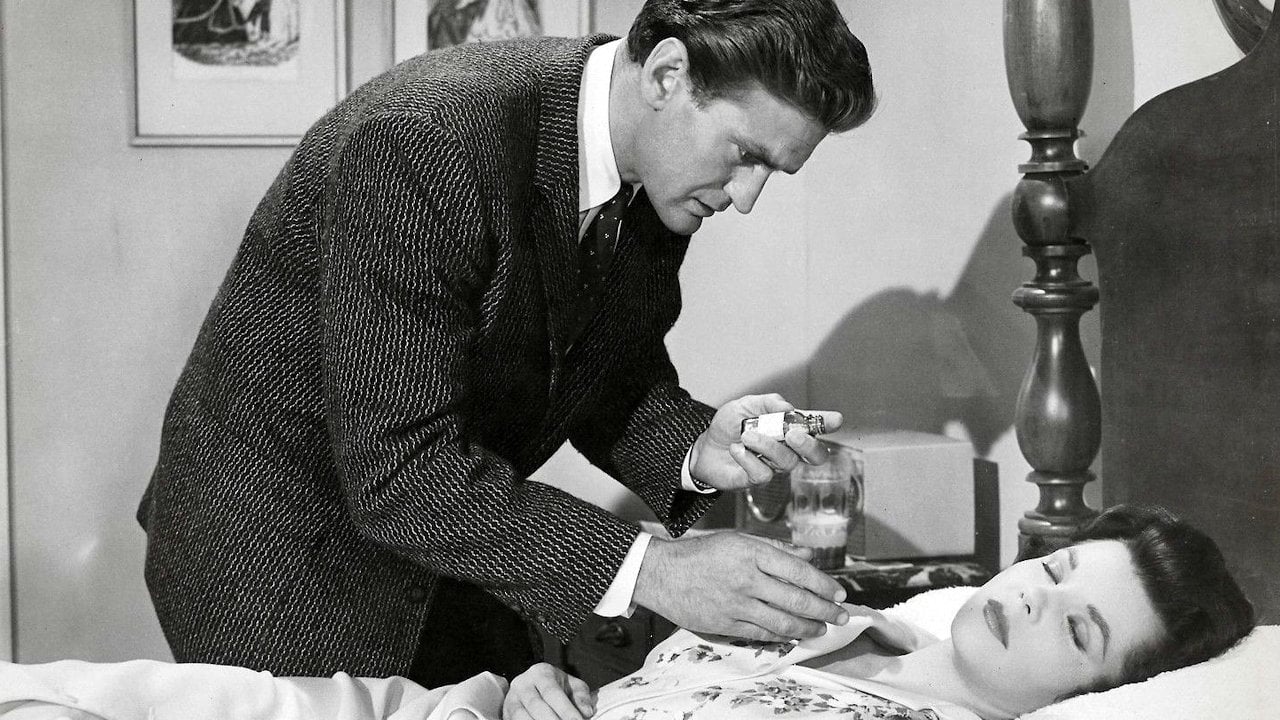
Step Down to Terror is a loose, uncredited remake of Alfred Hitchcock's Shadow of a Doubt (1943), transplanting the Santa Rosa template to similarly sun-bleached small-town California and replacing Hitchcock's formal precision with the more functional visual grammar of late-cycle Universal International noir. Director Harry Keller works efficiently within tight constraints, and the film is most interesting as a document of how the domestic noir premise had migrated, by 1958, from prestige thriller to programmers. Rod Taylor brings a credible menace to Johnny Walters that exceeds the material's ambitions, and his performance alone earns the film attention beyond its B-picture station. Russell Metty's cinematography – more restrained here than his concurrent work on bigger productions – uses the domestic interiors to compress rather than illuminate, turning ordinary rooms into holding spaces. The film does not transcend its source or its budget, but it demonstrates how efficiently genre conventions could be redeployed, and how the figure of the returning male – corrupted, predatory, plausible – retained genuine cultural anxiety in postwar American cinema.
– Classic Noir
Metty frames Helen in a narrow upstairs corridor, the light from a partially open door falling at a low angle across the floor between her and Johnny's room. The camera holds at a slight remove, refusing to close in, so that the space itself becomes the subject – the geometry of a domestic interior that has become a trap. Shadow cuts across the wall behind Helen at a diagonal, bisecting the frame and isolating her figure. There is no dramatic movement; the scene's tension is entirely compositional.
The held distance of the camera here articulates the film's central argument: Helen is not an actor in this situation so much as a person slowly comprehending the space she occupies. The light beneath the door is the film's recurring moral image – something present, not quite visible, requiring a decision she does not yet have the information to make. The scene does not force resolution; it simply records the weight of proximity to danger one has let inside.
Russell Metty, working here at a register well below his collaborations with Douglas Sirk in the same period, nonetheless brings to Step Down to Terror a coherent visual logic. Shooting largely on studio interiors dressed to suggest a working-class California domestic space, Metty confines his lighting to sources that make narrative sense – table lamps, hallway fixtures, daylight through curtained windows – rather than the more expressionistic setups he applied elsewhere. The effect is a mild, persistent claustrophobia: rooms that appear ordinary but refuse to release their occupants. Metty's lens choices stay close to standard focal lengths, avoiding the wide-angle distortion that more stylized noir employed to signal psychological instability. The restraint is purposeful. In a film whose horror depends on the familiar appearing safe, Metty keeps the visual register just plausible enough that each deviation – a shadow that falls wrong, a doorway that frames a figure too tightly – registers as a genuine disruption rather than a stylistic signature.
Tubi has carried Universal International programmers from this period and is the most likely free streaming source, though availability should be confirmed.
Archive.orgFreePublic domain status for some prints of this film makes Archive.org a plausible source; picture quality varies by uploaded print.
Amazon Prime VideoRentalRental or purchase through Amazon offers the most reliable access to a consistent print if streaming sources are unavailable.