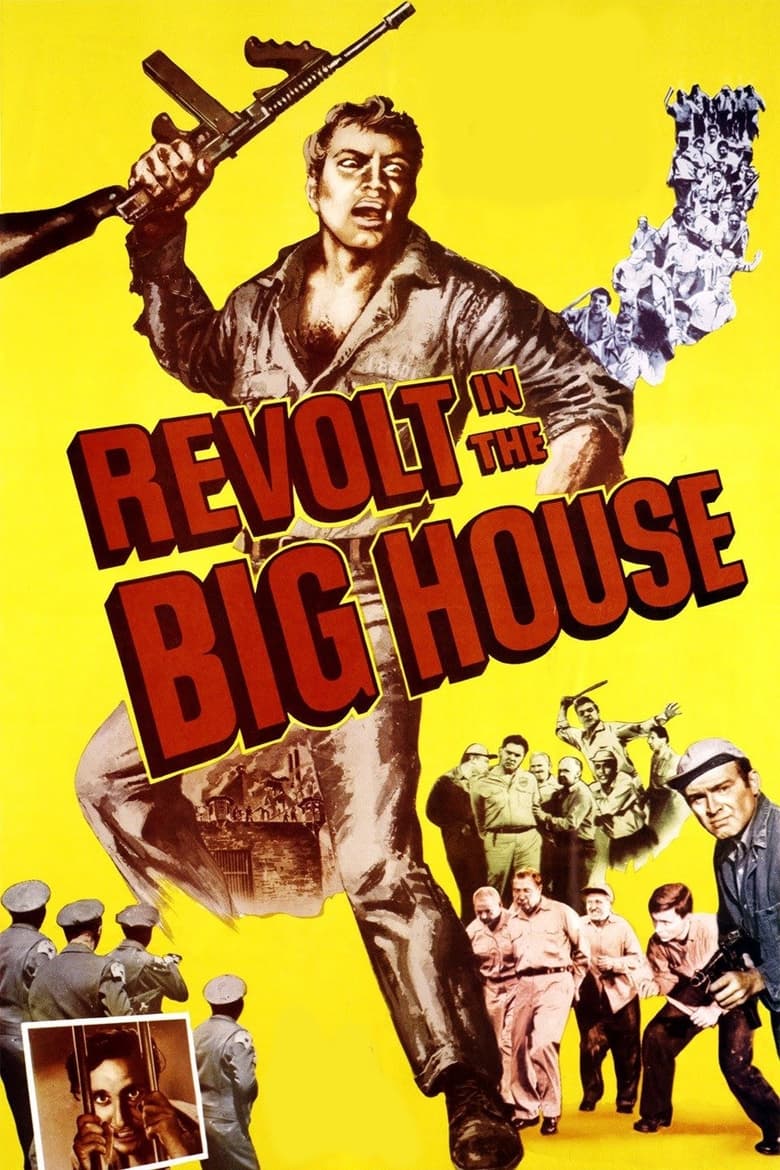
Lou Gannon (Gene Evans) arrives at a state penitentiary with a reputation and an agenda. A hardened career criminal, he moves quickly to consolidate power among the inmate population, identifying the weak points in the prison's hierarchy and the men he can use. Among those he draws into his orbit are Rudy Hernandez (Robert Blake), a young prisoner still capable of reform, and Ed 'Bugsy' Kyle (Timothy Carey), a volatile and unpredictable killer whose usefulness is matched only by his capacity for chaos.
Gannon's plan for a full-scale prison revolt takes shape through a web of coercion and calculation. Doc (John Qualen), an aging inmate who has made a separate peace with confinement, resists being drawn in. Guard Captain Starkey (Walter Barnes) senses the pressure building but cannot locate its source. The alliance between Gannon and Kyle grows increasingly unstable as Kyle's erratic behavior threatens to detonate the scheme prematurely, and Rudy begins to question whether the violence Gannon is engineering serves any purpose beyond Gannon's own escape.
Revolt in the Big House belongs to the cycle of late-1950s prison films that used the penitentiary as a compressed social arena – a place where institutional authority and criminal will grind against each other in full view. The film is less interested in the mechanics of the uprising than in the moral cost extracted from those caught between the instigators and the state, and it positions Rudy's crisis of conscience as the film's moral fulcrum.
Revolt in the Big House is a lean, unshowy entry in Allied Artists' mid-period crime output, directed by R.G. Springsteen with the efficiency of a filmmaker who understood genre constraints and worked within them without apology. What distinguishes the film is its cast. Gene Evans brings a coiled, pragmatic menace to Gannon that avoids melodrama; he is not a ranting villain but a man who applies criminal intelligence the way a foreman applies labor. Timothy Carey, always one of American cinema's most genuinely unsettling performers, gives Kyle a feral unpredictability that no other actor of the period could replicate. Robert Blake, still years from his television celebrity, locates something genuinely ambivalent in Rudy – a young man who understands that Gannon's logic is seductive precisely because it is coherent. The film reads, in retrospect, as a document of its moment: the late-1950s anxiety about institutional authority, the question of whether systems of confinement reform or simply defer violence, and the particular American suspicion that the men running prisons and the men locked inside them may not be as different as the uniform suggests.
– Classic Noir
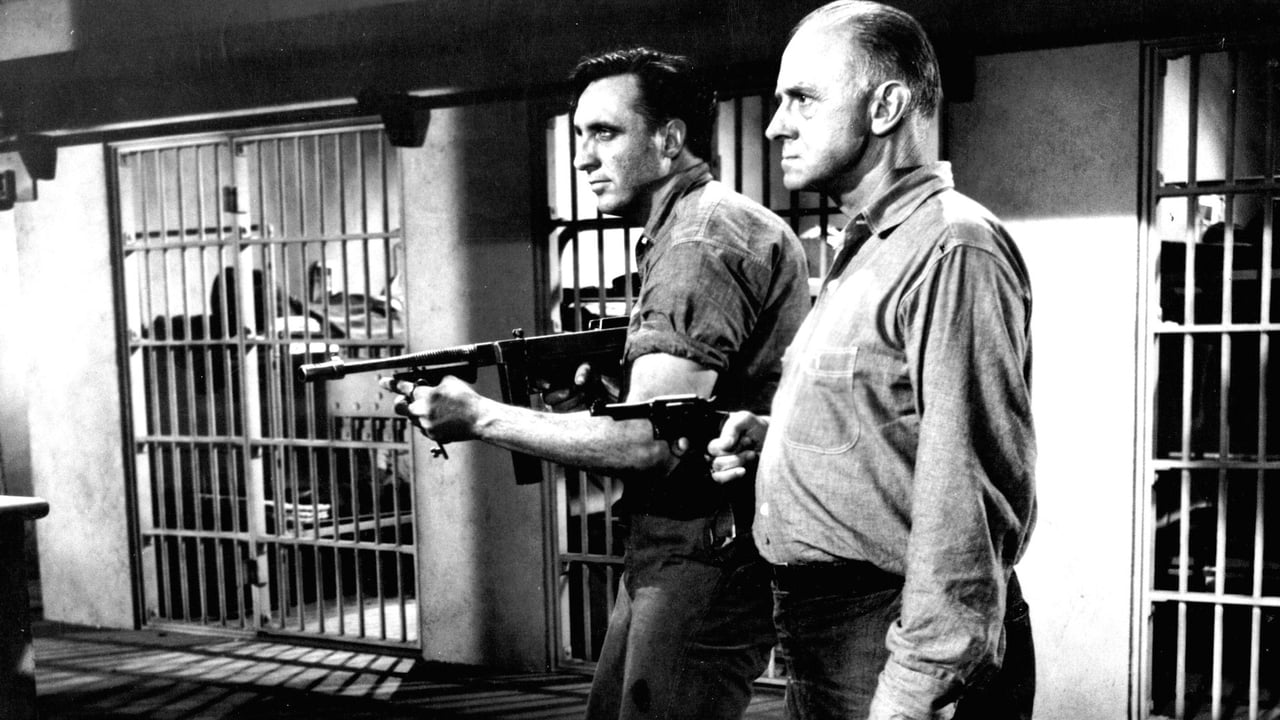
The camera holds at a low angle in the narrow cell block passage, the overhead institutional lights throwing hard parallel shadows across the concrete floor. Carey's Kyle fills the foreground, his body angled to block the frame, while Evans' Gannon stands deeper in the shot, partially obscured. William Margulies does not move the camera; the compression of the space does the work, the geometry of the corridor enforcing the power dynamic without editorial commentary.
The scene crystallizes the film's central instability: Gannon believes he controls Kyle, and Kyle knows otherwise. Nothing is resolved here, but the audience understands that the revolt's real danger is not the prison administration but the ally Gannon cannot fully predict. Carey's stillness – more threatening than any display of aggression – makes the point that within systems built on force, the man immune to calculation is the most dangerous variable.
William Margulies shoots Revolt in the Big House with the disciplined economy of a cinematographer who had come up through B-picture production and knew how to extract atmosphere from constrained resources. Working largely on studio-constructed sets that approximate the architectural monotony of a real penitentiary, Margulies uses overhead institutional lighting not as a limitation but as a moral instrument – the flat, unsparing light of the cell block strips away shadow and with it the possibility of concealment, while the rare scenes in partial darkness acquire a weight precisely because they depart from that norm. His lens choices favor moderate wide angles that emphasize the geometry of confinement: doorframes, bars, and corridors become compositional elements that contain the characters as surely as the prison itself does. There is no attempt at visual flourish; the restraint is the point. The camera's neutrality mirrors the institution's, and the effect is quietly oppressive.
Tubi has carried Allied Artists titles from this period with some regularity and is the most likely free point of access for this film, though availability should be confirmed.
Archive.orgFreeIf the film has entered the public domain, Archive.org may offer a full streaming version at no cost, though print quality varies.
Amazon Prime VideoRentalAllied Artists catalog titles from the late 1950s appear periodically as low-cost rentals on Amazon; check current availability.