Stan Grayson (Kevin McCarthy) is a jazz musician who wakes from a vivid, disturbing dream in which he stabbed a man in a mirrored room and stole a key from his body. The dream has the texture of memory rather than fantasy: he finds a woman's hair in his hand, a strange key in his pocket. When a man turns up dead in circumstances that align with what Stan dreamed, his private anxiety hardens into something approaching certainty. He may have committed a murder in a state he cannot consciously access, and he cannot identify the victim, the room, or how he came to be there.
Stan's brother-in-law, police detective Rene Bressard (Edward G. Robinson), takes the case with a skepticism that professional habit compels him toward and a personal loyalty that pulls him back. As the investigation proceeds, the outlines of a conspiracy emerge: Stan has been the instrument of a hypnosis-based murder plot, placed and retrieved from the scene without conscious awareness. The architects of the scheme believed they had constructed an untraceable crime, and they very nearly had. The film traces Bressard's methodical dismantling of their construction alongside Stan's increasingly desperate effort to recover what he did and did not do.
Maxwell Shane's film – a remake of his own 1947 Fear in the Night, which starred DeForest Kelley in the McCarthy role – is adapted from Cornell Woolrich's story "And So to Death," and it carries that source's characteristic atmosphere of psychological instability made concrete. The hypnosis premise serves as a formal correlate for noir's broader preoccupation with the gap between guilt and knowledge: a man held responsible for an act he may or may not have performed, by a will he may or may not have exercised.
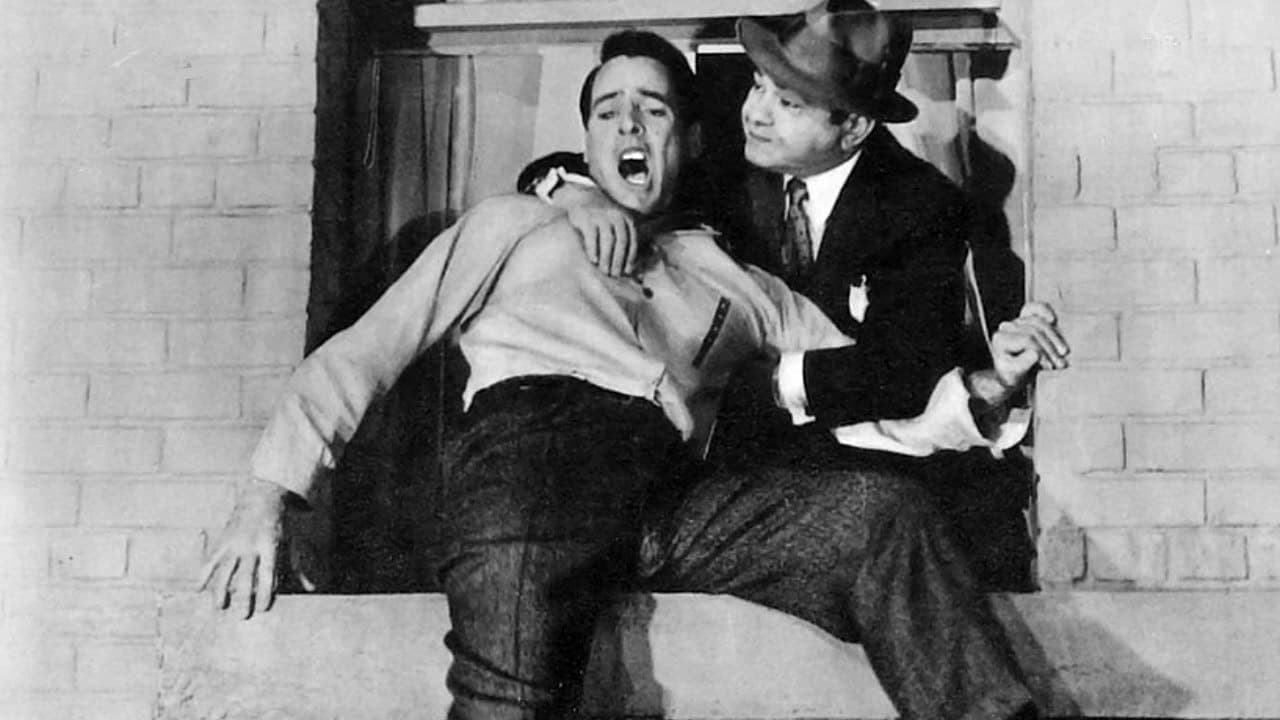
Maxwell Shane's second adaptation of the Woolrich source – the first being his own Fear in the Night (1947) – benefits from an expanded budget, stronger performers, and the accumulated confidence of a director who knows exactly what the material can carry. Kevin McCarthy, whose anxious intensity is an underused resource in mid-decade American cinema, makes Stan Grayson's crisis of epistemology entirely credible: this is a man for whom the distinction between guilt and the suspicion of guilt has collapsed, and McCarthy holds that psychological state without melodrama. Edward G. Robinson's Bressard is the film's structural anchor – a detective operating in a register closer to tired competence than heroic investigation, which is precisely right for a Woolrich adaptation where the institutional machinery of detection is less interesting than the subjective terror it is meant to resolve. Joseph Biroc's cinematography uses the mirrored room of Stan's dream as a recurring visual touchstone, an environment where identity becomes unreadable and surfaces multiply without resolving. Shane handles the hypnosis mechanics with more restraint than the material invites, treating them as plot mechanism rather than sensation. The result is a modestly scaled but genuinely unsettling entry in the late noir cycle, one whose interest in the unreliability of subjective experience locates it squarely within Woolrich's particular territory of waking dread.
– Classic Noir
Joseph Biroc stages the reconstructed murder room with a deliberate disorientation: the mirrors multiply the figures present and dissolve the geometry of the space so that no single exit or entry point is legible. Stan moves through this environment with the careful tentativeness of a man retracing a path he walked in darkness – the body's memory competing with the mind's refusal. Biroc uses the reflections not as expressionist flourish but as a literal problem of identification: in a room where every surface returns an image, the question of who did what and in which direction becomes formally unstable.
The scene is the film's visual thesis made physical. Nightmare is interested in the mirrored room as a space where subjective certainty comes undone – where a man cannot confirm or deny his own actions because the environment itself has been designed to obscure agency. Shane's staging resists the obvious temptation to make the scene lurid; instead it holds on Stan's face in a medium close-up that asks the audience to read a man trying, and failing, to read himself.
Joseph Biroc, a prolific and technically assured cinematographer whose career spanned low-budget noir and major studio productions, brings to Nightmare a visual sensibility calibrated to the film's psychological subject. His primary challenge is the mirrored room of Stan's dream – an environment that demands disorientation without sliding into the kind of baroque expressionism that would signal genre rather than genuine unease. Biroc's solution is to light the room with near-even sources that eliminate reassuring shadow depth, making the reflections as legible as the originals and therefore doubling the instability rather than concealing it. In the film's New Orleans sequences he uses a somewhat warmer, more ambient approach – the city at night rendered as seductive rather than threatening, a visual register that makes Stan's initial complacency credible. As the conspiracy closes in, Biroc tightens his key-to-fill ratios incrementally, so that the film's visual world darkens in precise correspondence to its protagonist's narrowing options. The progression is disciplined rather than demonstrative – the formal intelligence of a craftsman who understands that in a film about the boundaries of consciousness, the camera's claim to objectivity is itself part of the argument.
Criterion's presentation includes the fully restored 112-minute cut with corrected contrast levels, making it the preferred version for serious viewing.
TubiFreeA public-domain transfer is available free of charge, though image quality is inconsistent and the cut may vary – adequate for a first encounter.
TCMSubscriptionTCM broadcasts the film periodically as part of its noir programming; check schedules for upcoming airings with original broadcast framing intact.